Retrievable false crotch for long rappels

Tom Dunlap

Here from the beginning
Administrator
I've read many times about a rappel,

http://en.wikipedia.org/wiki/Rappel

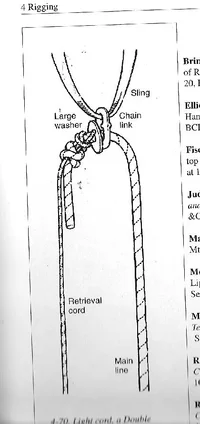
retriever system that rock climbers use. The put a sling onto an anchor and add a rap ring or chain link. The rope is threaded through the ring/link, a heavy washer and then a stopper knot is tied outboard of the washer. A light line is tied to the tail for pulling the rope clear.

If the climbing line is tied with a running bowline around the branch there is way too much friction to pull the rope down.

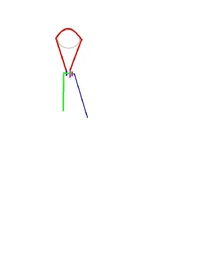
It seems like this system could be adapted to a false crotch. Take a look at my drawing and let me know what you think.

The FC is a ring on ring or biner/screw link setup
Blue on left is the large biner
Purple on right is screw link
Red is the washer/stopper knot
Green is the rope
Blue is the throwline

After the descent, the climber would put a stopper knot or rely on the eye splice to go through the large biner and catch the screwlink.

This would only really be needed on really long cescents where you might have been caught with only a short rope.
 

Attachments

  • 35304-SRTretrievableFC.webp
    35304-SRTretrievableFC.webp
    6.9 KB · Views: 564
I was JUST looking at this system on On Rope this past weekend. At first, I scoffed, citing unknown washer strength as a point of concern. But as I looked at the pic more, I realized that the washer isn't really seeing any significant loads. I decided I'd sure try it if given the chance.

My only point of real concern was if the washer would cut in to the rope.

love
nick

ps- Yes, I really did scoff.
 
Dat's da one!

If rope cutting were a concern a Dremel dressing would radius things nicely. For that matter a bulky knot would work without the washer don't you think?
 
That is exactly what I was thinking. My first thought was to use a link of chain instead of a washer, since the chain link has a more forgiving inner surface.

I guess it'd work with NO washer of any sort. I'd like the washer (actual washer, chainlink, etc) as piece of mind and CF.

I've used chain links for friction saver small rings in the past. They work well.

love
nick
 
Tom

I use the techniques you're talking about. But for rock climbing I purchased some small 25kN screw links - no need for a washer, the hdf just jams. If I think it can pop through, I'd tie another srew link to the end and capture the live rope.

For trees, I just reverse the friction saver, and tie an alpine butterfly. This jams in the small ring. I then clip this with a krab to the live line as back up. Maybe a figure 8 knot would be better.

I normally use this when I want to srt back up my work line after lunch etc, but the ground workers are busy - rather than calling them to untie the end of my line, I can deal with it myself aloft.

Hope this helps! /forum/images/graemlins/wink.gif
 
Alternatively, one could tie off the FC with some slipped knot,
and have the retrieval line pull the release (also). (Note that the RL
is opposed to the loaded rap. line, so when it matters, it should
NOT be possible to make a premature release!)

*knudeNoggin*
 
I know I'm bringing up a thread that's been sitting a while, but I just read it today. I thought of another idea that might be helpful. <u>Please tell me what you think.</u>

Oh, and I'm new here. My name is Shayne and I'm hoping to get in the business. I do already have some rope experience that I've gained through climbing, caving, and my love for the subject matter. I've been reading a while, learning a lot from all of you. I'm quite impressed with this board and with those of you who contribute to it. Thanks for sharing your experiences and knowledge.

For retrieving the rope, I know that Tom Dunlap said that a running bowline would be hard to pull around because of the friction, but here's a variation of that idea (see attachment)-

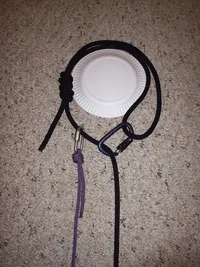
Tie a figure 8 on a bight (or other suitable knot) on the end of your line, leaving a generous loop (the loop should be big enough to keep the knot on the bottom; this will keep if from getting caught on the FC when retrieving). The loop goes over your FC, and is secured back to the standing part with a locking carabiner.

A retrieval line is then attached to the line between the knot and the locking carabiner using a quick link (or second carabiner).

Once you reach the ground, you pull the retrieval line which draws a bight of the rappel line down. Once the retrieval line is half way to the ground, the rappel line will fall (since it is doubled back, close the the FC). Then--assuming the weight and inertia of the falling line hasn't done the job--pull the 8-on-a-bight and locking carabiner around the FC by giving the rappel line a tug.

The only possible drawback I can foresee would occur if the rappel line got tangled in branches AFTER it fell out of the quick link. This is an unlikely scenario, but certainly possible.
 

Attachments

  • 36892-HighRappelRetrieval004.webp
    36892-HighRappelRetrieval004.webp
    613.5 KB · Views: 339
STL, I'm not sure what you're asking.

If you're asking "What is a running bowline?" see the attached picture.

If you're asking how the running bowling is applicable here, the answer is that one could tie a running bowling around the FC, then attached the retrieval line to the loop on the bowline and pull it out of the tree. As Tom Dunlap stated, there may be instances where the weight of the rope and the wrap of the running bowline produce too much friction on the FC to retrieve the set up.

I hope that answers your question.
 
I tie the running bowline half way on the rope and pull on the running end to retrieve it but you don't want any limbs or stubs near it when you pull it free.
It's ok on a spar pole but I use Buckinghams FC where there are limbs.
 
[ QUOTE ]
PS. Yes, the paper plate is my FC. But I wouldn't recommend doing that off the ground.

[/ QUOTE ]

FC?? False crotch?? For climbing, a false crotch is a Friction Saver, Rope Guide, adjustable friction saver, or some variation of these through which a climbing line is threaded. But here, and elsewhere, it seems that you are using FC to refer to a branch that is your tie-in point. That's usually referred to as a natural crotch.

Or am I missing something? /forum/images/graemlins/confused.gif
 
[ QUOTE ]
Or am I missing something? /forum/images/graemlins/confused.gif

[/ QUOTE ]

No, sorry. I'm the confused one. You're right, the plate represents a branch and therefore a natural crotch.

The term is a bit new to me, as are many of the things mentioned in these forums. I'm still coming up to speed.
 
[ QUOTE ]
HAHA, I know what a running bowline is, was just trying to tell you another way but now I c ur point! climb on

[/ QUOTE ]

OK. I read that and thought "I guess he's making fun of me; surely he knows what a running bowline is!?"
 
[ QUOTE ]
I tie the running bowline half way on the rope and pull on the running end to retrieve it but you don't want any limbs or stubs near it when you pull it free.
It's ok on a spar pole but I use Buckinghams FC where there are limbs.

[/ QUOTE ]

Kevin, is this in a situation where the doubled rope reaches the ground? I don't understand what you mean.
 
It would seem that the quick link/pull line would work better/smoother, if it were attached to the bight of the rope or the biner, instead of being attached to the standing part of the rope.

Where the quick link is now attached, the pull line would pull the standing part of the rope through the biner, the quick link/pull line would then fall to the ground, and there would be a chance that the biner/bight of the rope would get tangled in the crotch, or other limbs on the way down.

This is just my observation, and there might be a reason why you have attached the pull line to the standing part of the rope, rather than the bight or the biner. If so, could you please explain.

I've attached your picture where I feel the pull line would be better attached.

Thanks
Mike
 

New threads New posts

Back
Top Bottom