Jehinten
Been here much more than a while
- Location
- Evansville
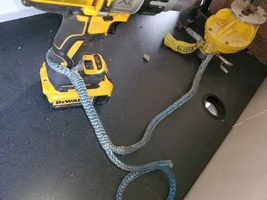
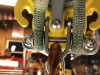
Not sure if anyone else has done this, but I spliced a whoopie onto my rollgliss to prevent accidentally dropping the drill. It works well and adds piece of mind while up in the air. 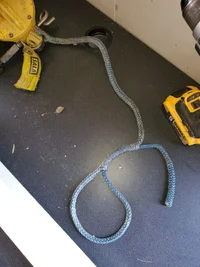
Follow along with the video below to see how to install our site as a web app on your home screen.
Note: This feature may not be available in some browsers.
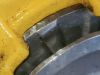
Jehinten, is that a worn spot inside the sheave, on one of the teeth? If so how did it happen or was it already there when you got it?

Maybe. PM me please.Since I have a seldom used Wraptor, I'm never going to get around to messing with my Rollgliss. I think it's the 500, IIRC.
Any interested parties?

 It works fine if you just use it for ascending. And so I was trying to solve this problem: how do I ascend with the device, detach, go about my work, then descend on my climbing system, but then have the drill back at the bottom when I'm ready to go back up?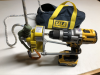
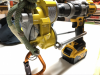
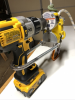
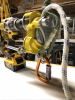

how do I ascend with the device, detach, go about my work, then descend on my climbing system, but then have the drill back at the bottom when I'm ready to go back up?
I tried this one yesterday, but I was fumbling with the safety hitch, rappelling on the uni, and running the drill in reverse. three hands needed. It would help to remove the safety hitch, as long as I have the climbing system attached this might work OK, but would still require both hands.The third is to come down with your weight on your climbing device but running the drill in reverse (unweighted) as you go
Yup, I forgot about your safety hitch on the rollgliss. when I use mine, which is pretty seldom, I winch up and tend my climbing device as I go. This way your primary climbing system is your backup during ascent with no need for the additional hitch.I tried this one yesterday, but I was fumbling with the safety hitch, rappelling on the uni, and running the drill in reverse. three hands needed. It would help to remove the safety hitch, as long as I have the climbing system attached this might work OK, but would still require both hands.
For true one handed rappeling, next time I will just take the chuck off the shaft. The way my twist rod works, it will hold the drill in any orientation as long as it has the battery installed. Take the battery out, and I can work it out (also a feature).
In reality, I wouldn't even need the DDRT system for descent like this, because the R550 braked descent is very good, it's about 3ft/s.
But in order to keep all my gear with me on ascent & descent, I would keep the DDRT attached and rappel with it, the clutched R550 just going along for the ride, acting as backup.
I'm just getting started on a Rollgliss 550 (five fifty) project, Have read this whole thread in an effort to learn everything I might from all of the experience you all have. My thoughts so far -- posted here for your criticisms (and amusement) are:
-- Midline attachable is too important to forsake. I have gently taken off the outer plate on the drive side and will re-install it with thumbscrews with a hole in the turning knurl of each, through the "loop" of which holes will pass a small safety line. The driving sheave freed from a pin or two that pokes into it, it can be slid off the shaft and the rope freed, or the rope wrapped around it (tightly - but it goes) and put into place, and the cover put on. (The hardest part is not dropping the two little stainless bits (look like tiny kidneys) at the two top corners when you take them off and then put them back on.) No more cam cleat, true, but...enh. I'm pretty sure I will not miss it -- poorly positioned for my purposes, anyway.
-- And I realized I can't emotionally deal with the drill. I tried (weakly). But no. So, I am thinking E-bike style. Lithium battery with a battery manager, etc. +/- $55 (battery hookup.com). Brushed 24V 500 Watt motor (some mentalizing about that and other related matters below) (Whee-Bay) $52. PWM direction and speed control board (15 kHz) China, etc. $18. Right, I can't also use this thing to make holes. (I did take completely apart a deWalt drill 3 speed geared, fancy, 24v, etc. recently - before becoming fully stubborn on this subject.)
-- The "logic" such as it is... goes: Wraptor, etc. talk about ascent at 30 to 100 feet per minute. A good speed to go up a tree we'll call 60 feet per minute, or one foot per second. One horsepower (no kilograms or Newtons here) is ascent against earth gravity for 550 lbs one foot, one second. So (just the way I do my taxes) if I weigh 275lbs (no, not really) but I'm wearing a "saddle" etc) I need 1/2 hp. A hp is also +/- 750 watts, 1/2 hp is +/- 375 watts. Or, it is like putting / pulsing about 16 amps into the 24V motor. A little more to accelerate, a little friction loss, energy wasted as heat, but the 7s battery I ran into discharges at something like 20C (and is several amp-hours).
So, we'll see. Like everybody else, most of all I need the time to work on this rather than do real work. But I believe the numbers are there, and I have experience with the technology of batts/managers/motors/controllers to the effect that properly constructed the stuff is pretty reliable....
I'm sure other people here have thoughtful comments to make -- and I would be grateful for them no matter what the basic view expressed or the conclusion reached.
The sole purpose of the drill's clutch (or is it the drill's gearbox?) is that it will hold position. I have tested several drills with my system, an older brushed milwaukee, and 1st/2nd gen FUEL drill/driver, a late gen FUEL drill/driver, a FUEL hole hawg (no clutch.. that one held 0 position!), and older brushless Dewalt and the Dewalt 996. At this point in my testing, only the Dewalt 996 is satisfactory.I would be interested in any view you might have to the effect that either a) a position brake (as opposed to the descent brake that is part of the Rollgliss) is actually helpful in such a device (given that you are going to hang it from a rope grip - and you are not worried about it leaping "upward") or b) that there is a value to a friction coupling greater than current limiting to keep from over-torquing.
. . . I haven't modified any sheaves to use 11mm climbing lines. . .
Rappelling down the R550 is great, that’s also how I come down. The braked descent is cool.I found on my second Rollgliss that the unmodified original sheave works fine on every full size rope I have except some big 12.7mm Vortex Cool. I made both of them mid-line attachable finally biut used them at first right out of the box with the drill. As others have noticed, the main issue is how to get the drill back down to the ground later without the tedious, battery-draining process of running the drill backwards the whole length. I got by this by detaching the drill and rappelling down on the Roillgliss, the same as the way it is used in industry. Kind of fun, actually, but the added wear and tear on the device bugged me. And it is just SO nice having them mid-line attachable so that it is usable on any rope you are on. I have even used mine a few times on my hook line for power traverses. It really is not a bad job to mod it, just some time at the vise with a hacksaw and file or an angle grinder, to remove the metal that forces the rope in place.