Reduction Pruning on Large Trees

I'm no numbers man but 10 percent reduction 80 percent less likely to break I've herd or red somewhere down the line.. species depending I reckon as well
 
@Daniel your video talking about how reducing a limb by 15% can increase its strength by 50% has had me thinking about it for a few weeks now. It makes sense. I learned full-tree reduction in my first couple years in the trade, from an Englishman who was very good at it. So many of these trees in the city are hardier than we give them credit for. These blanket rules that are taught to new tree guys are just way too simplistic. Such is the way that most things are taught I suppose.
If I recall correctly the study that came up with a 10% reduction = 50% stronger was specific to static ice storm loads. The species all seemed to be east coast trees.
Wind is a different animal. And it’s now suggested that total crown reduction can increase mechanical stress on the lower stem of the tree
 
The tree fits the space now but it won’t later. The best time to prune a tree is always 10 years ago. Find a middle ground for amount reduced and make good pruning cuts. If you don’t do it someone else will that probably doesn’t care as much as you do. Be realistic with expectations, the client will now need to manage the tree in a regular cycle. If all goes well it’s a long term client and the tree can “benefit” from it if done right. Crimson maples aren’t exactly the greatest tree, so be mindful of pruning wounds and size of cuts but you can also manage potential failures in a failure prone species.

I’d compromise by size of pruning wound > length removed.
 
Source? That’s an intriguing thought.
Here is a blurb about some of the research. I've come across more but this is just what is at my fingertips.

All of which I have gleaned from thinning on the tips retains the most mass dampening, while reducing loading stress.
@Matt Follett has done some work in this, I attended one of his classes where he spoke of rigging accelerometers to various places on a limb and pruning in different methods.
 
Last edited:
And it’s now suggested that total crown reduction can increase mechanical stress on the lower stem of the tree
Run the logic behind that argument by me please.. cause I sure don't get it... This is one of those scenarios where when my first reaction is "that's rediculous", I have learned to start paying attention because this is outside my box... So please enlighten us... How do you or anyone else explain that?

Oh.. OK. it's about mass dampening..
I have one time (in 40 years) witnessed the oscilation of trees to failure.. It was wild to watch.. Big willows across the street from where we were working. When the rain, wind and thunder started, we ran fro cover under the front porch, these two willows across the street started flopping side to side, with the crown slapping the ground on one side then the other, back and forth three or four times untol the strems gave way and the teres ended up laying on the ground..

Unfortunatelty that theory, as good as it may sound on the compter, does not fit into my real world experiene since 2004... The mass dampening during wind storms has no effect on non wind related snow and ice loads, nor on summer limb drop. And I seen my trees stand through many wind storms that casued failure of many trees in the same neighborhoods.

At 33:20 of the above video you can hear a question from the audience saying that reduction pruning works to prevent storm damage as has been his experience. Mine too, and I've had enough years of my trees surviving many wind storms and the worst ice storm anyone around here can remember in 2014 to KNOW that reduction pruning is very effective at reducing storm damage.

SO what else you got? (and hey, I gave it a chance)
 
Last edited:
Run the logic behind that argument by me please.. cause I sure don't get it... This is one of those scenarios where when my first reaction is "that's rediculous", I have learned to start paying attention because this is outside my box... So please enlighten us... How do you or anyone else explain that?
A brick wall sees more wind stress than a dynamic mass dampening structure. Reduction on a limb reduces the mass dampening, but shortens the lever arm thus makes failure less likely. It does increase wind loads.
Do this throughout the tree (reduction on the entire outer crown) the tree becomes more like a brick wall with less dampening, and loads the root plate and stem more.
 
…….
SO what else you got? (and hey, I gave it a chance)
Not playing this game where you go back and edit your post and include all this crap to make yourself feel smarter.

Cool?
Did you not read where I was speaking to the static loads? A few posts up..
wind by far is the biggest overall factor I deal with. We get some wet snow, occasionally upto 18” +\- and every once in a while Ice storms. Ice storms are more frequent in Portland than the Sound.
How about you show me what you got?
 
Great article

Here is a blurb about some of the research. I've come across more but this is just what is at my fingertips.

All of which I have gleaned from thinning on the tips retains the most mass dampening, while reducing loading stress.
@Matt Follett has done some work in this, I attended one of his classes where he spoke of rigging accelerometers to various places on a limb and pruning in different methods.
Here's some copy and pasting for those that won't go to the link.
However I disagree with the premise of the article which is that somehow a tree being violently shaken side to side as shown in the gilman videos proves that the mass dampening of the unreduced canopy is somehow better for the tree... These guys are living in their ivory towers.. they should have taken a ride with me after that ice storm in 2014.... Whole neigborhoods looking like bombs ent off, the trees were all over the ground, then when I got to my clients houses were there would be one little pile of sticks at the base of the tree, small enough that one man could drag to the chipper... over and over and over again. Neighborhood after neighborhood, tree after tree... Some of these Norway maples ( a species extremely prone to storm damage) had such terrible branching structure with all kinds of defects in their many over-extended limbs before pruning, but didn't lose a single branch in that ice storm after tip reduction. I just re-pruned this tree last week after not touching it for probably 5 years. This is a great example:


then afer pruning it last week it looks like this:


F. Rinn: "The real wind load that is coming down to the stem base of the tree is approximately 1/10th of that which is usually assumed, because of the damping and the dynamic movement of the crown […] We pruned trees by about 10% and the wind load was increased by 10%. […] When you take away the small flexible parts of the branches, only the stiff (one is there) [parts remains]. The stiff branches have a higher wind load because they cannot move in a dynamic way. So a light reduction of the crown will very likely increase the wind load of the tree."

F. Rinn: "We measured the same trees with and without dynamic crown cabling and with the crown cabling the wind load was always bigger than without, because it stiffens the crown. So the maximum wind-load at right at the base was always higher with this things in the tree."
It's important to leave dynamic cables loose. They're there to hold the load in case of failure but, they stiffen the crown and increase wind load.

To go further into the question of crown reduction... arborist often face the dilemma of weight reduction.

G. Moore: "Weight reduction aims to reduce excessive weight or load at the end of a long branch. It comes from the application of the simple lever model [...] The lever model is very powerful and very persuasive. Every single one of you in this room remembers the lever model from junior science, it's familiar to you."
G. Moore: "Every engineer loves the idea of something as simple as the lever model: That's a big tree! That's got a big branch! There's a weight on the end! That CAN'T be good! You better do something about it... What will you do? - We'll reduce the weight!"
G. Moore: "So there's an appeal to that, but lets have a look at it: Is it consistent with the basic principles of modern arboriculture? - No, it's not!... Does it stress mature trees? - Yes it does. Is there any proof that it actually achieves it's objectives?... Now, what's its objective? - To stop the branch falling off."
G. Moore: "[…] There's no evidence what so ever! [...] Weight reduction should only be practiced when you don't have any other option and in some instances […] you probably don't have any other option, because your insurers and your managers want some demonstration that you have done "something", "anything". So that if something goes wrong they can then go back and say: - Ha! But, look what we did! and you don't want (someone like) me come along and say: Yes, you did do that but, by doing that you took away a whole lot of the mass that was damping and that other branch fell and that's the one that demolished the house or killed someone. So you've got to think this through... I know that weight reduction is going to be done. I know it's going to be done when there are big branches over foot paths. I've done it my self... or over houses. But I'm not at all convinced that it's actually efficacious, in other words that it achieves the outcome. Something for you to think about it."


"DISADVANTAGES OF WEIGHT REDUCTION by Greg Moore, 2014:

• Creates significant wounds

• Interferes with carbon cycle

• Interferes with water cycle

• Effects capacity for mass damping

• Alters loads and affects physical stress optimization within canopies"

G. Moore: "What all this tells you is, pruning as professionals it's not just about having a chainsaw and chopping a bit here and there… Is it? It's much more than that and in some instances some of you are going to need to call on to other experts, people who actually do have an understanding of some of this physics and some of this biochemistry and chemistry to give you some good advice and once you've got that advice you can then carry on your particular tasks."
"WEIGHT REDUCTION by Greg Moore, 2014

• Weight reduction aims to reduce excessive weight or load at the end of a long branch

• It is a simple lever model

• There may be a lack of branch taper and a low foliage to branch ratio

• Does not appear consistent with the basic principles of modern pruning practices

• Stresses mature trees

• No proof that it achieves its objectives

• Is an intrusive practice that should be discourages under most circumstances

• Should only be considered when there has been significant interference with a mature specimen"

Some of you may off course believe that the lack of research that Moore talks about is fake news and you may point out to Gilman's research, where his research exposed trees to four twin turbocharged diesel engines:

(From Ed. Gilman's Youtube channel)

Tree not pruned blowing in the wind:

Gilman concludes in his video :

E. Gilman: "Notice how much less the main trunk is moving left to right in 75 to 90 mph wind compared to the tree that was not pruned shown in the accompanying video."
That increased sway and flexibility on the non pruned tree is exactly what the tree is supposed to do in order to dampen oscillations and dissipate wind energy in an optimal way.

Does this kind of research suffice the professional community to conclude that arborists can do better than nature's design by cutting back branches and reiterates?

While you think about it, consider the fact that even though the non pruned tree swayed more, it did not fail during the test.

Persuaded to reduce wind load, arborists must understand and recognize tree response before pruning. Trees do not form reaction wood unless they are mechanically stimulated. Reaction wood growth is indeed induced by mechanical stimuli. Mechanical triggers stimulate cambial activity modifying wood quality. (Fournier et al., 2015)

There are many factors that act as mechanical stimuli to tree response but, wind-induced thigmomorphogenesis certainly plays a major roll. A phenomenon easily appreciated in flagged trees whose shapes are molded by intense dominant winds.

"Thigmomorphogenesis tends to reduce the strain and stress the stem experiences, making it less likely to fail under mechanical loading." (Badel et al., 2015)

Plant response to mechanically induced flexing, whether by wind, ice, snow or animals was defined as thigmomorphogenesis by Jaffe in 1973. (Badel et al., 2015)

continued below

 
Arborists may get intimidated and impressed by sophisticated mathematical equations derived from archaic theories of optimal design and constant safety, originated by Metzger in the XIX century and resurrected by Mattheck in the early 90s but, these mathematical equations rarely consider tree response. Recent research in biomechanics demonstrate that trees do not form reaction wood unless they are mechanically stimulated. (Fournier et al., 2015)

The influence of dominant and regular winds on tree response must be considered. As the flexible dynamic parts of the tree dampen oscillations and dissipate wind energy to a much larger scale than the stiff parts, they trigger the tree to respond to the stimuli by growing reaction wood tissue in order to consolidate its structure. So, even though wind events of exceptional magnitude may still uproot trees, dominant and regular winds reinforce their structure making them more solid and stable in order to withstand stronger winds. (Drénou, 2009, Fournier et al., 2015)

In no way does this mean that trees may not fail. Periodical aerial inspections must be performed but, reaction wood as a response to wind-induced thigmomorphogenesis has to be considered before making major decisions. Also theories that lack research concerning tree development must be put aside. Like the omnipresent Harris-Gilman school that insists on giving apical dominance to all trees, not having a clue about the different types of fork. Main forks are mechanically solid and stable and each fork element explores its own space, on its side, without competing with each other.

For further reading on tree development related to pruning you may consult "Tree Architecture vs Tree Structure, a Practical Approach Related to Pruning by David S. Restrepo" and "Main fork vs accidental fork explained (Drénou) and the so called “structural pruning” and all forks regarded as defects (Harris) by Restrepo".

Despite the fact that we have made giant steps over the last 40 years in tree pruning, starting with the publication of the CODIT by Shigo and Marxx in 1977, it's imperative for us as arborist to establish the foundation of a sustainable future. Where systematic pruning will henceforth become an archaic practice.

There are many other things that we can do for trees as arborists but, we have to come to envision an avant-guard sustainable tree heritage management, where:

"We have do the MAXIMUM to do NOTHING, nothing that will interfere, alter or modify the tree and its environment"
- Gerard Passola (on the management of remarkable trees)
It may sound simple but, it's something extremely complex to achieve on urban trees. This is an arboricultural principle that may be applied in the management of remarkable trees but, we can nonetheless contemplate applying it to urban trees in a no so distant future. Keeping in mind that in arboriculture:

"It's often wiser to do nothing than to intervine. The disparity between actions to avoid, or even to proscribe, and those to recommend is immense."
- Christophe Drénou (Beyond Tree Myths, 2016 - L'arbre. Au delà des idées reçus)
Instead of pruning trees systematically, we can move on to periodical aerial inspections and intervene if there are legitimate structural defects that may compromise the tree's longevity, people's safety or the integrity of urban infrastructure. But Sooner or later we have to come to realize that systematic tree pruning is nothing but the result of our excessive anthropomorphism. Our hair grows and we cut it. In a similar way, tree branches grow and we cut them. Except that there is a colossal difference. While our hair grows at its base, trees grow in their extremities and that... TOTALLY changes all the rules!

References:


Title updated on 2022.07.08 "Tree Crown Reduction Decreases Mass Damping of Wind-Induced Oscillations and Wind Energy Dissipation". Original title: Tree Crown Reduction = Wind Load Increase.
 
@Daniel Glad you found it of substance once you dug deeper into it.

Someone just has to click the link to find all those quotes. I don't think a copy paste is needed taking up all the space on this thread.

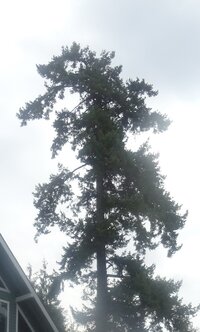
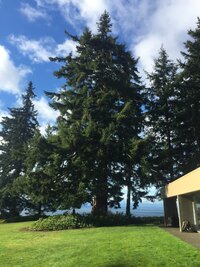
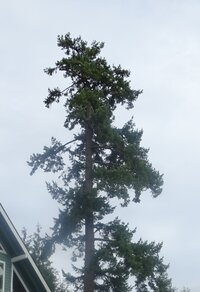
There is always a time and place for everything. Here is a previously topped (or actually we think it blew out) doug some of the limbs are pushing over 30' and 6" in diameter. Tree is in a critcal area, with a 30' near vertical drop to the beach on one side. Kinda short at 120' and about 30" diameter.IMG_1686.jpegIMG_1685.jpeg

different property, also a shorty but even stockier. Within 50 from a 150' vertical bluff looking due east straight to the Juan De Fuca straight. Which is a WIND TUNNEL with the olympics on one side and Vancouver Island on the other right into the pacific. But it's also apart that gets blasted with a 50+ mile long sea to the south between the Olympic's and the Cascades.IMG_7023.jpeg

Do you think that I don't put effort into understanding the available research into the pro's and con's of thinning, crown reduction and mass dampening as well as the related forces on the stems?
 
Last edited:
Here'd the deal. It's so hard to set up a proper experiment when it comes to trees. Best methof I can think of is prune like x vs prune like y, and wait a huindred or two years and see what happens. Because of the limitations of science, we are forced to make assumptions extrapolations which are often mistaken and result in a system where bad practices are considered unquestionale.

SHigo based his recommendations for target pruning on the discoloration in wood. He never actually figured out that there are some types of discoloration that result in failure and some types that don't. But I did..

ps.. nice pics and agreed that practices may vary depeending on climate consitions.
 
Recent research in biomechanics demonstrate that trees do not form reaction wood unless they are mechanically stimulated. (Fournier et al., 2015)
One story that Dr S shared with us in the class in the '80s was a desktop experiment he ran.

He bought a couple of potted flowering plants. Each had a ring of wire connected to a chopstick to support the plant. He set them in a good spot in his office. Each got turned every day. But...one was given a little shake every day. At some time he took out the support wire of both plants. The one that just got turned...for sun..kinda fell apart. The one that got jiggle every day...stood up straight.

He had stimulated reaction wood to form by the daily jiggle.
 
He never actually figured out that there are some types of discoloration that result in failure and some types that don't. But I did..


@Daniel

Do tell. Please share what you figured out. What type of discoloration should we be looking for? If this is true then all arborists should know so we can look out for it.

How did you find this discoloration?

Has this been peer reviewed?

This is kind of Holy Grail type knowledge...it its true.
 
Tom,
I took a course called the philosophy of science in college. That was probaly the most important course I ever took because it offered my a perspective on the limitations and inhernet problems with science. SO while science is a decent method of ascertaining knowledge, there are others that are just as valid.

Common sense is often lacking in the ivory tower types.. Like the guy who is trying to say that reducing a crown puts more strain on the main stem. It's complete nonsense that shows how little practical experience he has. Yet, he has the degree and the science to back up that complete garbage teaching.

Shigo was a forrester and his main job originally was doing science that would preserve log value. While all discoloration damages log value, not all discoloration causes tree failure... Trees shed limbs in the woods for centuries without failure. The sugar stick theory fails to account for this. And no science ever follows the experiment long enough to us e failure from storm damage as an outcome. Expreapolating from discoloration to the type of structural damage that causes tree failure was a mistake. I believe I AM the first person to ever make that argument.

And at it's best, science is very messy with people of different theories duking it out. Good science means that statuus quo is getting challenged and must have the wherewithal to stand up to scrutiny. Science doesn't mind being questioned.. cults do.

I've written an article on the topic, which I may revisit...

More later
 
Good thread! I think another point that I didn't see brought up is - client expectations after pruning. Are they looking for a nice hedged globe tree or will they be happy with the inevitably scraggly loose tips that will occur if someone is making proper reduction cuts? I bet it's the former. I could see, if one didn't manage client expectations, a person doing a great reduction job (hopefully with a bucket or lift) and then the client reacting like - "can you make it more round/even/globular?" or something like that. When reducing a mature tree like this, one is rarely provided with all of the appropriately placed lateral branches to reduce to in all of the right places, which leads to a somewhat irregular looking silhouette. If it were me, I'm on the side of talking them out of it, based on increased maintenance in the future and a likely difficult-to-satisfy client expectation. I'd push for crown raising and roof clearance. At least start with that and see how they like it.
 
Personally, I wouldn't think of him as a forester.
Just look at the list of his published paper in chronological order.... Nearly all his early work was on discoloration
So...what are you claiming? What did you say first?

Please expand on your discoloration observations.

What I AM claiming is that target pruning (and the many failed attempts at it) do far more damage to the tree than reduction cuts.

IN any live limb over 4" diameter we should do our best to not make a target cut, even if that means leaving a short stub which can be pruned back some years later after the tree has formed an obvious collar of callous growth around the obvious dead stub. Reducing live limbs to shoots as small as 5-10% of the parent stem's diamter is acceptable in two stage pruning, as is cutting back to nodes, per Guy Meilleur's recommendation for pruning storm damaged limbs. etc...

There's a natural evolution of understanding going on. Shigo took us from the flush cut to the target cut. The next step is from the target cut tot he stub cut or reduction cut. The industry is slow to change but as Sam Cook said... "change gonna come"
 

New threads New posts

Kask Stihl NORTHEASTERN Arborists Wesspur TreeStuff.com Teufelberger Westminster X-Rigging Teufelberger
Back
Top Bottom