
Navigation
Install the app
How to install the app on iOS
Follow along with the video below to see how to install our site as a web app on your home screen.
Note: This feature may not be available in some browsers.
More options
You are using an out of date browser. It may not display this or other websites correctly.
You should upgrade or use an alternative browser.
You should upgrade or use an alternative browser.
Redirects
- Thread starter tod_k
- Start date


- Location
- turnersville nj
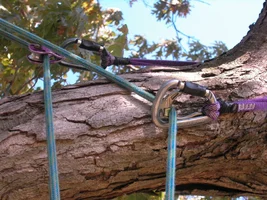
I use one very similar but Like the way you used that third biner .
- Location
- Halifax, Nova Scotia
I like that. That's what we're looking for, innovative and practical use of the tools to make climbing more efficient.
I hadn't seen that revolver before. Nice.
BAB
I hadn't seen that revolver before. Nice.
BAB

- Location
- georgetown ontario canada
I used to have some trouble while moving around under the redirect (I just used another friction saver) because the more the rope moved the more it tried to pull one end of the friction saver through the crotch. I fixed this problem by using long friction savers as redirects so I could do a double wrap. This kept them fixed and it was only a little harder to get them out.
Has anyone else had redirects try to pull themselves around a branch? I wonder if the use of pulleys helps to correct the problem.
Dave
Has anyone else had redirects try to pull themselves around a branch? I wonder if the use of pulleys helps to correct the problem.
Dave
I know what you mean Dave. That technique seems to work well if you tie in point has very little friction. If you are using a ring to ring friction saver you have unequal tension on either side of your rope. If you climb off something with less friction every thing will be smooth.
- Location
- turnersville nj
I have a prussic Knot with a ring on a Petzel Jane with a pully in the eye the knot seems to help keep it in place .I have had that problem befor and agree with Todd,more friction more drag.I use this system with the ropeguide and it has made a big difference and the whole system is retreivable from the ground.
- Location
- Costa Rica
Guys,
I like your innovation. I still prefer a marine style snap shackle, using a throwline to release it and running through a double pulley with the becket removed for less friction. I use to have a picture of this on my site, It will be back online soon. I never have had any failure with the snap shackle, and it is slick! I have alot of great pictures to share from this incredible garden of eden that I am living in. Costa Rica has trees I have never seen in the states or europe and canopy tours that are as illegal as they come. I will be posting some pics soon.Nice to be back on the webboards and in touch with my peps!
Pura Vida to you all from close to the equator,
Xman
I like your innovation. I still prefer a marine style snap shackle, using a throwline to release it and running through a double pulley with the becket removed for less friction. I use to have a picture of this on my site, It will be back online soon. I never have had any failure with the snap shackle, and it is slick! I have alot of great pictures to share from this incredible garden of eden that I am living in. Costa Rica has trees I have never seen in the states or europe and canopy tours that are as illegal as they come. I will be posting some pics soon.Nice to be back on the webboards and in touch with my peps!
Pura Vida to you all from close to the equator,
Xman
too bad the revolver doesn't double auto lock, then you could do away with the balllock. That is sweet though.
I use the same type of redirect, just with a biner on each end.
Dont you love when the homeowner is watching, then just after you touch down, they ask you "how in the world are you going to get all your gear down from there?" "climb back up?" /forum/images/graemlins/grin.gif
I use the same type of redirect, just with a biner on each end.
Dont you love when the homeowner is watching, then just after you touch down, they ask you "how in the world are you going to get all your gear down from there?" "climb back up?" /forum/images/graemlins/grin.gif

- Location
- Retired in Minneapolis
Xman!
What a treat to have you back. I've thought of you often.
How about giving us a trip report in the Tree Free Zone?
don't be gone so long buddy!
What a treat to have you back. I've thought of you often.
How about giving us a trip report in the Tree Free Zone?
don't be gone so long buddy!

- Location
- Norfolk
Is that redirect that you are using retrieved with a simple overhand knot like with the friction saver false crotch. And if so does that revolver have sufficient space for overhand knot to pass through it. I have seen these types of redirects before at TCC's but have not made one up yet. I think that I will soon.
Steve
Steve

- Location
- Ontario, Canada
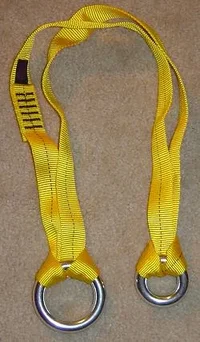
The ring to ring works well, I just prefer the least amount of friction as possiable. To retrieve it I have a little bit of whipping just belowe my splice. I use it to retrieve the redirect as well as the RG. Scott Profit showed my a great little trick to retrieve it while in the tree. I will post a pic later.

- Location
- Home of the New Jersey Devils
Do so Todd!

- Location
- Bloomington, Indiana
[ QUOTE ]
With the new aluminum rings available from Sherrill, this works and is less expensive ...
[/ QUOTE ]
Kevin;
Do you mean that you use this as a FS or as a re-d? If you use it as a re-d how do you get the standing part of the rope through the ring?
Hey Todd;
Any chance you could re-size that photo? My tired old computer can't process all of that information.
Thanks!
Mahk
With the new aluminum rings available from Sherrill, this works and is less expensive ...
[/ QUOTE ]
Kevin;
Do you mean that you use this as a FS or as a re-d? If you use it as a re-d how do you get the standing part of the rope through the ring?
Hey Todd;
Any chance you could re-size that photo? My tired old computer can't process all of that information.
Thanks!
Mahk
- Location
- Ontario, Canada
You have to feed the end of the rope through it and rehitch, I just posted it as an option.

NickfromWI
Participating member
- Location
- Los Angeles, CA
I heard there was a talk at TCI about redirects. What did I miss?
love
nick
love
nick
- Location
- Home of the New Jersey Devils
You missed a very good presentation. I'll give Mark B some time to reply for himself.

- Location
- Basel, Switzerland
... Cheers, Mark. Always the gentleman!
Hi Nick,
sorry I didn't reply to your question on the TCI thread, I'm suffering from the post-trade show low. Gets me every time, same as after TCC's. Just really hard to get back to the daily grind.
The presentation at TCI that I did with Chris Cowell was part of an on-going series of workshops about hands-on work safety and good working standards. We did the redirect workshop in Augsburg during the Augsburger Baumpflegetage at the Climbers' Forum in March the first time. It's essentially looking at how forces change and in-/decrease when working with redirects.
The format we've chosen uses a combination of power-point and a climber in the tree running parallel, i.e. as things are coming up on the screen, they're also being demoed in the tree. We felt this contibuted to linking theory to everyday work situations.
We've reworked the presentation with Andi Detter, who is one of the guys responsible responsible for the physics behind Freeworker/Sherrill's rigging software. I reckon he's one of the most knowledgeable people in this area I've talked to so far. The forces we're discussing here are of a very complex, compound nature. Add to that the chaotic element that trees are and you end up with something that is very hard to quantify. Essentially we were intersted in trying to give people some hands-on rules of thumb, pointers to back up gut-feelings.
As there are so many variables and unknowns, it turned out this isn't so easy. Obviously, one key issue we have to consider is bending moment imposed upon the anchor points, we also have to look at the type of redirect used and the direction of force vectors.
Further we have to deceide whether we're looking at the whole tree or just individual parts, i.e. limbs. In order not to completely overload people we choose the latter. In this case what is central is the angle, that the line takes between the main anchor and the redirect. 90° will induce max. bending moment, as that angle in- or decreases the load will lessen. The force vectors and their resultants are also key-players. Is the redirect limb being compressed or cross-loaded? Ideally you're trying to place the anchors in such a way as to compress the limb. The resultant of the two vectors (your line either side of the redirect) will, in this case, bisect the angle between them. If that coincides with the limb, bingo, you're in compression mode.
Crumbs... I think if I hadn't just written that, I'd be very confused. /forum/images/graemlins/icon310.gif Doing these workshops makes me realise every time how complex these issues are. They're hard to explain, hard to set up and hard to understand. Every time I've understood something new, new questions crop up. But that's OK - we're not physicists, we're arborists, but we should work with people who can further our understanding of the issues. We should also be careful how we portray them. A "it's really easy, just stick up a sling and a carabiner, hey presto.... easy as eating cake"-mentality is, taking all of the above into acount, a gross oversimplification.
I think it's an on-going discussion, the more imput into the matter the better. Some answers we'll never have, or be able to quantify precisely, but we should be able to understand the underlying principles well enough to be able to work with them safely.
Hi Nick,
sorry I didn't reply to your question on the TCI thread, I'm suffering from the post-trade show low. Gets me every time, same as after TCC's. Just really hard to get back to the daily grind.
The presentation at TCI that I did with Chris Cowell was part of an on-going series of workshops about hands-on work safety and good working standards. We did the redirect workshop in Augsburg during the Augsburger Baumpflegetage at the Climbers' Forum in March the first time. It's essentially looking at how forces change and in-/decrease when working with redirects.
The format we've chosen uses a combination of power-point and a climber in the tree running parallel, i.e. as things are coming up on the screen, they're also being demoed in the tree. We felt this contibuted to linking theory to everyday work situations.
We've reworked the presentation with Andi Detter, who is one of the guys responsible responsible for the physics behind Freeworker/Sherrill's rigging software. I reckon he's one of the most knowledgeable people in this area I've talked to so far. The forces we're discussing here are of a very complex, compound nature. Add to that the chaotic element that trees are and you end up with something that is very hard to quantify. Essentially we were intersted in trying to give people some hands-on rules of thumb, pointers to back up gut-feelings.
As there are so many variables and unknowns, it turned out this isn't so easy. Obviously, one key issue we have to consider is bending moment imposed upon the anchor points, we also have to look at the type of redirect used and the direction of force vectors.
Further we have to deceide whether we're looking at the whole tree or just individual parts, i.e. limbs. In order not to completely overload people we choose the latter. In this case what is central is the angle, that the line takes between the main anchor and the redirect. 90° will induce max. bending moment, as that angle in- or decreases the load will lessen. The force vectors and their resultants are also key-players. Is the redirect limb being compressed or cross-loaded? Ideally you're trying to place the anchors in such a way as to compress the limb. The resultant of the two vectors (your line either side of the redirect) will, in this case, bisect the angle between them. If that coincides with the limb, bingo, you're in compression mode.
Crumbs... I think if I hadn't just written that, I'd be very confused. /forum/images/graemlins/icon310.gif Doing these workshops makes me realise every time how complex these issues are. They're hard to explain, hard to set up and hard to understand. Every time I've understood something new, new questions crop up. But that's OK - we're not physicists, we're arborists, but we should work with people who can further our understanding of the issues. We should also be careful how we portray them. A "it's really easy, just stick up a sling and a carabiner, hey presto.... easy as eating cake"-mentality is, taking all of the above into acount, a gross oversimplification.
I think it's an on-going discussion, the more imput into the matter the better. Some answers we'll never have, or be able to quantify precisely, but we should be able to understand the underlying principles well enough to be able to work with them safely.
- Location
- Basel, Switzerland
oh, by the way I forgot to mention before: The Augsburger Baumpflegetage with a two day climbers' forum will be taking place from the 19th to 21st of April. These issues are one of the topics we'll be discussing further. We've got at lest one afternoon pencilled in with Knut Foppe, Ronny Epple, Chris Cowell, Beddes and myself - amongst others. I realise it's a long haul, but it should all be very interesting. It's always a great event to hang-out and meet, I can thoroughly recommend it.
Also, there's the german TCC two weeks later and various other euro comps to boot as a further incentive!
Just a thought...!
Also, there's the german TCC two weeks later and various other euro comps to boot as a further incentive!
Just a thought...!
New threads New posts
-
test
-
-

-
-
 Fruit tree holding on by a thread, client wants to get another year out of it. Thoughts?
- Started by climbingmonkey24
- Replies: 55
-
-


