Questions about DIY backyard zip line?

Location
Howell
Hi, I don;t know if this is the right forum for this topic, but I am looking for advice on building a backyard zip line as follows"

-106' between two trees (pitch pine) over flat ground. So I would install starting point of line higher up on one tree than end point of opposing tree.
-I plan on tying around the trees on both ends as opposed to a bolt through.
-I would like both children and adults to be able to use, so need something rated for 250+pounds.
-Looking at some of the kits for sale at various websites.

So here is my wish list:
I would like a kit that has everything, but the cable lengths offered are 75', 100', 150'. Distance between tress is 106'. By everything I mean, extras like harness, seat, brake block, etc.

I would like to use a gravity stop type braking with a stop block for safety. Although one kit (Alien Flier I believe) offers a trolley with a trigger style brake built in, which is appealing.

I would like a detachable trolley with closed top, so if someone happens to grab the top of the trolley while in motion they won't injure their hands.

So I'm not sure if I should piece a kit together separately, or buy a kit and cable separate, or if their is a complete kit that has everything I need. Budget is max $400, ideally.

Also, are the trees I want to use ok for this? Pitch Pines tend to sway a lot in the wind, so not sure if they are even the proper tree to begin with...

Thanks for any suggestions, and if there is a better forum out there for this please let me know!
 
Before you buy gear you need to have an understanding of the amplified loads on the ends of a zip line. In some setups the static load can be multiplied by factors of ten twenty thirty! The gear might not break but what about the anchor points

Do a search here for zip line or speedline loads. You'll regret not doing your engineering if the trees break
 
All of these backyard kits are meant to be installed between trees (or poles, other stationary structures). They state to pick a healthy tree at least 12" in diameter where the cable will attach. Are you saying I should figure out these zip line loads because of the specific trees I have?

I'm already looking at two slightly larger diameter trees with a 75' run as opposed to my original scenario anyway, because one of my first choice trees does not seem hardy enough. Although I have to say, I've never seen one of these pitch pines fall over in any type of high wind weather.
 
Ziplines properly installed will often only have 5-6 percent drop for the entire span. They use the curve of the line for the acceleration and braking.

My suggestion?
Don't limit yourself with a budget. Build it right or don't build it at all. One person's health insurance deductible is at least 10 times your budget to build your zipline.
 
There are actually cheaper budget kits out there. $350-$400 range seems to be for decent quality. The cable length is what increases the cost of the kit, so from what I can tell a 75'-100' kit with quality components and a weight limit of 250-325 pounds is right in my budget range.
 
Put up some pictures of your trees?

Why do you want to choke and kill your anchor trees, rather than through-bolt?
"-I plan on tying around the trees on both ends as opposed to a bolt through."
 
Why do you want to choke and kill your anchor trees, rather than through-bolt?

Well, in researching all of this I read that a bolt through is more damaging to the tree than wrapping the cable. One is permanent the other is not. One way allows for adjustment to how high the start or end point is, the other does not. I would use block spacers between the cable and tree if that makes a difference. Obviously I would not want to kill the tree. You can also adjust the tension of the cable around the tree as the tree grows. I'll try to get some pics up, thanks for the reply!
 
Having been an arborist for years and also having experience installing ziplines, I would recommend through bolting. Far less damaging to the tree long term. I would really say it depends on the longevity of the line though.
 
Having been an arborist for years and also having experience installing ziplines, I would recommend through bolting. Far less damaging to the tree long term. I would really say it depends on the longevity of the line though.

Huh. I wonder why there is such conflicting info out there. I may start out with a cable wrap then, and after adjustments do the bolt through. Forgot to mention another pro of wrapping is safety check - you can visibly inspect all components, as opposed to not being able to see if the bolt may have broken/sheared inside the tree...
 
mcgeggy, the conflict is between people who just want to sell you some gear over the internet, and trained and experienced professionals who use ziplines to move significant mass over high value targets. The marketers of the kits figure you probably don't have (or want to purchase or rent) a drill sufficient for through-bolting applications, so they hawk equipment that can be installed without it and try to imply an advantage. Starting off with a cable wrap is like saying "I'm going to put a torniquet on your right arm for an hour, but it's ok because afterwards I'll take it off."
 
mcgeggy, the conflict is between people who just want to sell you some gear over the internet, and trained and experienced professionals who use ziplines to move significant mass over high value targets. The marketers of the kits figure you probably don't have (or want to purchase or rent) a drill sufficient for through-bolting applications, so they hawk equipment that can be installed without it and try to imply an advantage. Starting off with a cable wrap is like saying "I'm going to put a torniquet on your right arm for an hour, but it's ok because afterwards I'll take it off."

Really? Your comparing a human arm to a tree trunk? Trees are that fragile then? As far as "people just selling gear over the internet", it's not like you can find these kits at local brick and mortar stores. Just because products and/or info comes from the Internet doesn't mean it's all crap. All the info here is on the Internet too...

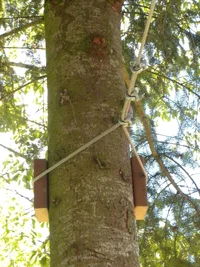
I don't think you've even looked at these sites selling these kits before criticizing. I really don't understand the logic of drilling a hole through a tree to attach cable, and then after some use if an adjustment is deemed necessary, drill another hole. As opposed to temporarily wrapping until your certain the attachment points are ideal, and then drilling the hole for permanent install. The pic below really doesn't look like it's going to injure a tree if left for a few weeks.image.webp
 
Huh. I wonder why there is such conflicting info out there. I may start out with a cable wrap then, and after adjustments do the bolt through. Forgot to mention another pro of wrapping is safety check - you can visibly inspect all components, as opposed to not being able to see if the bolt may have broken/sheared inside the tree...

If you use adequate hardware broken bolts should never be an issue. Especially with how they are being loaded. What we did when we were building the course was to do slings around the trees to run the lines and get a feel for them. Then when we were satisfied with how they were running and the elevation of the lines, we would put in the brackets for the ziplines. If you are on Instagram look up my account (@alifewithtrees). On there you will find some pictures of the course and the hardware that we were using. Super tree friendly and adjustable for tree growth and cable height and tension.
 

New threads New posts

Back
Top Bottom