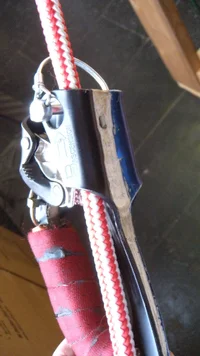
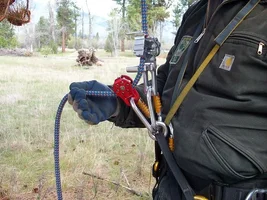
Question About Ascender Set Up For SRT???

I am currently using Kong double handle ascenders backed up by a Kroll ascender beneath it. I have a pulley that is attached to the Kroll. I install the whole works on a single climbing line. From there I run my climbing line through the pulley. I do this for a meqns of quick bail out also if I need to do a little work on the way up I can. I tie an overhand knot beneath the Kroll and install a 'biner in it. I just do a little work from this set up.

Does this sound OK???
 
I use a similar setup, only my pulley is attached to my Petzl Ascentree with my doubled line running through it and attached to my floating ring on my saddle with the Hitchclimber pulley. Because I have a TreeFlex saddle, I have a dedicated seperate point of attachment for the Croll to attach to which works great.

When I want to do work on the way up, I just stand up a little bit on my Pantin and disconnect the Croll from my SRT line. Make sure your friction hitch is set snug before sitting back down and disconnecting from the Pantin.

My Petzl Ascentree is backed up with a biner clipped though both holes and the line and snugged up with a blakes hitch tied above it.

Works great.
 
[ QUOTE ]
I use a similar setup, only my pulley is attached to my Petzl Ascentree with my doubled line running through it and attached to my floating ring on my saddle with the Hitchclimber pulley. Because I have a TreeFlex saddle, I have a dedicated seperate point of attachment for the Croll to attach to which works great.

When I want to do work on the way up, I just stand up a little bit on my Pantin and disconnect the Croll from my SRT line. Make sure your friction hitch is set snug before sitting back down and disconnecting from the Pantin.

My Petzl Ascentree is backed up with a biner clipped though both holes and the line and snugged up with a blakes hitch tied above it.

Works great.

[/ QUOTE ]


Can you put a pic up of your set up???
 
I use a petzl I'd. The thing is great. base of my rig is a navaho variobelt or sequoia. Am'd biner to the I'd. Im right handed so i'm using the blue handled acender w/ foot loop. On the top hole of the acender I have a Petzl fixe pulley (connected w/ biner) that lets me pull the climbing line down instead of up. I can ascend, lock-off, and descend w/ the same set-up. slick and efficent.
 
I don't really like working off the ascenders. I use a cocoon pulley above my kong dualcenders to work off of. It works great. Just tie a klemheist and run your system to that and have that hooked to your harness as a back up and hook into your ascenders as well and put on the pantin and just up you go.
 
SRT

I am currently doing SRT on these experimental ascenders.
They are downwardly adjustable. Really sweet. Really secure and responsive.


202263-srt.JPG
 

Attachments

  • 202263-srt.webp
    202263-srt.webp
    215.4 KB · Views: 101
Re: SRT

Thanks! So much good about these that it couldn't be kept secret from my arbo bro's.

We have Treebuzz's Mark Adams to thank for this. He is the first known (by me) to have described the earliest version of this particular setup in the August 2007 ISA Arborist News, third page.

He described it's use in doubled static ascent, but it does doubled dynamic as well as SRT. That makes this piece of kit rather unique.
 
Re: SRT

I've been using this for RADS:
4092742132_7c659c41a1.jpg


It has several advantages:
1- no 'shark teeth' to pick the rope.
2- the ascender and pulley can easily be removed from the rope by just removing the cam from the PMI Grip.
3- it has unexcelled up and down motion. In fact, you can tether it with a light cord and actually pull it down if it's out of reach.
4- it is very compact.
5- emergency escape is simple and fast since the whole thing can be uninstalled by just removing the cam.

And here's a short video of it in action - I had just replaced my rope bridge on my Cougar saddle and it was a bit too long so it shortened the stroke range. I shortened the bridge to what it should be and that made a big difference.

http://www.youtube.com/watch?v=84wcGIYgKxw
 
[ QUOTE ]
I am currently using Kong double handle ascenders backed up by a Kroll ascender beneath it.

[/ QUOTE ]

I was thinking you might say the Petzl Shunt (< 11mm).
 
SRT RADS

Cool setup, Ron. Seen RADS setups done before, many times over, but not quite as uniquely as yours. Well-done.

Kinda takes the advantage of 1:1 ascent out of the picture, though. Honestly, that's a primary advantage of SRT, not having to do the pull rope-push device-hoist yourself method much akin to the 2:1 hitch system that SRT is supposed to have advantage over. You have an inverted 2:1 hoist system, well-put together, really unique in how and where the pulley is and how you made that work.

So ascent is a pull down, seat, push up, repeat with footlocking being more or less taken out of the equation. It would offer the climber equal to what one would get in 2:1 DdRT ascent, which is 1/2 of whatever length the advancement is attempting to gain, just minus the friction at the tie-in point.

You're bringing into the SRT system the inherent disadvantages of DdRT ascent that which we're trying to get away from by going to SRT. Not that it doesn't work; clearly it does, but I see a lot of two-handed doubling of motions on ascent.

The advantages I see are:
Not having to set a friction saver.
And #5 from your list.

#4 I don't see 'very compact'. I see multiple parts and pieces that all need to be stowed and managed independently when not in use.

#3 Unexcelled up and down motion, once again, 2:1 up, all upper body, both hands, multiple individual motions controlling separate components, vertical rate is limited by the system. I'll give it 'consistent' up motion. Down,... that depends how smooth the descender is, probably much like a grigri which is pretty good if you find that tiny sweetspot and can have a belay hand on the rope beneath. But yours, on descent, you almost have to keep one and on the rope grab and the other controlling the descent device. Going out on limbwalks, though, you could leave the rope grab where it is and go out, one hand on device. Coming back in you wouldn't need the rope going through the pulley as you could tend slack 1:1 through the Cinch itself, then pull slack through the pulley when you get back.. or the weight of the tail would pull slack through with a simple rope jiggle from your end, that would be sweet and save a lot of extra motion.

#2 Pulley and ascender can be easily removed. I'll give you that. And you can do it on a fully weighted rope, this is an advantage. You could even unclip the pulley alone, drop it to the ground and bail out, leaving the PMI on rope if it was essential to get out as fast as humanly possible (bees). That could save you a few seconds.

Once in the canopy, do you then take off the rope grab and pulley and connector and stow them on your saddle and work straight off the Cinch?? or do you manage the canopy work / work positioning duties with the system intact until final descent (or descend with everything intact?

#1 Shark's teeth picking.... I've even heard it termed 'tearing at the rope'. I'm not sure how to even respond to that except to say that I've never experienced it in a negative way. I guess it might depend on the particular device, or the particular rope. I'll stay aware, though.


My intent here is not to criticize, but to critique, thoroughly evaluate a system, a set of components and what are the advantages and limitations. That is all. I hope I don't come off as a fault-finding dickwad. Physics are at the center of this, not human pride or emotion.
 
Re: SRT RADS

Wow, great response Tree Machine, let me see if I can address some of your points. And, sorry for my slow response; don't know how I missed your post.

First, a clarification: the RADS, the system I show in the pic is a 1:1 on the legs and 3:1 on the hands.

There are a number of commonly used SRT methods, some are sit-stands, some are rope walkers, some require advancing at least one ascender manually, some advance the ascenders automatically.

The RADS is not the most efficient SRT method but it is in the ball park with sit-stand methods. Granted there is some advantage to a system that auto advances an ascender, say with a chest or shoulder harness, but then there's the trade off - more gear and more harness on you. For a long entry climb a more efficient system has to be weighed against some other issues. For example,

A buddy of mine nearly died from an unexpected attack of bees - it just took him too long to get down. Another buddy on DDRT got caught by a sudden thunder storm and was barely able to reach the ground - his TIP was just about too high for his rope length. Hence the trade-off. The RADS is more efficient than DDRT and is sufficiently efficient for a long entry climb - well, long to me is 50 - 60 feet.

When I reach my entry TIP, I pretty much quit using the foot loops and just climb with my arms and use my feet on limbs. But I'm likely doing much shorter pitches so arms don't fatigue.

I haven't noticed the Grigri having a "...tiny sweetspot...", and the Cinch I show in the pic is even smoother than the Grigri I think.

It is true that going down, at least for a longer distance, you would need to remove the upper ascender or descend and move the upper ascender. But as I listed it in #2 and again in #5, it is very easy and simple to remove the PMI Grip. Because the rope remains threaded through the pulley it is simple to reinstall the Grip and the climbing system is right back in place.

One thing I didn't mention in my post is that you can tether the Grip and if you need to pull the Grip down, you can do it remotely with the tether.

You are right about a limb walk, you can leave the Grip in place and just continue to move out the limb. You can also move it down with you as you have opportunity. You can uninstall the Grip, but I find by leaving it in place on the rope, all I have to do to move back toward the trunk, is pull on the down rope - there's no tending involved at all.

There is one down side to leaving the Grip some distance from you: if you loose the down rope, you may not be able to retrieve it until you go back to the tree. However, even that isn't much of a problem since you can still tend the rope at the Cinch/Grigri. But you can avoid the problem altogether by running the down rope through a biner on your saddle - that keeps the down rope close to you even if you let loose of it.

Once in the canopy, I do SRT RADS pitches and positioning. I leave the system intact at all times until I'm ready to descend out of the tree.

Rope picking is a common phenomenon with toothed ascenders. PMI even advertises that their new X-Cam design will not pick ropes the way the more aggressive tooth configurations do. My ropes have a lot of cosmetic picks from toothed ascenders, that's why I started looking for something else.

I didn't in any way take anything you said as a critisizm and I appreciate your thoughts.

I've tried everything from DDRT split-tail rope-walkers to Mitchell and double bungie rope walkers, Texas and Frog sit stand systems and my pick is the RADS. Part of that is the rapid escape capability, the instant reverse from ascend to descend for a short distance, a decent SRT ascending method, minimal gear and harnessing, the ability to climb with my feet free of loops and straps, and my rope will always be long enough for me to reach the ground.
 
Re: SRT RADS

Dear all,

what do you think would be the best decender for such a setup? GriGri, Chinch, ID, some more out there?

Ron, it looks like that you already put the GriGri aside.

Best regards

Thomas
 
Re: SRT RADS

[ QUOTE ]

Dear all,

what do you think would be the best decender for such a setup? GriGri, Chinch, ID, some more out there?

Ron, it looks like that you already put the GriGri aside.

Best regards

Thomas

[/ QUOTE ]
Well, hmmmm, uuuuh, maybe I've put the Grigri aside, then again, maybe not.

I know for a fact, because I've tested both, a Grigri works much better on smaller diameter rope than the Cinch. The Grigri is spec'd for 10-11mm the Cinch for 9.4 - 11 mm, but the Grigri works on 9mm and the Cinch slips - especially when trying to stop a rappel. But that's irrelevant for most here because you will never be on a small diameter rope and I presume you will continue to use your hawsers because the person before you and the person before him, etc., did. Just razzin' you guys - take no offense.

A more important concern that I have not been able to evaluate for myself is the heat dissipation on long rappels. I.e. which gets hotter, the Cinch or the Grigri? And does it matter? I mean is one going to burn the rope in two where the other won't?

Another consideration is durability. Time is on the side of the Grigri. Grigris have been in use for a long time and I've never heard of one wearing out. OTOH, the Cinch may be just as durable, but we don't know.

I do know this, neither was designed for long rappels, they both were designed for catching a fall on dynamic rope, so who knows and does it matter - everything will eventually need to be replaced. I'd just like for it to be later rather than sooner.

My choice on 10mm up to 1/2" rope, but including PI & Lava is the Cinch. It can be tethered to prevent losing it. I think it's significantly easier to install and remove; I like the handle being towards me, and the compactness. The Grigri's lever and cam are spring loaded to open or release, the Cinch is not spring loaded at all.

I also have an I'D. The concept is great and the best on the market. But the truth is not in the concept but in the details. It's big, it's heavy and the lever flops around gets in the way. The newer versions with the push button in the end of the lever may be better.

I haven't tried the Eddy Tom referred to, but it is almost double the cost of a Grigri or Cinch, I paid $57 for my Cinch, and from what I've read has little advantage over the Cinch or Grigri. It appears to be both bigger and heavier than either.

It's big claim is the panic mechanism. From what I've read, there's a pretty narrow margin between the release to descend and the panic position. Plus, can anyone name one instance where a climber fell because he panicked and pulled his Grigri's lever more? It'd be pretty rare if it's happened at all.

Bottom line - the Cinch, at least my opinion and I've done lots and lots of SRT with RADS and even dual RADS, and right now my choice would be the Cinch and a PMI Grab for the upper ascender, with the Petzl Fixe pulley as shown in the pic in a previous post.

What's shown in the pic works well; it's not the best ascending system, it may not have quite the up and down as a DDRT, but each system has it's trade offs. E.g. I think DDRT is the most inefficient climbing system we have, and I have done two different types test that support that claim. So for me, for the reasons I described previously, plus the cost and simplicity of the method and gear, the RADS I show in my post above is my choice.

And, I don't disagree with Tom about the Uniscender, but it is expensive.

 
Re: SRT RADS

Ron, I like your pulley idea to gain more pull.

I'm going with Tom on this; A Uni is the best way to do it. I don't have one at the moment. (I've been dishing out monies to pay for broken machinery this year). :smrik: Some time soon I'll get one...
cool.gif
 
Re: SRT RADS

Hmmm, at first I thought the Uni had no disadvantages, but as I thought about it, perhaps it does. This is nothing major but - you have to lift your body weight with your legs with the Uni, either with foot loops, foot ascenders, or the tree itself.

In comparison, last night on my RADS, I needed to adjust my position, and reached up with one hand and pulled myself up with no help, or very little, from my legs. I have found that to be quite helpful more than once.

Plus, for those times I have a tender knee (not often thank Goodness) I can unload the forces on my knees by using more of my arms. You just can't get the same benefit from a 1:1 SRT.
 
Re: SRT RADS

Sorry, Ron, RAD is easily accomplished with the Uni. I use it frequently when returning from limb walks or awkward positions that require careful, precise movement. It just requires the addition of a pulley, as pictured, and your choice of top ascender and pulley. Works great.

Dave
 

Attachments

  • 203292-Unifairlead.webp
    203292-Unifairlead.webp
    118 KB · Views: 118
Re: SRT RADS

[ QUOTE ]
Sorry, Ron, RAD is easily accomplished with the Uni. I use it frequently when returning from limb walks or awkward positions that require careful, precise movement. It just requires the addition of a pulley, as pictured, and your choice of top ascender and pulley. Works great.

Dave

[/ QUOTE ]
Dave,

I just connected the words with the pic and got the full picture. And I agree, if you add an upper ascender and a pulley to that ascender and a lower pulley as shown in the pic it would be a RADS, albeit an expensive one, but then if you've got the Uni already....
 

New threads New posts

Back
Top Bottom