
Navigation
Install the app
How to install the app on iOS
Follow along with the video below to see how to install our site as a web app on your home screen.
Note: This feature may not be available in some browsers.
More options
You are using an out of date browser. It may not display this or other websites correctly.
You should upgrade or use an alternative browser.
You should upgrade or use an alternative browser.
pulley/ rack combo
- Thread starter surveyor
- Start date

The ability to midline attach is huge. Just more versitility. When advancing rope 15 or 30 ft over or up. Remove. Drop rope thru crotch bring back to ya install and go. The easy of mid-line attaching equipment is great. Having to move device thru 120ft of line to get to end. Not much fun. All these advancement in inventions is great! Keep it up! Still loving the dogbone! Climb on...
Sawdust, I was trying your hitch cords, and used the thickest one tied in a Blakes (with only one eye attached to the P/R) It worked, but was too hard to advance after being weighted. The XT like Moss showed still works best for me (with a small dia. line tied in a loop).
I see no way to make the P/\/R midline attachable, except to have 3 removable quick release pins, which would compromise the safety.
I see no way to make the P/\/R midline attachable, except to have 3 removable quick release pins, which would compromise the safety.
With the i-to-i hitch cords. Use VT, distel, schwabisch or Knut. These will advance much easier the the blakes. Did you get the New Tribe Saddle? Ive got a small buchingham leg strap Model#13902. This may be to small for ya tho?
Ok I will try those. I finished a survey job today, so it is back to experimenting. I missed out on the New Tribe. Not sure what size saddle would fit me. I used to have a 32" waist, but that has been expanding lately.
edit:
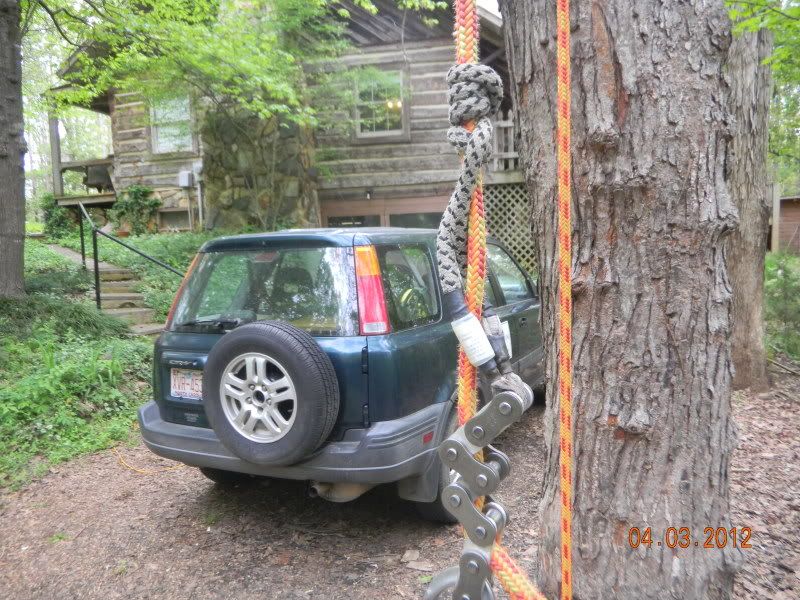
Yes the schawbisch advances very nicely with the beeline, however the P/R really needs a criss-cross wrap in the hitch knot,in order to moderate how the hitch releases the P/R, so I added a criss-cross weave below the schwabisch, works like a charm. The beeline pictured is 28' i to i, I beleive it could be quite a bit shorter and reduce sitback, say 24".
I ordered some stainless steel stock yesterday for the attach points.
edit:
Yes the schawbisch advances very nicely with the beeline, however the P/R really needs a criss-cross wrap in the hitch knot,in order to moderate how the hitch releases the P/R, so I added a criss-cross weave below the schwabisch, works like a charm. The beeline pictured is 28' i to i, I beleive it could be quite a bit shorter and reduce sitback, say 24".
I ordered some stainless steel stock yesterday for the attach points.
Caleb came by and tried the P/R yesterday afternoon. He tried to ascend with a hand and foot ascender above and below the hitch, with a foot loop on the upper ascender, and found that it would not be pulled along upwards from the harness attach point. It pushed upwards from below fine, it just did not like to be pulled upward. I have been working on this issue, and find that if I do not use the rigid double link pictured above, at the harness attach point, but instead just go with the swivel links at the harness attach points, it will slide upwards when pulled on a taut line from the harness attach point.
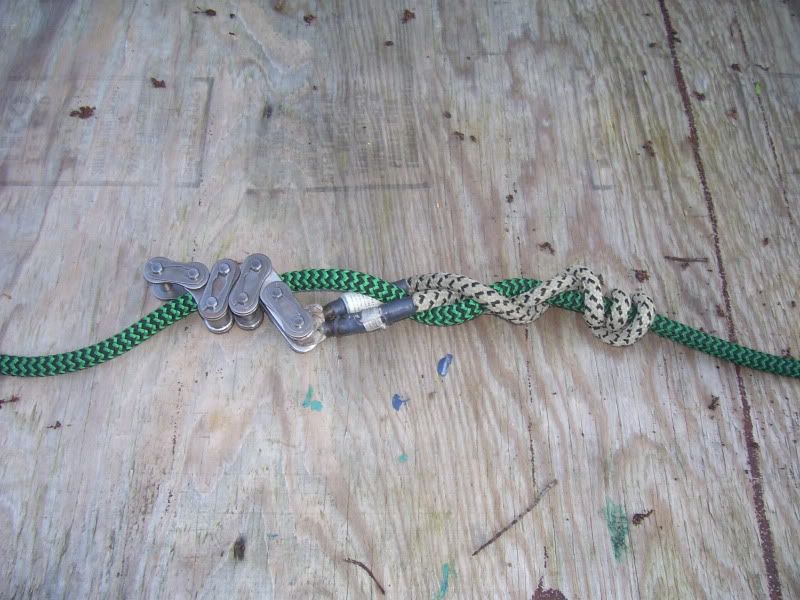
With the pulley rack it is handy to affix the hitch cord eye to eyes semi-permanently to the stainless steel headstock by unfastening the spring clip and side plate and inserting the eye to eyes and replacing the side plate and spring clip. but then how to form the hitch knot (XT)? I will show a series of pictures that shows how. The hitch cord pictured is 8mm beeline x 28". first up form three loops as shown at the end of the doubled hitch cord, then insert the climbing rope through the three loops, like so.
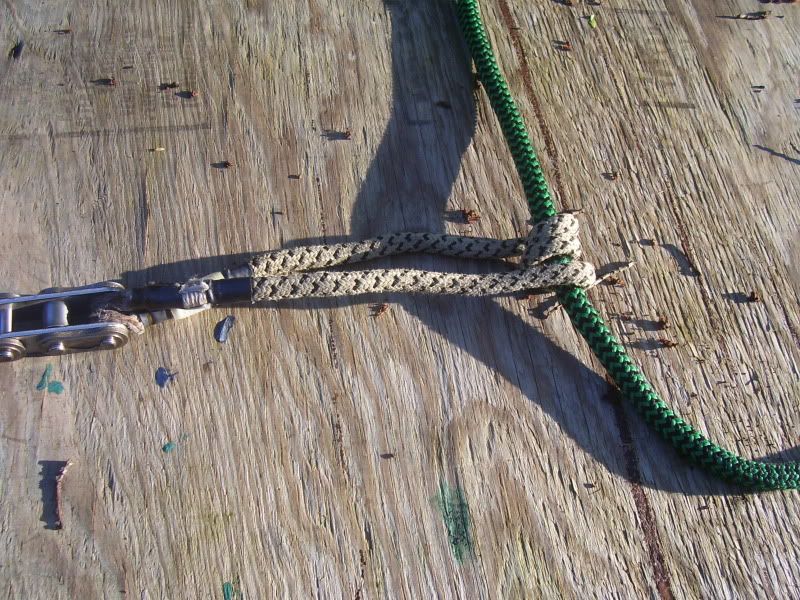
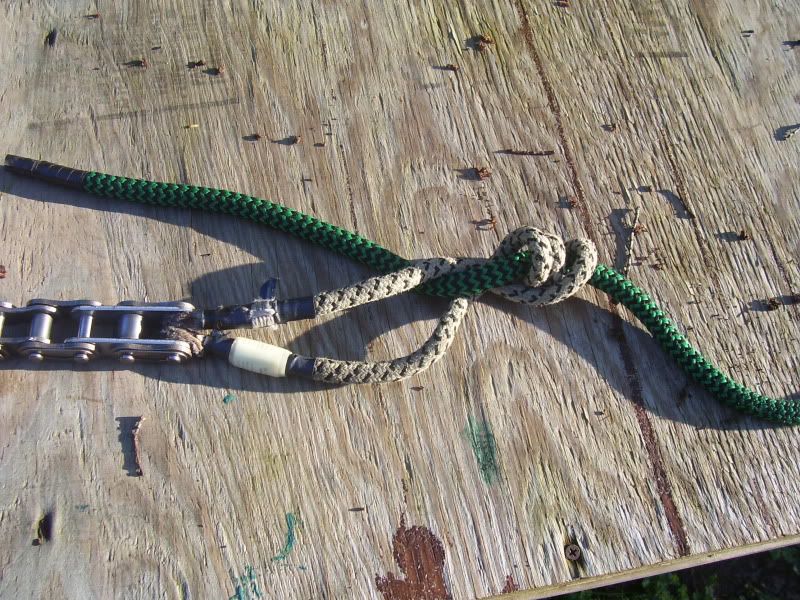
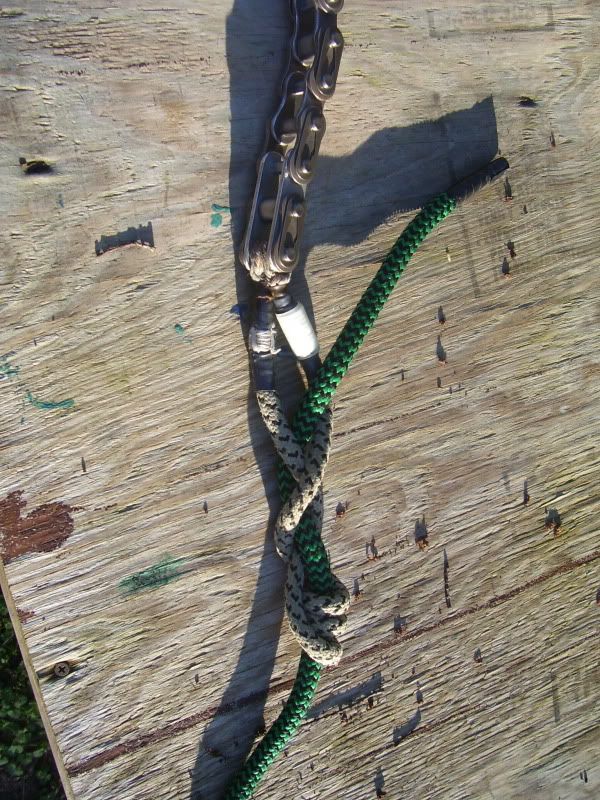
Do this criss cross weave for the third time in the same manner, and the XT is formed. You end up with three wraps and three weaves. Of course the number of wraps and weaves could be altered to suit the need, but the hitch remains in the XT form.
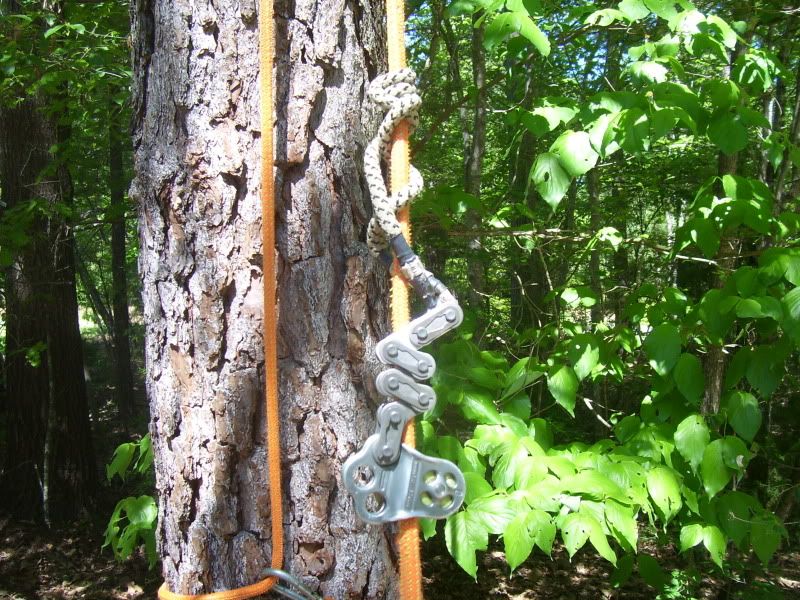
Then continue to weave through the P/R like this and clip the harness in at the bottom.
Then continue to weave through the P/R like this and clip the harness in at the bottom.
This configuration works even better. Attach a hitch climber pulley to the bottom attach point (Thanks for sparking this idea Tony!). Now you can tend slack even nicer, plus it has an attach point for self advancing on a double line, or can be pulled upwards easily on a single line.
Gordon
Gordon

- Location
- Longmont, CO
Good for you. I too have thought of this very idea. I even have scetches of it.
However, if the industry can produce just a chain-like device (to eliminate the need of a cord), it would be even more awesome. It would nearly last a lifetime with stainless steel parts too.
Just a thought:
If there were a 100% chain-like design, the distance between pins (on the very first link) would have to be very close to the diameter to the rope. If it were, it would grab first and allow the system to elongate and grab when loading into the rope. In your system that is what the V.T. hitch is for. It does the grabbing. The pins in the chain links provide the additional friction needed to feel like you're using it DDRT or with a Singing Tree wrench.
Nice work!
However, if the industry can produce just a chain-like device (to eliminate the need of a cord), it would be even more awesome. It would nearly last a lifetime with stainless steel parts too.
Just a thought:
If there were a 100% chain-like design, the distance between pins (on the very first link) would have to be very close to the diameter to the rope. If it were, it would grab first and allow the system to elongate and grab when loading into the rope. In your system that is what the V.T. hitch is for. It does the grabbing. The pins in the chain links provide the additional friction needed to feel like you're using it DDRT or with a Singing Tree wrench.
Nice work!

Tony
Carpal tunnel level member
- Location
- Lancaster, PA
I have been playing around with sureyor's pulley rack combo. I gotta say being a bit of a curmudgeon lately when it comes to climbing techniques, this set up has possibilities.
In effect, it is a hitch dependent uniascender. It works well doubled rope or single. Requires about 15 seconds to change over including anchoring. It is smooth to tend slack, but will not self tail that I have found yet.
You might be saying why not just get a uniascender, the original was O.K. Bit clunky with slack and I never liked the idea of looping the rope over top to manage friction occasionally. Still a fine piece of equipment. The new version seems flimsy to me. I regularly wore out lock jack cams when I used one (probably just me!). But non replaceable parts on any system are a downside in my mind.
The pulley/rack can be a bit heavy, but you only notice with excessive slack (never a good idea anyway).
I have some video I am putting together hopefully today with some pros and cons.
All in all thought its a nice alternative ? I look forward to working with it more.
Tony
In effect, it is a hitch dependent uniascender. It works well doubled rope or single. Requires about 15 seconds to change over including anchoring. It is smooth to tend slack, but will not self tail that I have found yet.
You might be saying why not just get a uniascender, the original was O.K. Bit clunky with slack and I never liked the idea of looping the rope over top to manage friction occasionally. Still a fine piece of equipment. The new version seems flimsy to me. I regularly wore out lock jack cams when I used one (probably just me!). But non replaceable parts on any system are a downside in my mind.
The pulley/rack can be a bit heavy, but you only notice with excessive slack (never a good idea anyway).
I have some video I am putting together hopefully today with some pros and cons.
All in all thought its a nice alternative ? I look forward to working with it more.
Tony
- Location
- Longmont, CO
[ QUOTE ]
...You might be saying why not just get a uniascender, the original was O.K. Bit clunky with slack and I never liked the idea of looping the rope over top to manage friction occasionally. Still a fine piece of equipment. The new version seems flimsy to me. I regularly wore out lock jack cams when I used one (probably just me!). But non replaceable parts on any system are a downside in my mind...
[/ QUOTE ]
Tony. Did you know you can get new cams? The rebuild is only $80 dollars. So, the parts are replaceable.
...You might be saying why not just get a uniascender, the original was O.K. Bit clunky with slack and I never liked the idea of looping the rope over top to manage friction occasionally. Still a fine piece of equipment. The new version seems flimsy to me. I regularly wore out lock jack cams when I used one (probably just me!). But non replaceable parts on any system are a downside in my mind...
[/ QUOTE ]
Tony. Did you know you can get new cams? The rebuild is only $80 dollars. So, the parts are replaceable.
I find that crumudgeons are the ones that know the most : )
The high grade steel links and rollers should wear very slowly.
Look forward to your video. I am thinking of coming to the Charlotte competion and would bring my various experiments, including a pulley rack with the stainless steel headstock.
The high grade steel links and rollers should wear very slowly.
Look forward to your video. I am thinking of coming to the Charlotte competion and would bring my various experiments, including a pulley rack with the stainless steel headstock.
Tony
Carpal tunnel level member
- Location
- Lancaster, PA
Jamin,
That I did not know. I believe surveyor is correct through I don't see this thing wearing out.
Nothing against the Uni. Just not me. I am not entirely convinced SRT work positioning is all it cracked up to be. Then again I am a curmudgeon!
For all of you out there rocking a Uni, keep on rocking

Tony
That I did not know. I believe surveyor is correct through I don't see this thing wearing out.
Nothing against the Uni. Just not me. I am not entirely convinced SRT work positioning is all it cracked up to be. Then again I am a curmudgeon!
For all of you out there rocking a Uni, keep on rocking
Tony
Tony
Carpal tunnel level member
- Location
- Lancaster, PA
Tony
Carpal tunnel level member
- Location
- Lancaster, PA
Thanks surveyor. And yes configured in doubled rope mode I believe a new climbing hitch may just out last the climber.
In fact, the rack absorbs so much friction it does all the work except hold you stationary. That makes it even more crucial to find a hitch/line combo that works consistently every time. I found that if the combo works without the rack it will work with.
I can't stress enough that a XT or VT be used. I tried probably a dozen different knots with multiple materials in various configurations. It seems that hitches like the Knute or similar where there is a half hitch at the bottom near the rack, counterintuitivly work less reliably.
Start with three wraps then three braids down and go from there.
Tony
In fact, the rack absorbs so much friction it does all the work except hold you stationary. That makes it even more crucial to find a hitch/line combo that works consistently every time. I found that if the combo works without the rack it will work with.
I can't stress enough that a XT or VT be used. I tried probably a dozen different knots with multiple materials in various configurations. It seems that hitches like the Knute or similar where there is a half hitch at the bottom near the rack, counterintuitivly work less reliably.
Start with three wraps then three braids down and go from there.
Tony
New threads New posts
-
test
-

-
 Alternatives to standard asphalt around roots
- Started by southsoundtree
- Replies: 11
-
-

-

-


