Prusik snug, running bowline basal anchor

Phil

Carpal tunnel level member
Location
Oak Lawn, IL
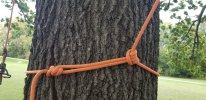
When I climb I frequently use a basal anchor. I have traditionally used a simple running bowline with yosemite tie off. I've seen lots of folks discuss the issue of having such a simple setup change orientation or position on the trunk when slack is introduced and then removed. Such a release of tension would occur most noticeably when advancing to a higher PSP without undoing the basal anchor. I started to take a full turn around the standing end of my line before tieing the bowline. This seemed pretty secure. As I looked at it at I realized I'm halfway to tieing a 4 coil prusik. So today I decided to tie a prusik snugged running bowline basal anchor.

This worked awesome. I snugged it up and it never moved. I climbed to my PSP, slacked my line completely, sending about 15' of rope down toward the base of the tree so I could pull my climbing system through a higher union. Reattached and finished my work. The basal anchor never budged.

I came up with this idea on my own, but I have a hard time believing I'm the first to think of it. Has anyone seen this or used this before? If I can't find any sort of literature referencing this knot, I'm going to plant my flag on it and claim it as an original known as the "Running Prohaska Bowline". My last name is Prohaska... I was already robbed of name immortality once haha
https://notableknotindex.webs.com/blakeshitch.html
No relation to Heinz Prohaska of course, but that would have been cool if it had carried my last name.
 

Attachments
  • 20211021_095956.jpg
    20211021_095956.jpg
    524.7 KB · Views: 88
Last edited:
That looks simple and secure. I hope you get to keep your chosen name for it.
I use the mentioned running bowline with a yosemite finish as my base tie on every climb and have been doing so for a long time. Not once has it given me any trouble.
 
I also tend to use a running bowline for my basal tie. I've never had an issue with it. I guess I keep the bowline loop pretty small, and maybe that has something to do with how secure it is when slacked. I've never understood why people would use anything else.

I'm curious about why the Yosemite finish. For a basal tie I don't see any advantage. It looks more tidy and I can see some other applications where it might be useful, but I have also read warnings about how easy it is to tie it incorrectly which would make it more prone to failure. I don't remember how to tie it "wrong", just how to tie it correctly.
 
Yes, super simple to tie, set, dress, and inspect. And it's one of the few inherently secure bowlines that are approved for rescue without a stopper (depending on country/location/organization), unlike the Yosemite bowline.
Why is the Yosemite not considered "inherently" secure while the other is? What is the arboriculture industry not informed on? I've seen the yosemite used exclusively as the end-all-be-all secure backup to the plain bowline.

Will the Scott's finish work just as well in double braid lines and kernmantle lines? I don't own any kernmantles to test on.
 
Why is the Yosemite not considered "inherently" secure while the other is? What is the arboriculture industry not informed on? I've seen the yosemite used exclusively as the end-all-be-all secure backup to the plain bowline.

Will the Scott's finish work just as well in double braid lines and kernmantle lines? I don't own any kernmantles to test on.

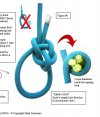
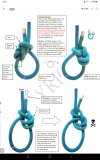
The Yosemite has 40 years of history. Scott's is not as well known, even though developed in 2011. In most ropes, and tied correctly, Yosemite is a secure knot. But it can be tightened in the wrong order, resulting in a different knot. Here is a little writeup by a member of the International Guild of Knot Tyers. Personally I think that a more significant issue is incorrect tying/dressing and difficulty teaching and inspecting when compared to the Scott's finish.
Screenshot_20211024-175120_Drive.jpg
 
The Yosemite has 40 years of history. Scott's is not as well known, even though developed in 2011. In most ropes, and tied correctly, Yosemite is a secure knot. But it can be tightened in the wrong order, resulting in a different knot. Here is a little writeup by a member of the International Guild of Knot Tyers. Personally I think that a more significant issue is incorrect tying/dressing and difficulty teaching and inspecting when compared to the Scott's finish.
View attachment 78442
Learned something new from this. Thanks for the share.
 
  • Like
Reactions: JCB
....but I have also read warnings about how easy it is to tie it incorrectly which would make it more prone to failure. I don't remember how to tie it "wrong", just how to tie it correctly.

Yosemite Tie-off being a backup to a Bowline is technically not a problem for the security of the Bowline if the YTO is formed incorrectly. The security is correctly tying, dressing, and setting the Bowline. Clearly there should be an effective backup to a RB used for a lifeline.

The accident that happened involving RB/YTO was when an experienced rec climber used a RB/YTO as a rope termination on the standing end of their DdRT system and accidentally clipped into the part of the YTO just before it turns up and tucks through part of the Bowline. They were doing a system switchover at height and when they clipped in and committed their weight to the tail of the YTO, it immediately pulled out and they dropped to the ground. They suffered a spinal injury and have since recovered with no paralysis. Not to digress too far but the safety mistake there besides clipping into the wrong place on their termination knot was that they didn't stay tied in with their lanyard or another line slacked enough that they could fully test the integrity of the new tie-in before fully committing to it.

Richard Mumford has written extensively about this accident. He was on the scene when it happened. It was climber error likely due to fatigue or "low vigilance". Two climber mistakes were made which led to the fall, YTO was not at fault per se. I don't think many people are using a Bowline as termination for their DdRT/MRS climbing system these days. Main reason being it's not a cinching attachment which means the carabiner can rotate to the gate when the line is slacked in the tree.

For a RB base tie it's so simple to leave enough tail after the bowline to tie an effective stopper knot as the backup. The YTO is a clean/neat backup as mentioned and is no danger to the climber in a base anchor.
-AJ
 

This is the problem when knot use is discussed in a rock/alpine context vs. a tree climbing context. The mistake shown in the photos above is a serious rookie error that a beginning rock climber might make tying their life line to their harness connection loop. Also... the tail is depicted dangerously too short exiting the YTO. Mixed messages, not a good graphic.

If a tree climber cannot tie a secure Bowline blindfolded they shouldn't be climbing. Tree climbers should not be using a Bowline as a line termination to a carabiner, there is no good reason to do so and there are several reasons not to. The life support knot no matter what the knot is is always well tied and dressed before it is fully set, then the back up is fully set. Note that in the illustration text the name of the knot is "Yosemite" Bowline. There is no such knot in the tree climbing world, it is a Bowline Knot with a Yosemite Tie-Off. Words are important, incorrect use of life-support terminology in tree climbing can lead to misconceptions, bad communication when it counts, and potential costly errors.
-AJ
 
That looks simple and secure. I hope you get to keep your chosen name for it.
I use the mentioned running bowline with a yosemite finish as my base tie on every climb and have been doing so for a long time. Not once has it given me any trouble.

Yep, the "Running Prohaska Bowline" looks great. Likewise I've never had an issue with a simple RB with backup as my base anchor. When I tie to skinny or slippery bark small trees adjacent to the tree I'm climbing in I put two or three half hitches above the backed RB. Snug it all up and you can slack your main rope for days and the RB won't move.

51627459767_3d8d751708_z.jpg


-AJ
 
Last edited:
This is the problem when knot use is discussed in a rock/alpine context vs. a tree climbing context. The mistake shown in the photos above is a serious rookie error that a beginning rock climber might make tying their life line to their harness connection loop. Also... the tail is depicted dangerously too short exiting the YTO. Mixed messages, not a good graphic.

If a tree climber cannot tie a secure Bowline blindfolded they shouldn't be climbing. Tree climbers should not be using a Bowline as a line termination to a carabiner, there is no good reason to do so and there are several reasons not to. The life support knot no matter what the knot is is always well tied and dressed before it is fully set, then the back up is fully set. Note that in the illustration text the name of the knot is "Yosemite" Bowline. There is no such knot in the tree climbing world, it is a Bowline Knot with a Yosemite Tie-Off. Words are important, incorrect use of life-support terminology in tree climbing can lead to misconceptions, bad communication when it counts, and potential costly errors.
-AJ

The screen shot is from a paper on bowline knots. He probably used Yosemite Bowline because that is a common reference for that knot (used on Wikipedia, etc.). Certainly jargon varies across the country and world,. Yosemite finish, tie-off, knot, all give enough information to understand the reference. The illustration shows a short tail simply because it's an illustration of the knot structure.

Anyone interested in reading the full paper can download it here. The password to open it is "copyright, but it is a freely downloadable pdf made available by the author.

 
... I'm curious about why the Yosemite finish. For a basal tie I don't see any advantage. It looks more tidy and I can see some other applications where it might be useful, but I have also read warnings about how easy it is to tie it incorrectly which would make it more prone to failure. I don't remember how to tie it "wrong", just how to tie it correctly.

It is important to remember that the ease of tying and untying the bowline comes with a price and that is a knot that can lose 'set' when subjected to repeated slack cycles. The yosemite finish is very good at mitigating that tendency.

Many things we do can be made more dangerous by doing them wrong. The most appropriate correction for that is to do them right. I make it a practice to test 'all' new-to-me rope/knot combinations well in advance of their use. Looking or focusing on one component, such as the knot, within a system, will not accurately translate into how well they will perform when combined.
 
The screen shot is from a paper on bowline knots. He probably used Yosemite Bowline because that is a common reference for that knot (used on Wikipedia, etc.). Certainly jargon varies across the country and world,. Yosemite finish, tie-off, knot, all give enough information to understand the reference. The illustration shows a short tail simply because it's an illustration of the knot structure.

Anyone interested in reading the full paper can download it here. The password to open it is "copyright, but it is a freely downloadable pdf made available by the author.

Understood!

Things can get weird when high-angle disciplines intermingle. The uses of same knots can be very different. There have been attempts to smooth the terminology differences but each high-angle discipline has it’s own knot culture, uses and naming. Indeed the graphic shown is focusing on how a YTO can go bad but they should’ve been more thorough/consistent since their message was all about safety and showed a longer tail. That’s in an ideal world ;-)
-AJ
 
Indeed the graphic shown is focusing on how a YTO can go bad but they should’ve been more thorough/consistent since their message was all about safety and showed a longer tail. That’s in an ideal world ;-)
One thing that really struck me from CTSP training was if you’re going to introduce a graphic or image, it should never show what isn’t meant to be done, unless it has a giant X around it. Many people rely heavily on visuals for learning and they will take things literally, like how short the tail is. Many people could learn the knot from that graphic and get the wrong impression.
 
One thing that really struck me from CTSP training was if you’re going to introduce a graphic or image, it should never show what isn’t meant to be done, unless it has a giant X around it. Many people rely heavily on visuals for learning and they will take things literally, like how short the tail is. Many people could learn the knot from that graphic and get the wrong impression.

Yes, the reference comes from the world of the International Guild of Knot Tyers. Definitely knot nerds, of which I am a budding one. The lack of proper tail in illustrations is common in discussions of analysis of chirality and topology amongst the knot nerd community. I should have been more careful on how I introduced this to this community and will be more careful in future.
 
Yes, the reference comes from the world of the International Guild of Knot Tyers. Definitely knot nerds, of which I am a budding one. The lack of proper tail in illustrations is common in discussions of analysis of chirality and topology amongst the knot nerd community. I should have been more careful on how I introduced this to this community and will be more careful in future.

No worries, you're fine, keep at it! I'm all for clarity and when things start to slip I speak up, it is not an admonition whatsoever. Plus you said "chirality" so you can say whatever you want ;-)
-AJ
 

New threads New posts

Back
Top Bottom