Reading your post was like “wow!”. I’m glad I read it, otherwise I would have spouted all the same things!
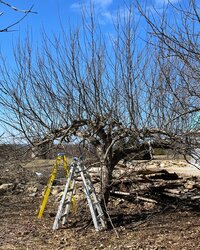
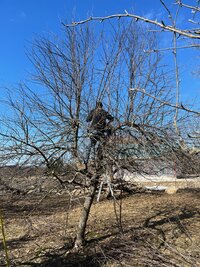
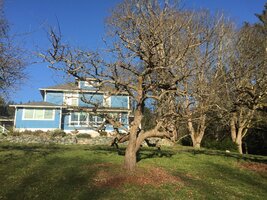
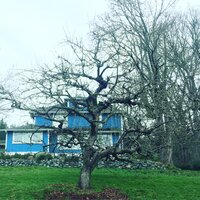
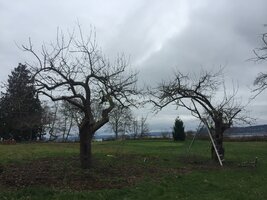
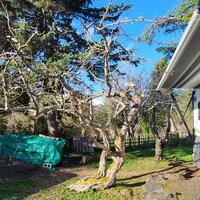
Rather coincidentally, we just got a call to reign in some trees that were neglected for a few years. Mostly pear, plum, peach and cherry varieties since apples would be very susceptible to rust issues with all the Eastern Red Cedars on surrounding land.
The client had just bought the property and had several concerns, but also some misconceptions. The best part is that she and her husband want to be deeply involved in their own trees, and plan to do as much of the pruning and spraying as they can. They were not sure about how to restore the trees to a more manageable size. They also own a copy of ‘The Holistic Orchard’ by Michael Phillips. We were already off to a great start!
The things we had to establish were:
- How high are they willing to work for maintenance and harvesting? We settled on 8’ to 12’.
- How often are they willing to prune? They agreed to perform as many cycles as required based on growing conditions.
- Are they willing to accept mostly, but not all, perfect fruit. Yes! This just keeps getting better!
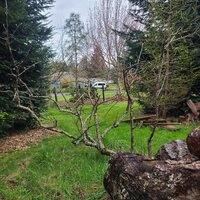
There are, however, different schools of thought on restorative measures. Some say reduce them slowly over time (low dosage, medium frequency). Some say hit them hard (high dosage, choose your own frequency). I recommended we do no more than 20% bud loss for the first visit. That took some explaining, and found the simplest lesson was for them to leave all material directly beneath the tree it came from and imagine gathering it up and holding like a bouquet. The bouquet should be n more than 20% the sizes of what remains in the tree.
Remember that this is all a game of light. When a tree is trained a particular way for many years and then let go, it will naturally form numerous, vigorous sprouts. Their height before and laterals form is in part due to stem density, and reduced light in the areas a lateral would be preferred. By thinning the number of stems, and also reducing the height of the remaining ones, you can encourage lateral growth through phototropism and hormone response (spreading out auxin). Any laterals that form will be more prone to horizontal growth if they are below other foliage. These new laterals can eventually become your highest structural branches. Once they harden off in your desired form and location, you can remove the parent stems above their points of attachment. If your client can stand having a taller tree, you can form other tiers above by training other laterals oriented in other directions.
Be aware of pruning with specific goals during specific times of the year. A common misconception is that one prunes in Winter for a reason, while that reason may actually be that it was when the farmer had the time to do it. There should really be 4 or 5 doses per year!
Eventually, once the desired structure has been established, your pruning targets may include, but may not be limited to:
- Unwanted vegetation.
- Unwanted or unproductive structure.
- Unwanted vegetation.
- Overly dense buds on spurs.
- Overly dense fruit on spurs.
- Unwanted vegetation.
- Entire spurs.
- Oh, and don’t forget unwanted vegetation!
With all this said, your client has to understand that this is basically impossible with a single visit. Even one visit annually is inadequate. Also, one arborist may have a multi-step plan that another arborist might not be able to pick up and run with.
Cool thread. Hope it gives you a good dose of useful information. Good luck and have fun!



 thanks everyone