
Proper collar cut for vertical stem?

Yeah...the Blue line is right where the book says to make the cut...and it is like the tree said "I wanted to be cut right here!" (I tell people all the time to look at dead branches on trees before you start cutting live and ask the tree "where do you want this branch pruned" - it will show you. I think that tree does indicate "where to make the cut".

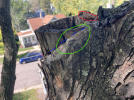
Maybe it is the angle of the picture, but the "red circled area" doesn't look like the callous tissue is even with the "green circle". It looks to me like the green read the textbook, but the red did not?

I do think a faster growing individual would have compartmentalized that better than this - not a lot of response growth for 8 years. (Not great tree health?) A silver maple should have grown a lot more. While growth rates are species dependent, where it develops response growth is not (for the most part...never say "always" in nature!)

It is a great picture for discussion. Not trying to argue any point, just sharing thoughts on what I see in it.

(edit: forgot to add the edited pic back in)
codominate removal.png
 
Last edited:
Yeah...the Blue line is right where the book says to make the cut...and it is like the tree said "I wanted to be cut right here!" (I tell people all the time to look at dead branches on trees before you start cutting live and ask the tree "where do you want this branch pruned" - it will show you. I think that tree does indicate "where to make the cut".

Maybe it is the angle of the picture, but the "red circled area" doesn't look like the callous tissue is even with the "green circle". It looks to me like the green read the textbook, but the red did not?

I do think a faster growing individual would have compartmentalized that better than this - not a lot of response growth for 8 years. A silver maple should have grown a lot more. While growth rates are species dependent, where it develops response growth is not (for the most part...never say "always" in nature!)

It is a great picture for discussion. Not trying to argue any point, just sharing thoughts on what I see in it.

(edit: forgot to add the edited pic back in)
View attachment 78007
Ahhh gotcha, you may be right. I was up close on the green side but didn’t check both sides until I was farther away. From there it does indeed appear uneven.
 
Personally in my area I diverge in two different ways when making cuts like the this. First I avoid it, but if it’s the only option I’ll leave a big ass stub and try to do my best weighing out how nature would break it and doing the least amount of harm. The end result is much like a mini habitat snag on a living tree.
The second is trying to find a node or cluster of laintent bids to get it to sucker out, obviously this require management. But it buys time for the decay to advance and new growth rings for wall 4
Perfect.. always best to leave a stub and hope it grows from the latent buds.... if not, come back in 5 years and re-trim the deadwood or just leave nature to take its course.

Trees lose limbs like that in nature and survive indefinitely.. trees have evolved to survive the type of decay resulting from the death of limbs, so leaving a dead stub is not a big deal. Not so when the guy with a chainsaw violates the living tissue of the parent stem... The entire industry paradigm of pruning practices has resulted from Shigo's teachings on target cuts and compartmentalization. The fallacy in Shigo's science was the mistaken assumption that the least amount of discoloration and decay resulting from pruning cuts indicates the best cut. He failed to make the distinction between the type of discoloration and decay that a tree can easily survive and the type that causes premature failure. NO pruning science has ever followed the results of pruning practices to the structural failure of the tree.

Shigo observed that a perfect target cut would lead to the least amount of discoloration in the parent stem, without having the sense to understand how completely impractical the expectation that perfect pruning cuts can be made consistently. There is simply no way that production arborists as a whole would be able to make those perfect cuts on a consistent basis. In the real world, there are probably less than 5% of the arbs that both have the proper education and really care about making perfect target cuts. And even that 1 out of 20 is bound to make bad cuts on irregular limbs that often occur in pruning scenarios.

The issue with trying to make perfect target cuts is that if the cut is made too far back the tree sustains irreparable harm. So it's best to always err on the side of leaving a stub. Shigo couldn't see that. His advice was to always attempt to make a perfect target cut. If you were unsure of where the target was, take a guess and go back a year later to see how the wound wood was growing. That's ivory tower mentality. Zero common sense in that recommendation. The vast majority of tree workers in the field will not have that luxury.

There are other benefits to leaving a stub, which have yet to be postulated within the industry. I have left enough stubs and gone back 5+ years later to see what these benefits are. They are right there in front of your eyes if you can simply look at the tree with an open mind.

One thing every experienced arb knows is that the cuts made on the job will be a lot harder to judge than those pictures in the text books. Pruning practices in the industry have been established by the ivory tower types and often offer little practical knowledge to the man with sawdust in his pockets.

Even the title of this thread "proper collar cut" shows the industry bias that is SHigo's legacy, as if the only proper cut is a collar cut.


Perfect.. always best to leave a stub and hope it grows from the latent buds.... if not, come back in 5 years and re-trim the deadwood or just leave nature to take its course.

Trees lose limbs like that in nature and survive indefinitely.. trees have evolved to survive the type of decay resulting from the death of limbs, so leaving a dead stub is not a big deal. Not so when the guy with a chainsaw violates the living tissue of the parent stem... The entire industry paradigm of pruning practices has resulted from Shigo's teachings on target cuts and compartmentalization. The fallacy in Shigo's science was the mistaken assumption that the least amount of discoloration and decay resulting from pruning cuts indicates the best cut. He failed to make the distinction between the type of discoloration and decay that a tree can easily survive and the type that causes premature failure. NO pruning science has ever followed the results of pruning practices to the structural failure of the tree.

Shigo observed that a perfect target cut would lead to the least amount of discoloration in the parent stem, without having the sense to understand how completely impractical the expectation that perfect pruning cuts can be made consistently. There is simply no way that production arborists as a whole would be able to make those perfect cuts on a consistent basis. In the real world, there are probably less than 5% of the arbs that both have the proper education and really care about making perfect target cuts. And even that 1 out of 20 is bound to make bad cuts on irregular limbs that often occur in pruning scenarios.

The issue with trying to make perfect target cuts is that if the cut is made too far back the tree sustains irreparable harm. So it's best to always err on the side of leaving a stub. Shigo couldn't see that. His advice was to always attempt to make a perfect target cut. If you were unsure of where the target was, take a guess and go back a year later to see how the wound wood was growing. That's ivory tower mentality. Zero common sense in that recommendation. The vast majority of tree workers in the field will not have that luxury.

There are other benefits to leaving a stub, which have yet to be postulated within the industry. I have left enough stubs and gone back 5+ years later to see what these benefits are. They are right there in front of your eyes if you can simply look at the tree with an open mind.

One thing every experienced arb knows is that the cuts made on the job will be a lot harder to judge than those pictures in the text books. Pruning practices in the industry have been established by the ivory tower types and often offer little practical knowledge to the man with sawdust in his pockets.

Even the title of this thread "proper collar cut" shows the industry bias that is SHigo's legacy, as if the only proper cut is a collar cut.


Fallacy, ehh? Very strong words of criticism from some one with a few youtube video's against someone who had volumes of published research!
Always use a proper pruning cut when you can unless other goals are in play
When you cannot make a proper pruning cut.... get creative using best available science
 
Shigo was originally a forester.. If you look at a list of his early publications, many of them had titles that included "discoloration and decay". His primary concern at the time was preserving log value. So his early work was more related to that than to applications related to arboriculture. While he did the tedious task of unlocking the tree's methods of compartmentalizing decay, which lead to a revolution in pruning practices, he failed to make the distinction between the type of decay that a tree can easily survive and the type that leads to terminal failure such as the decay created by flush cuts.

Given the fact that a large percentage of cuts in the field do not offer clear indications of where the proper cut should be, even for those that have proper education on the subject, and the reality that many if not most arbs do not have a good education, and a significant percentage of arbs couldn't care less about a tree's long term health enough to even bother attempting to make good target cuts, it simply is not realistic to create a standard that arbs should all strive for the perfect target on every cut. The result of such a standard has and will continue to inevitably lead to a significant percentage of cuts that violate the branch protection zone. Given the harm done by these cuts on the wrong side of the perfect target is irreparable and often catastrophic, it would be much better for the trees to make a recommendation that all cuts should be safely outside the branch protection zone, thus leaving a stub when there is no clear unambiguous target cut. The resulting harm from leaving a stub is almost negligible in terms of long-term failure. So it's just common sense that leaving a stub is better than taking a chance on violating the BPZ.

The interpretation of Shigo's work has also lead to a widespread failure to recognize the irreparable damage done by making large "proper" target cuts. Many arbs rely on their knowledge of making a "proper" target cut and go about removing large limbs (anything over 4"). Unfortunately for the trees, many of these large cuts will never properly compartmentalize, no matter how perfect the target is achieved. If these limbs had been reduced rather than removed, the trees would have had far better chances of survival. Due to Shigo's work, the industry has become hyper-focused on "proper" target cuts and has failed to recognize the obvious benefits of reducing large limbs over removing them.

And lastly, the industry has been slow to evolve past Shigo's work. While Shigo made a revolutionary step in getting us to stop making flush cuts and bringing our cuts out past the collar, the next evolution in pruning practices would be to leave stubs and reduced limbs with the hope that the limb lives and regrows from latent buds or existing sprouts, or the stub allows the tree time to set up its defenses at the protection zone before any decay can set into the main stem. The industry's tendency towards Shigo-worship has slowed the evolution of pruning practices down tremendously. Our inability to look past his work has resulted in pruning practices that are to a large extent stuck in the 1970's
 
Shigo was a plant pathologist, not a Forester.
Shigo started as a forester.. working as a pathologist for the US Forest Service.

Shigo furthered his education at the University of West Virginia, receiving a master’s degree in biology in 1958, and a Ph.D. in pathology in 1960. His career as a pathologist began with the U.S. Forest Service later that year. “I was a creature of opportunities,” Shigo notes.
 
Last edited:
True enough ATH, Shigo was a plant pathologist (officially for the FS ) and mycologist (which does not have a OPM occupation code). When we first met in 1977, Shigo's official FS business cards gave his title as "Chief Mycologist" (a position which actually did not exist). His graduate work in WV in the late 1950s was on biocontrol of the oak wilt fungus.
However, I agree with more than a little of Daniel's treatment. Shigo's FS assignment was to investigate the causes of wood discoloration and decay that reduced wood value for timber products. This had been a focus of FS research and development for the half-century before Shigo came on the scene. Important, but not revolutionary. And "discoloration and decay" is still on my nameplate at the Durham lab.
What was revolutionary in the early 1960s, was that his assignment coincided with manageable (although still formidable) chainsaws that a single person could operate. Prior to Shigo, the patterns of wood discoloration and decay were observed in the cut ends of logs on the timber landing or in the sawmill. Through axial longitudinal rips, he could associate those patterns to basal wounds and branch stubs. Those basal wounds were often the result of active forestry management and logging damage in the past, what was termed "post-harvest decadence". His work on pruning first involved the pruning of high-value hardwoods such as black walnut in the US Midwest, to maximize production of clear specialty timber and veneer. In that work, he found that making neat and pretty flush cuts resulted in significant losses of timber quality and value. However, with other changes in forestry management and ownership, foresters found little reason to change what they did outside of a few specialty products.

OK then, as "urban forestry" reared up out of the ongoing mess of Dutch Elm Disease, he was asked to participate and so he sought to relate his findings to the urban situation. What he saw was, yes, flush cuts, topping, and wound dressings were the marks of professional tree surgery. He saw that experienced tree surgeons caused much of the structural and decay problems of urban trees. Because so many cuts resulted in so much damage, he encouraged as few cuts as possible. I'm relying on memory here, but he presented the 90-3-90 rule: Ninety percent of the time, pruning 3 branches corrects 90% of the problem. Handy and cute, but strictly followed resulted in fewer, larger cuts. Most of us now would say more, smaller cuts are the way to go.

Folks now want to put a much finer and exacting point on these questions. Great! The resolution of the issues of these threads could come about by experimentation that includes dissection. As for the OP, Shigo would lean towards the more steeply angled cut in order to reduce the wood volume in the dead or soon-to-be dead codominant stem. Yes, that does cause a larger ~transverse wound area. Does that matter here? Let's set up the 10-20-50 year studies to check that out. While we are at it, let's do some dissection studies following coronet pruning or other practices that come into and out of vogue. Oh me? Probably not, I've been frying other fish for most of these three decades.
 
Last edited:
True enough ATH, Shigo was a plant pathologist (officially for the FS ) and mycologist (which does not have a OPM occupation code). When we first met in 1977, Shigo's official FS business cards gave his title as "Chief Mycologist" (a position which actually did not exist). His graduate work in WV in the late 1950s was on biocontrol of the oak wilt fungus.
However, I agree with more than a little of Daniel's treatment. Shigo's FS assignment was to investigate the causes of wood discoloration and decay that reduced wood value for timber products. This had been a focus of FS research and development for the half-century before Shigo came on the scene. Important, but not revolutionary. And "discoloration and decay" is still on my nameplate at the Durham lab.
What was revolutionary in the early 1960s, was that his assignment coincided with manageable (although still formidable) chainsaws that a single person could operate. Prior to Shigo, the patterns of wood discoloration and decay were observed in the cut ends of logs on the timber landing or in the sawmill. Through axial longitudinal rips, he could associate those patterns to basal wounds and branch stubs. Those basal wounds were often the result of active forestry management and logging damage in the past, what was termed "post-harvest decadence". His work on pruning first involved the pruning of high-value hardwoods such as black walnut in the US Midwest, to maximize production of clear specialty timber and veneer. In that work, he found that making neat and pretty flush cuts resulted in significant losses of timber quality and value. However, with other changes in forestry management and ownership, foresters found little reason to change what they did outside of a few specialty products.

OK then, as "urban forestry" reared up out of the ongoing mess of Dutch Elm Disease, he was asked to participate and so he sought to relate his findings to the urban situation. What he saw was, yes, flush cuts, topping, and wound dressings were the marks of professional tree surgery. He saw that experienced tree surgeons caused much of the structural and decay problems of urban trees. Because so many cuts resulted in so much damage, he encouraged as few cuts as possible. I'm relying on memory here, but he presented the 90-3-90 rule: Ninety percent of the time, pruning 3 branches corrects 90% of the problem. Handy and cute, but strictly followed resulted in fewer, larger cuts. Most of us now would say more, smaller cuts are the way to go.

Folks now want to put a much finer and exacting point on these questions. Great! The resolution of the issues of these threads could come about by experimentation that includes dissection. As for the OP, Shigo would lean towards the more steeply angled cut in order to reduce the wood volume in the dead or soon-to-be dead codominant stem. Yes, that does cause a larger ~transverse wound area. Does that matter here? Let's set up the 10-20-50 year studies to check that out. While we are at it, let's do some dissection studies following coronet pruning or other practices that come into and out of vogue. Oh me? Probably not, I've been frying other fish for most of these three decades.
I was hoping you’d speak up. Interesting, and here in the PNW there seems to be a growing trend to manage urban trees in a more forestry mindset. Certainly so in my area, where I’m more likely to be dealing with 40 acre forested parcels than park trees. Unfortunately many of these 40 acre parcels want their forest to look like a city park.
Hopefully we are going through a cultural shift with how we see trees for the forest, with less focus on resource extraction. Time will tell, and unfortunately the PR campaigns and timber wars are far from over!
Hope our paths cross again sooner than later
 
Shigo started as a forester.. working as a pathologist for the US Forest Service.

Shigo furthered his education at the University of West Virginia, receiving a master’s degree in biology in 1958, and a Ph.D. in pathology in 1960. His career as a pathologist began with the U.S. Forest Service later that year. “I was a creature of opportunities,” Shigo notes.
Working as a pathologist for the USFS does not make one a forester...anymore than working as a butler in the Whitehouse makes one a President or working as a CEO for McDonald's makes one a burger flipper.

The last forester working in the Delaware (Ohio) USFS research lab retired several years ago. They still are doing great research. Still a Forest Service lab. USFS is a major funding source for many urban forestry programs. They aren't just fire and timber.

Yes, Shigo started his career researching decay as it pertains to timber degradation. But he did that as a pathologist, not a forester.

When you start with wrong facts, you come to wrong conclusions...
 
Last edited:
Many arbs rely on their knowledge of making a "proper" target cut and go about removing large limbs (anything over 4"). Unfortunately for the trees, many of these large cuts will never properly compartmentalize, no matter how perfect the target is achieved. If these limbs had been reduced rather than removed, the trees would have had far better chances of survival. Due to Shigo's work, the industry has become hyper-focused on "proper" target cuts and has failed to recognize the obvious benefits of reducing large limbs over removing them.
This is such an important point, that these cuts should be avoided in the first place. Do you have a lot of pushback from clients when you are talking them down from larger cuts? That’s the biggest problem I see. All the arborists I’ve worked with are doing as much as they can to avoid these kinds of cuts.
 
True enough ATH, Shigo was a plant pathologist (officially for the FS ) and mycologist (which does not have a OPM occupation code). When we first met in 1977, Shigo's official FS business cards gave his title as "Chief Mycologist" (a position which actually did not exist). His graduate work in WV in the late 1950s was on biocontrol of the oak wilt fungus.
However, I agree with more than a little of Daniel's treatment. Shigo's FS assignment was to investigate the causes of wood discoloration and decay that reduced wood value for timber products. This had been a focus of FS research and development for the half-century before Shigo came on the scene. Important, but not revolutionary. And "discoloration and decay" is still on my nameplate at the Durham lab.
What was revolutionary in the early 1960s, was that his assignment coincided with manageable (although still formidable) chainsaws that a single person could operate. Prior to Shigo, the patterns of wood discoloration and decay were observed in the cut ends of logs on the timber landing or in the sawmill. Through axial longitudinal rips, he could associate those patterns to basal wounds and branch stubs. Those basal wounds were often the result of active forestry management and logging damage in the past, what was termed "post-harvest decadence". His work on pruning first involved the pruning of high-value hardwoods such as black walnut in the US Midwest, to maximize production of clear specialty timber and veneer. In that work, he found that making neat and pretty flush cuts resulted in significant losses of timber quality and value. However, with other changes in forestry management and ownership, foresters found little reason to change what they did outside of a few specialty products.

OK then, as "urban forestry" reared up out of the ongoing mess of Dutch Elm Disease, he was asked to participate and so he sought to relate his findings to the urban situation. What he saw was, yes, flush cuts, topping, and wound dressings were the marks of professional tree surgery. He saw that experienced tree surgeons caused much of the structural and decay problems of urban trees. Because so many cuts resulted in so much damage, he encouraged as few cuts as possible. I'm relying on memory here, but he presented the 90-3-90 rule: Ninety percent of the time, pruning 3 branches corrects 90% of the problem. Handy and cute, but strictly followed resulted in fewer, larger cuts. Most of us now would say more, smaller cuts are the way to go.

Folks now want to put a much finer and exacting point on these questions. Great! The resolution of the issues of these threads could come about by experimentation that includes dissection. As for the OP, Shigo would lean towards the more steeply angled cut in order to reduce the wood volume in the dead or soon-to-be dead codominant stem. Yes, that does cause a larger ~transverse wound area. Does that matter here? Let's set up the 10-20-50 year studies to check that out. While we are at it, let's do some dissection studies following coronet pruning or other practices that come into and out of vogue. Oh me? Probably not, I've been frying other fish for most of these three decades.
Glad you are still around to tell the story straight.
 
Indeed so, I've worked with both foresters and arborists for more than thirty years, even as an ISA member, but I am neither. I've always worked on the physiology of parasitism of plants and fungi. Some of my projects are more tree-based, or fungus-based, or disease interaction-based, depending. For me, my research is a single arc straight through my undergraduate work through to now. I have the blessing and privilege to work to understand how these creatures do what they do. Sure, some of that is ivory tower stuff, and I say that with great joy and pleasure. But the best part is walking among the trees, in wildland or park, in wonder at what the day has brought. And yes, taking a shovel or a saw to look at the inside. Yes, it's still lots of fun. Once again, TMI.
 
True enough ATH, Shigo was a plant pathologist (officially for the FS ) and mycologist (which does not have a OPM occupation code). When we first met in 1977, Shigo's official FS business cards gave his title as "Chief Mycologist" (a position which actually did not exist). His graduate work in WV in the late 1950s was on biocontrol of the oak wilt fungus.
However, I agree with more than a little of Daniel's treatment. Shigo's FS assignment was to investigate the causes of wood discoloration and decay that reduced wood value for timber products. This had been a focus of FS research and development for the half-century before Shigo came on the scene. Important, but not revolutionary. And "discoloration and decay" is still on my nameplate at the Durham lab.
What was revolutionary in the early 1960s, was that his assignment coincided with manageable (although still formidable) chainsaws that a single person could operate. Prior to Shigo, the patterns of wood discoloration and decay were observed in the cut ends of logs on the timber landing or in the sawmill. Through axial longitudinal rips, he could associate those patterns to basal wounds and branch stubs. Those basal wounds were often the result of active forestry management and logging damage in the past, what was termed "post-harvest decadence". His work on pruning first involved the pruning of high-value hardwoods such as black walnut in the US Midwest, to maximize production of clear specialty timber and veneer. In that work, he found that making neat and pretty flush cuts resulted in significant losses of timber quality and value. However, with other changes in forestry management and ownership, foresters found little reason to change what they did outside of a few specialty products.

OK then, as "urban forestry" reared up out of the ongoing mess of Dutch Elm Disease, he was asked to participate and so he sought to relate his findings to the urban situation. What he saw was, yes, flush cuts, topping, and wound dressings were the marks of professional tree surgery. He saw that experienced tree surgeons caused much of the structural and decay problems of urban trees. Because so many cuts resulted in so much damage, he encouraged as few cuts as possible. I'm relying on memory here, but he presented the 90-3-90 rule: Ninety percent of the time, pruning 3 branches corrects 90% of the problem. Handy and cute, but strictly followed resulted in fewer, larger cuts. Most of us now would say more, smaller cuts are the way to go.

Folks now want to put a much finer and exacting point on these questions. Great! The resolution of the issues of these threads could come about by experimentation that includes dissection. As for the OP, Shigo would lean towards the more steeply angled cut in order to reduce the wood volume in the dead or soon-to-be dead codominant stem. Yes, that does cause a larger ~transverse wound area. Does that matter here? Let's set up the 10-20-50 year studies to check that out. While we are at it, let's do some dissection studies following coronet pruning or other practices that come into and out of vogue. Oh me? Probably not, I've been frying other fish for most of these three decades.
I believe the 90-3-90 rule was for line clearance, meaning that 90% of the time removing three branches was going to get the job done. I believe Guy and others have taught that Shigo's work has been misapplied in that he did teach the value of reducing large over-extended limbs but that has largely been ignored by industry "experts" in favor of target cuts (AKA "proper" collar cuts).
 
I believe the 90-3-90 rule was for line clearance, meaning that 90% of the time removing three branches was going to get the job done. I believe Guy and others have taught that Shigo's work has been misapplied in that he did teach the value of reducing large over-extended limbs but that has largely been ignored by industry "experts" in favor of target cuts (AKA "proper" collar cuts).
You know Daniel, I think you are spot on here with the line clearing angle. I don't have one in reach, but I think that rule was in the "little yellow book" for line clearing. Apologies if I confused the issue further!
 

New threads New posts

Back
Top Bottom