preserving this old fella...

robinia

Participating member
Location
Ontario, Canada
I've got an old patient at work that needs some extra TLC. I do a fair bit of cable installations, both static and dynamic, and I've got some ideas for this one but thought I'd put it out there to get some second opinions from TreeBuzzers.

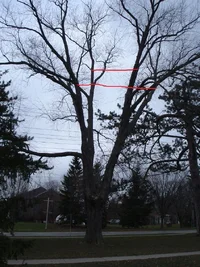
This is the tree. Decent size Silver Maple in a busy spot. Lots of pedestrian and vehicle traffic, hydro, as well as an important part of the landscape.
DSC01764.jpg


Here is the problem. North side of tree:
DSC01757.jpg


South side:
DSC01756.jpg


Close up on South Side:
DSC01755.jpg


Both stems at the base are near 36" diameter. The cavity on the north side doesn't go anywhere and is actually fairly shallow. Considering that limb was removed about 15 years ago I'd guess it is well compartmentalized. The South side cut was made about 8 years ago after that limb failed around 5 feet out. There's lots of calous growth arond each cut, although the canopy didn't look all that vigorous this year.
Removal is always a last option but looking for preservation strategies here.

Thoughts? Ideas?
Thanks in advance for the input!
 
I'd guess that there is a significant decay column from those two cuts, they seem pretty close. I'd first try to find out how bad it is before going any further.

Do you have access to a tomograph or resi? If not maybe just a drill with a small bit could give you some decent info.

I don't see how cabling can help in this situation, unless I'm missing something.

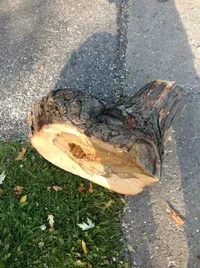
I attached a pic of a silver maple we took down this year that had some big pruning cuts on the trunk. Never tought that there woul be that much decay...
 

Attachments

  • 342777-photosilver.webp
    342777-photosilver.webp
    52.7 KB · Views: 127
R & R is for sure the end result here, just not yet.
I've been instructed to keep the tree as long as possible, but just how to do that best is all on me. I've got the luxury of keeping close tabs on all my patients though, so I can live with situations longer than alot of other people could.
Judging by the vigour I'm expecting this tree to simply stop pushing leaves before there is a major failure in that crotch. I am planning on installing two 8-ton Cobra cables as a fail-safe for the time being. Not for actual support but more like a catcher/redirect if there was a large tear out.
I really didn't want to add steel into the mix because I'm guessing I could be acting against the reaction wood here. Or not. I was also considering a short rigid cable down low - maybe ten feet above the crotch, hopefully far enough away from any decay column, just to add extra static support.
Maybe a hybrid steel/cobra situation?
All just ideas floating around...

Sean, nice to see you back here! The roots are looking pretty good from the little I've been able to expose and inspect. I'm quite condident in the root plate stability.
I'm always a little hesitant to go in drilling though. However, with the long term prognosis it's probably not a big deal anyways. Where do you see best for drilling?
 
Hub and spoke, all steel, at two thirds up the tree.

Looks like 4-5 cables and a ring.

1250 installed.

jomoco
 
Now there is a guy commited to this project. He`s even selling it!
jamminz.gif

That`s a decent bid but I think you are going to lose your shirt in travel time...
grin.gif
 
I have greatest success with crown reduction based on deflection and sounding and cabling if warranted.

Fom where We sit looks like 3o to 40% crown reduction.

I avoid steel in Silver, the in line pull may be to much if rot is faster than new wood growth.
 
[ QUOTE ]
the in line pull may be to much if rot is faster than new wood growth.

[/ QUOTE ]agree if rot is advanced but that does not seem likely here. however the "shallow" appearance of the one wound may be deceiving. use a bbg skewer in cracks to learn more.

2 cables crossing 3/16" EHS steel with wedgegrips, <$1000 steel may lessen adaptive growth but does not shut it down; that is a myth.

i'll be in niagara falls for valentines day; less travel than jon! Give me the word and I'll pack the gear.

R&R? this is a really straightforward case for support.
 

Attachments

  • 342905-silvermaplecable.webp
    342905-silvermaplecable.webp
    154.4 KB · Views: 35
maybe not, please consider the RISK, with so much traffic in the potential LZ.. I just don't trust silver maple with large areas of decay. When those two columns of decay merge, what good will a cable do? the whole top could go in any direction.

Its one thing if some backyard tree is threatening the house or pool or landscape, BUT and entirely different natter when human life is at risk.. it is simply not worth the risk.. What do we do as arborsits that is more important than protecting human life? NO WAY to save that tree without an consulting arb report after measuring decay. Its a much higher standard when a tree has the very real potential to kill.

If I was to "buy some time", I would make large reduction cuts, 6-8" cuts throughout the entire canopy, top and sides, making cables somewhat unnecessary.

Too bad the guy that made the last cut never read your article on pruning after storm damage Guy... If he had, he would have left a stub, cut just below the rip and it would take many years for that decay to reach the main stem.. THAT would be straightforward...
 
"maybe not, please consider the RISK, with so much traffic in the potential LZ.."

how much traffic will be out in major storms?

" I just don't trust silver maple with large areas of decay. When those two columns of decay merge, what good will a cable do?"

When will this merger take place? 2 years? 20? YOU DO NOT KNOW.

" the whole top could go in any direction."

So your crystal ball forecasts failure *below* the fork? do you not think there would be adaptive growth in all this time?

"Its one thing if some backyard tree is threatening the house or pool or landscape, BUT and entirely different natter when human life is at risk.. it is simply not worth the risk.. What do we do as arborsits that is more important than protecting human life? "

Human life is always at risk, so what are you saying?

"NO WAY to save that tree without an consulting arb report after measuring decay. Its a much higher standard when a tree has the very real potential to kill."

every big tree has the potential to kill. What are you saying? we are both just guessing.

"If I was to "buy some time", I would make large reduction cuts, 6-8" cuts throughout the entire canopy, top and sides, making cables somewhat unnecessary."

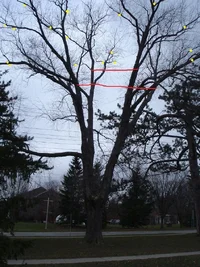
And what is your prediction on decay from these cuts meeting the decay at the fork? Quick, fast and in a hurry. This strategy would increase your liability exponentially. Reduction cuts could be done where the yellow dots are. Big lessening of load that way.

"Too bad the guy that made the last cut never read your article on pruning after storm damage"

How do you know those cuts were made after a storm? they might have been made for any reason, or no reason. They were collar cuts, aka proper pruning, what could go wrong?
crazy.gif
 

Attachments

  • 342934-tbsilvermaplecablePRUNE.webp
    342934-tbsilvermaplecablePRUNE.webp
    154.6 KB · Views: 66
Would it be possible, in a case like this, that cabling wuld put MORE strain on the weak point (the area of decay wherr the two cuts meet)???
 
Guy,
I like your yellow dots, so maybe 6-8" cuts recommended was a little extreme.... BUT MY GOD.. did you really write the below..

how much traffic will be out in major storms?

That's ridiculous.. you see the road and pedestrian walkway... can you not see the difference in risk between this tree and a backyard tree in a residential neighborhood?


What are you saying? we are both just guessing.

NO we are not.. you're guessing, I AM insisting on measurement of the decay from a consulting arborist... The whole point is not to guess with so much at risk.


So your crystal ball forecasts failure *below* the fork? do you not think there would be adaptive growth in all this time?

With such large wounds, its only a matter of time before the decay destabilizes the tree.. even with extensive pruning, the tree is history in the long run.. adaptive growth can't hold the size of top needed to keep the tree sustainable.


How do you know those cuts were made after a storm? they might have been made for any reason, or no reason. They were collar cuts, aka proper pruning, what could go wrong?

The OP states that the most recent cut was made after the limb failed about 5' from the trunk... do you really think that was a proper collar cut? NFW... even by Shigo's standards.. The callous growth does not circle the wound... it clearly would have been better for the tree to leave the 5' stub, trim the rip, and hope it re-sprouts... Unbelievable, to argue with you about something I learned from you.. LOL


[ QUOTE ]
"maybe not, please consider the RISK, with so much traffic in the potential LZ.."

how much traffic will be out in major storms?

" I just don't trust silver maple with large areas of decay. When those two columns of decay merge, what good will a cable do?"

When will this merger take place? 2 years? 20? YOU DO NOT KNOW.

" the whole top could go in any direction."

So your crystal ball forecasts failure *below* the fork? do you not think there would be adaptive growth in all this time?

"Its one thing if some backyard tree is threatening the house or pool or landscape, BUT and entirely different natter when human life is at risk.. it is simply not worth the risk.. What do we do as arborsits that is more important than protecting human life? "

Human life is always at risk, so what are you saying?

"NO WAY to save that tree without an consulting arb report after measuring decay. Its a much higher standard when a tree has the very real potential to kill."

every big tree has the potential to kill. What are you saying? we are both just guessing.

"If I was to "buy some time", I would make large reduction cuts, 6-8" cuts throughout the entire canopy, top and sides, making cables somewhat unnecessary."

And what is your prediction on decay from these cuts meeting the decay at the fork? Quick, fast and in a hurry. This strategy would increase your liability exponentially. Reduction cuts could be done where the yellow dots are. Big lessening of load that way.

"Too bad the guy that made the last cut never read your article on pruning after storm damage"

How do you know those cuts were made after a storm? they might have been made for any reason, or no reason. They were collar cuts, aka proper pruning, what could go wrong?
crazy.gif


[/ QUOTE ]
 
1. Install 10cm layer of finished compost in an area 4-5m radius from the trunk. Till into existing soil via compressed air tool.
2. Install 15cm layer of partially composted wood chip mulch atop the above 4-5m ring.
3. De-compact soils to 30% beyond dripline radius via aeration/vertical mulch with compressed air tool. Back fill with finished compost/sand blend. (depending on exisiting soil conditions)

The above will invigorate root growth and development, add root fertlising if you wish, though not critical. Sprouting and retrenchemnt will be best acheived with vigourous root growth.

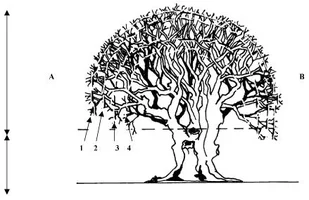
4. This winter, perform 3-4m canopy reduction. Spring response and flush should be favourable.
5. Cable supports - steel or cobra - whichever floats your boat. Under my 'banner' i would opt for steel only because most local 'expert witnesses' likely to be hired under litigation circumstances are inclined for steel. 4-5 hub and spoke legs.

Generally adopt a program of reduction over 15 years. Forcing the tree to sprout/retrench. In 25 years it would be possible to have the canopy height so low that the 'lever arm' is short enough that an extraordinary level of force would have to be employed to obtain bending moment necessary to cause stem failure.

A nice split rail cedar fence around the dripline would assist with risk abatement to the public. Eliminate grooming & mowing endeavors in this area and create a native wild flower garden area that requires minimal maintenance.

Our firm is about 1.5 hours away and willing to assist - though Full Circle TC would be a great company to work with on this one too. If more diligence is required Urban Forest Innovations would be available for Sonic Tomography and/or SIA if UofG were interested.
 

Attachments

  • 342957-Retrenchmentpruning.webp
    342957-Retrenchmentpruning.webp
    25.1 KB · Views: 43
NICE!...
Sounds Great if you can get it!

What's the price tag on that?

[ QUOTE ]
1. Install 10cm layer of finished compost in an area 4-5m radius from the trunk. Till into existing soil via compressed air tool.
2. Install 15cm layer of partially composted wood chip mulch atop the above 4-5m ring.
3. De-compact soils to 30% beyond dripline radius via aeration/vertical mulch with compressed air tool. Back fill with finished compost/sand blend. (depending on exisiting soil conditions)

The above will invigorate root growth and development, add root fertlising if you wish, though not critical. Sprouting and retrenchemnt will be best acheived with vigourous root growth.

4. This winter, perform 3-4m canopy reduction. Spring response and flush should be favourable.
5. Cable supports - steel or cobra - whichever floats your boat. Under my 'banner' i would opt for steel only because most local 'expert witnesses' likely to be hired under litigation circumstances are inclined for steel. 4-5 hub and spoke legs.

Generally adopt a program of reduction over 15 years. Forcing the tree to sprout/retrench. In 25 years it would be possible to have the canopy height so low that the 'lever arm' is short enough that an extraordinary level of force would have to be employed to obtain bending moment necessary to cause stem failure.

A nice split rail cedar fence around the dripline would assist with risk abatement to the public. Eliminate grooming & mowing endeavors in this area and create a native wild flower garden area that requires minimal maintenance.

Our firm is about 1.5 hours away and willing to assist - though Full Circle TC would be a great company to work with on this one too. If more diligence is required Urban Forest Innovations would be available for Sonic Tomography and/or SIA if UofG were interested.

[/ QUOTE ]
 
Guy,
Thanks for the input. I was hoping you would chime in here!
I'd be happy for the visit in February, you're always welcome, although I'm sure I'll do the work myself long before that.

Same goes for you, Mangoes.
Thanks for the referals and they're good ones at that. Both are good friends and have consulted here before.

Daniel,
You might want to be hesitant throwing stones from your glass house. I'm sure there are cuts you've made a decade ago that you might have made differently today.
 
how much traffic will be out in major storms?
That's ridiculous.. you see the road and pedestrian walkway... can you not see the difference in risk between this tree and a backyard tree in a residential neighborhood?"

Yes there is a difference but it is nothing to panic about.


" I AM insisting on measurement of the decay from a consulting arborist... The whole point is not to guess with so much at risk."

The practice of Tree Structure Evaluation based on measuring decay and using formulas is fraught with error. "Voodoo" in the words of one guy who sells resi and tomo eqpt.

"With such large wounds, its only a matter of time before the decay destabilizes the tree.. even with extensive pruning, the tree is history in the long run.. adaptive growth can't hold the size of top needed to keep the tree sustainable."

Pure guesswork, based on misunderstanding of thigmomorphogenesis.
tongue.gif
Listen to the other replies here re pruning.

"The OP states that the most recent cut was made after the limb failed about 5' from the trunk."

o my bad i missed that. Then that cut on that leader was most destructive; unfortunate. But jumping to the conclusion that the wound will be fatal shows a lack of familiarity with standard mitigation options.
And your call to refer this to a consulting arborist AS IF they had all the answers is um a bit overoptimistic.
blush.gif
The others here sound like they have confidence in their work and no such attempted dumping of liability is needed for them.

Most local consultants prefer steel? That UFI guy won't want to hear that...
frown.gif
 
[ QUOTE ]
Most local consultants prefer steel? That UFI guy won't want to hear that...
frown.gif


[/ QUOTE ]

The UFI guy would be in my corner under litigation circumstances, so long as there wasnt an installtion/workmanship error. (my guys are awesome, but human) The UFI guy is a great friend and mentor.

There are many local consultants who understand dynamic support application. But if i smell litigation potential, i would opt for steel, because most local consultants willing to work litigation cases are biased against.
 
[ QUOTE ]
[ QUOTE ]
Most local consultants prefer steel? That UFI guy won't want to hear that...
frown.gif


[/ QUOTE ]

The UFI guy would be in my corner under litigation circumstances, so long as there wasnt an installtion/workmanship error. (my guys are awesome, but human) The UFI guy is a great friend and mentor.

There are many local consultants who understand dynamic support application. But if i smell litigation potential, i would opt for steel, because most local consultants willing to work litigation cases are biased against.

[/ QUOTE ]

Agree with that approach, sure. Pondered the universe of Hong Kong from the 16th floor w UFI guy the other night; good to have friends and allies in all places possible! I prefer steel in most applications but try hard not to let that bias me. Seen a whole lot of cobra here in HK doing the job.
grin.gif
 
I'd love to be a lawyer bringing suit against Cobra in a court of law.

Mr. Cobra, can you please explain the logic behind cabling a tree with a material weaker than the tree?

Isn't the reason traditional cabling systems of steel are used because they can withstand forces capable of destroying weaker materials?

Jomoco
 

New threads New posts

Back
Top Bottom