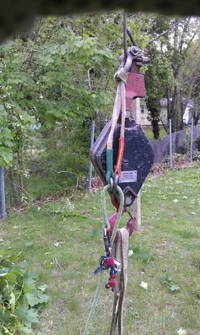
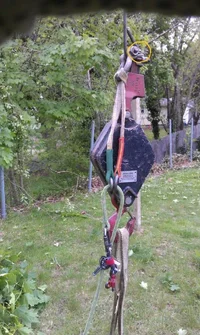
Pix of your crane tie in method

On another note. This is a good reason to use a set up similar to these shown verse tying directly into the hook with the rope. Imagine if that wear was on the hook itself were there are big loads on it.I dont mean a shackle or ring in the hook just rope on hook like the old days.
The same wear from ropes is seen at rock climbing biniers too.
 
[ QUOTE ]
On another note. This is a good reason to use a set up similar to these shown verse tying directly into the hook with the rope. Imagine if that wear was on the hook itself were there are big loads on it.I dont mean a shackle or ring in the hook just rope on hook like the old days.
The same wear from ropes is seen at rock climbing biniers too.

[/ QUOTE ]

Good point Mark. As a matter of fact, I know some old school crane guys who still tie in to the hook and you can see the groove in it. It's only slight and I know that they monitor it and replace the hook as needed.
 
I've tried tying off above the ball, and it sucks big time, because each time you tension your pick, everything above the swivel spins, making your climbing line above the ball into a weedeating tangled mess.

I use two 3/4 clevis' locked onto the main hook, that has a locked heavy duty gate. One clevis holds rigging, the other my climbing line with leather tube CS.

It aint ANSI approved, neither is it OSHA apporoved. Maybe that's why it works so good?

jomoco
 
[ QUOTE ]


I use two 3/4 clevis' locked onto the main hook, that has a locked heavy duty gate. One clevis holds rigging, the other my climbing line with leather tube CS.


jomoco

[/ QUOTE ]


another great way to tie in.

buzzard approved.
 
[ QUOTE ]
I've tried tying off above the ball, and it sucks big time, because each time you tension your pick, everything above the swivel spins, making your climbing line above the ball into a weedeating tangled mess.

I use two 3/4 clevis' locked onto the main hook, that has a locked heavy duty gate. One clevis holds rigging, the other my climbing line with leather tube CS.

It aint ANSI approved, neither is it OSHA apporoved. Maybe that's why it works so good?

jomoco

[/ QUOTE ]
Although not yet approved I think this is a very good system that should be approved. It addresses all safety concerns and the one thing I like better about this vs the above the weight attatch ment is the hook does not tilt out of plumb like on some of the smaller size cranes have.
 
ANSI's point of view has to consider the clowns with cranes out there that have no gates whatsoever on their hooks muchless a positive locking gate.

And you know if they let tying onto the hook as I do into the regs, it's just a matter of time before some fool gets confused and traps his climbing line under a rigging line/clevis, cuts it in half upon tensioning the pick, and falls to his death.

However, explicitly stipulating that all hooks have positive locking gates, and that all clevises on the hook are locked, and that the clevis used for your climbing line is used for that purpose exclusively, would make for the best and safest crane tie-in, in my opinion. Cranes have swivels for a very good and specific reason, to keep their loads from spinning when lift is applied to the pick.

Most rental cranes have 150 lb balls that have been bounced around on concrete and asphalt enough to roughen them up to the point that I would never let my climbing lines near them when spinning.

Just remember, it's your life on the line, everytime.

This tying off above the ball looks good in magazines, but in reality sucks big time on the job.

I'm totally fanatic about setting and tensioning each pick, inspecting it from clevis to clevis, before dropping down and pulling my climbing line from the hook/clevis. And yes I've changed rigging lay quite a few times when it don't bite just right upon tensioning.

The guys on the ANSI committees deciding this stuff have my sympathies, and hopes that some day soon they'll get it 'just right'.

jomoco
 
[ QUOTE ]
I've tried tying off above the ball, and it sucks big time, because each time you tension your pick, everything above the swivel spins, making your climbing line above the ball into a weedeating tangled mess.

jomoco

[/ QUOTE ]

I would like to point out that the spinning of the crane load line and ball, like a weedeater, will depend on the crane and the type of cable on that crane. I have worked off both types and you are absolutely correct about the type that spins... it sucks. Tying in the way you discribe is a great solution.
On the other hand if you get a crane with the "good" cable it does not spin significantly and tying in above the ball has its advantages.
On a side note I'm glad I'm not the only one that hangs out at the rigging until the slings are tight. I didn't once, and it bit me in the azz. If I hadn't got EXTREMELY lucky I wouldn't be here today.
 
[ QUOTE ]
Jomoco, Please dont call it a Clevis. Thats my brothers name and he earned it when he was born back in 1992. Call it a shackle thank you.

[/ QUOTE ]
We better stop calling the load line a cable too then. Its actually a rope
 
[ QUOTE ]
[ QUOTE ]
Dave,
The concave wear allows the rope to seat fine in the shackle. As far as wear goes, even if it was worn 75% of the way through, we’re talking about a 17,000 lb shackle! That would still give you 4,250 lbs of strength that would be more than enough to climb on, though obviously no one would do that.


[/ QUOTE ]The rope should fit nice in it since thats what wore it in. I dont think it makes the rope work any better with the grove.
75% wear does not mean 75% strength loss. My point was not that it would break at the point it is at. It was that it would fail an inspection.
If you were to use the above #s a 17k shackle new would break at 85k# if that were reduced 75% it would break at 22k#. still above 5K...If your talking tons just insrt ton for #
For the cost of the shackle I would replace it. 5000 hours/4 years. I would say you got your money worth.

Im not trying to be arguementative. Just pointing out the regs. and my opinion.

[/ QUOTE ]

Your right mark, its not cost of replacement. I would replace it in a second if I thought there was any issue. Chris is right, the rope does wear better on a round grooved channel then it does on the shackle alone, it seems to not flatten the rope as much when loaded. It seems like that lines last longer than they used too, its also nice because the climbing line has worn a few of the letters of “Crosby” off the shackle so it has a smoother surface to run on.
The first company I worked for just had an aluminum carabineer clipped thru the Becket, the climbing line rubbed the side of the ball really badly and the line would frequently get tangled around the ball, they ran that thing till it was literally half worn thru. The operator that taught me used to tie into a chain link welded to the boom tip. He would sit on the ball and ride to the tip and tie in each pick. Its scary when you look back at how things used to be done, sort of puts it into perspective when we start nit picking “safety issues” that are really no issue at all.

As far as the line getting tangled around the ball from tying in above the hook, we run anti rotational wire rope so we very little if any spinning of the ball. I have worked of cranes with standard wire rope and I just rigged my attachment point so that the ball could spin independently of my shackle
 
[ QUOTE ]
Its scary when you look back at how things used to be done, sort of puts it into perspective when we start nit picking “safety issues” that are really no issue at all.

[/ QUOTE ]

Dave, I could not agree with you more.
 
Not on this computer Tony.

But when you place two locked 3/4 clevises onto the crane hook and then lock the hook's gate, there's no way that the rigging on one clevis can damage your climbing line on the other clevis.

I love being able to point the gate side of the hook at the pick, tension the pick, double check the bite and lay relative to the COG, drop down, lanyard in, pull my line from the hook, reset it as an emergency escape route, then make the cuts.

Roger spoke of his crane op having his release cuts backwards, resulting in pinched saws etc.

My technique for vertical spar release cuts using a crane almost never varies. Imagine a clock face as the top of the spar, and we're looking down at it, the crane whose center pin I'm aiming at, is at 12 O clock. That's where I start my cut, with the crane behind me, I will start the cut at 9AM, cut through 10, 11, 12, 1, 2, and 3pm, Now the spar is cut exactly halfway through, without ever taking my saw out of the cut, I continue cutting clockwise around the spar until I'm at 8am, at which point the spar has been cut 11/12ths through, and I check with the CO to ensure he's ready at the 12 Oclock center pin. I'm cutting at the 9am spot on the spar now, 90degrees off the crane when the pick releases as I complete the 8am to 9pm release cut. The choker is set at 6am on the spar of course, and if the COG/boom tip/pulley is about 2 feet behind 12 Oclock on the spar, it sends the pick towards the crane's center pin everytime, with no binding or pinching whatsoever. Of course I'm talkin fat walk around spars between 36-60 inch DBH.

jomoco

 
[ QUOTE ]
Jomoco, Please dont call it a Clevis. Thats my brothers name and he earned it when he was born back in 1992. Call it a shackle thank you.

[/ QUOTE ]

Almost spit water on my comp screen @ this!
 
My crane op. said he heard that tying to the load line in anyway is no longer acceptable. I have always used a safety shackle on the load line above the ball he apparently was told that we need to have something that hangs on the top of the ball below the pin and not on the load line. Has anyone else heard this? I guess he was told that he would be fined if he was caught allowing me to tie into the load line. This kind of sucks because a clevis shackle doesn't really fit well around the top of the ball. I think I would have to get a giant ring or something, any thoughts or opinions?
 
Bill,

I do not remember the exact verbiage and it's way too early on a Sunday morning to look it up!

But your tie in looks fine to me. I would have no issues using it. By getting it down close to the becket like that it is less likely to be pushed up the line by brush and what not.

Tony
 
[ QUOTE ]
let me try that pic again

[/ QUOTE ]

that retention pin gets caught on a twig it could easily come out and not be noticed. Things could get ugly fast.

328420-328395-IMAG0361.jpg
 

Attachments

  • 328420-328395-IMAG0361.webp
    328420-328395-IMAG0361.webp
    190.4 KB · Views: 75

New threads New posts

Back
Top Bottom