moss
Been here much more than a while
- Location
- Carlisle, Massachusetts, U.S.
Excellent Tom, lightning didn’t ring true which is why I was puzzled.

Follow along with the video below to see how to install our site as a web app on your home screen.
Note: This feature may not be available in some browsers.
Where’d the bark along the crack go?
Many a tree tries to close a frost crack year after year, and some succeed, some keep trying, and some have necrotic tissues adjacent to the frost crack.Where’d the bark along the crack go?


More reasons to make that switch to whiskey:...., then @JD3000 injected it with 47 different exotic, imported beers, and then it froze the following winter and ....

I agree. However, the term doesn't have consistent use. I've seen it used as a synonym for sunscald from respectable sources. From a Michigan State publication:Frost crack can occur on other sides of the tree sk is not synonymous with sunscald/sw
Frost in your crack is not the same as a frost crack... Pull your pants up!I got a little of that frost crack shoveling snow off my truck, today.
Move aside Shigo!!Ok, I think I know what happened. First, it got caught in a rainstorm and swelled up like an over-ripe cucumber and then @moss built a campfire on the south side of it and dried it out, then a woodpecker got his beak stuck in it and tried to pry the crack open with a crowbar (which he obviously borrowed from some nearby crows) and 1000 monkeys climbed it with 1000 typewriters so they could write some Shakespear, and then a clown car pulled up and a buttload of evil clowns built a trapeze in the thing for the fat lady with tattoos, then @JD3000 injected it with 47 different exotic, imported beers, and then it froze the following winter and was struck by an out of control government worker in a 6X truck, who only came there to cordone off the area as a possible crime scene and to put up some signs that said, "Forest closed due to clown infestation", then @Tom Dunlap's weird friends with an unhealthy fascination with the North Shore came along and held some kind of strange May Day festival around the tree, and an elephant climbed most of the way up it and tried using it for a pogo stick, and @oldoakman used it to practice his big swings into the adjacent trees (most of which he knocked over) and then the tree farted out its giant trunkcrack and accidentally ignited 5000 cow farts when a spark from @moss's campfire, which for some strange reason was still burning, ignited the fart gases and the tree's trunkcrack couldn't handle the sonic vibrations and split the whole way up the tree, causing climate change and political unrest throughout most of the known world. There, now you know. Case closed. Next pic, please.

I have seen a lighting track that looked similar to this on a hardwood, however they usually have a little scalloping/unevenness along the length which would make it a little rarer.If this tree is inland from the lake it will be elevated about 50-100' above lakeshore. In the summer that is the difference between swimming and pants and jacket. In the winter it wouldn't be a surprise to have stretches of several days with highs barely in single digits and possibly -30* F or colder nights.
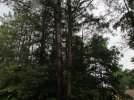
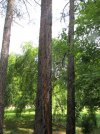
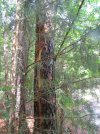
My eyes see frost crack. All of the lightning struck trees I ever worked on had splintered wood inside and more irregular edges like what might look like split American Elm. This looks like smooth grain splits like I've found when splitting aspen for camping in the Arrowhead.
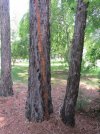
The blackening, to my eyes, is decay micro organisms not charred wood. Charing always seem to wash away soon. this is so uniform and complete.
No wrong answers because no one can eyeball the tree.
This came from a Facebook query. There are about 100 replies. When I posted I included a link to frost cracking. During the course of the thread another arbo who has lived up there for his whole life agreed with me. When the OP read about frost cracks and our comments he agreed. Several others 'liked' our responses and some weighed in with thoughtful a
It was interesting reading the replies, which lead me to think about the two camps, lightning or frost cracks. Like too many facebook threads it seems like there are many people who guessed lightning. My guess is that this is the only thing they might know about. How many homeowners would know what frost cracks are if they were given the diagnosis? I rarely had any that did. Almost all of the time cracks to homeowners were blamed on lightning. After an explanation they could understand what cracks were.
ONe guy replied that he was hiking during a storm and saw an aspen on the trail get hit by lightning. Totally freaked of course! He said that the lightning crack was ragged not regular like in the pics.
The feeling from the thread, for me, was like in a friendly political facebook thread. Two camps. And so many that bring an opinion based on what they know but don't take time to read or learn. A buddy of mine in my neighborhood is on the rump side of politics. We agreed to not go deep on politics to keep from wrecking things. Neither of us tries to convince the other. We do share some views and reading material for knowledge not necessarily for persuasion. WE both have learned from the other.
My picture based diagnosis: Frost crack