Oak tree report has me ""stumped"

baumeister

New member
image.webp note from a summary an article from Dr. Francis' . "

A tree’s vitality and reserves are key factors in a prog- nosis, so as always our first task is to make trees stronger. By knowing more about fungal strategies, the arborist can make a better diagnosis and can more confidently manage a tree. " Guy Mayor.

This is exactly what has caused me to struggle over this particular tree.

Here is a summary. : a good one for detective dendro I would be happy to write. Maybe he can give me some insight. ;).

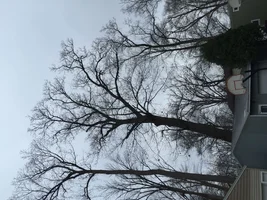
Subject. Quercus rubra. 205 inches circumference. (the larger tree in the center of the photo).
I have a large oak over 60 inches dbh with hen of the woods in between the root buttresses, ganoderma on the trunk ( both at the base.) And a Slight lean. These factors have cause me to be very concerned and I recommended a reduction. (Before my Francis visit). I went to do the reduction and found a large decay column in the trunk at 45 feet. (After my Francis visit). It is An old branch wound maybe 6 inches in diameter. that is open into the trunk with about 60 % decay evenly inside the trunk. Your typical squirrel / raccoon home. in the past 2 years the tips of the tree have started to naturally reduce themselves. At this point I decided not to invest in the reduction until I share the additional finding of the decay column and further assess the tree. Overall vitality of the tree is very good. Wound wood and reaction wood is also very good. Predominant wind direction is south. Tree lean is to the south so predominant winds push the tree against the lean. A large ash that was a significant protector from northeast winds has died (eab) opening up a potential for the following: oak in full leaf, heavy rain, a downdraft wind event out of the northeast and either a root zone failure or trunk failure at 45 foot weak spot. Both would result in complete destruction of target area being two garages with occasional occupancy. I saw a bed in the top of one of the garages. The association told me they do not allow people to sleep in the garages. I have done a basic tree risk analysis.

I have not sent anything back to the client yet. I need to go back to the site and do more investigation and documentation. I do not want to condemn the tree and my report puts it at moderate to low. My gut fears a failure. I am at a standoff. Any thought from you folks would be greatly appreciated.
 
Last edited:
If your gut it telling you something that your report is not then you do have a problem.

More investigation needed for sure. A level two (Visual tree assessment) appears to be inadequate in this case.

The first decision is what is your assignment and do you have enough of a budget to do a good job. Next you have to decide is fracture of the base or fracture at the racoon hole most likely or do both sites need thorough investigation.

What about use of tomograph, resistograph, electrical impedance, fractometer to test for shell wall, extent of decay, and wood strength. If you do not have these tools then do you need another consultant on the job? You have already indicated that your VTA does not match your gut (which some will say is the subconscious boiling of your knowledge and experience) so you need to do more.

At the base you need to also consider how much of the hen of the woods there is (% of circumference), is it connecting under the root buttresses, and where the Ganoderma is in relation.

Can you use some of the modelling applications to see how your findings impact the stability and fracture strength. This may help to inform you more.

All this being said you need to consider what wind speed you are do the risk analysis for, what is the likelihood of those speeds occurring, from what direction and where the fractured components are most likely to land. Then what is the target.

Place everything into a honest report along with your findings of vitality (or vigour?) and let the customer make some decisions. If you are not being paid for at least 4 hours of work then you likely cannot do this investigation and report as a money maker. You either complete it at a loss and provide the info thoroughly, objectively and unbiased or you provide inadequate info and analysis because you are rushed (the lack of payment is one of the main reason most tree cutters always conclude a report with tree removal).
 
Well, I am basically doing $150 basic treee assessment report. And that I am pretty much providing to the client at no cost. I do intend to go out to the tree one more time I'm going to be in the area anyways because of my "labor of love". Your info has given me great insight. What I will include in my report is a cost comparison of removing the tree and having some type of tomography done to it to identify exact decay columns.

Do you know anyone in my area with sonic tomography capabilities or any other noninvasive method?
 
Disclosing limitations and focusing on mitigation seems like a more honest approach.
YES!! I totally agree

I want to focus on mitigation and disclose limitation, but I fear that disclosing the limitation in this case is going to cause them to cut the tree down because they can't handle the risk. So I intend to do further research into exactly what condition the tree is in so that I can be as accurate as possible in my limitations.
 
The first three observations would force me to study root flare and zone. Test pull in multiple directions and/or observation during. Moderate to high winds.
 
To me, the sticking point in this is the budget as MrTree pointed to. Your basic assessment at a budget of $150 has gleaned sufficiently a report. That being that further indepth analysis is required to provide a prescription. That your initial assessment isn't conclusive is due to the limitations created by the budget and the methodology that it affords.

Imagine you go to a doctor and he does the usual basic physical. The results leave him undecided as to your health and what he might recommend or prescribe. What would you want him to do? Suggest surgery or more tests?
 
Honestly I think the analogy has missed the mark completely. Patient obviously has a broken leg. What needs to be done? Quick study and repair. Reduce load on the leg, removal of the leg, what have you.
 
:sir::astronauta::sir::sir::sir::sir::sir:
Honestly I think the analogy has missed the mark completely. Patient obviously has a broken leg. What needs to be done? Quick study and repair. Reduce load on the leg, removal of the leg, what have you.


Equally applies to the I individual contributing to global over population.

"Hey Doc, have 4 kids,thinking a vasectomy is due?"

Tests (testes?) and evaluation? Or schedule the appointment?

Just kidding!!!
 
How exactly do you test pull a 205 in circumference tree (80in diameter)?

You cannot do this by hand and even in high winds you may not gain much info. Certainly as far back as 2004 there was discussion of determining root plate stability and its difficulty in the easily accessed arboriculture literature. Since then 'pull-testing" has been used by some people to describe pulling of a crown with a rope to see movement etc. in the trunk. This is all well and good but I very much doubt pulling by hand on a 100 foot, 3 foot diameter oak is going to tell you too much. The forces you apply are nothing in relation to the forces the tree has withstood in the last couple days, let alone year or decades.

Testing using elasto-inclino methods (i.e. static integrated pull tests) are essentially unavailable in North America with only one or two people owning the gear and expertise to do it. While the system has intellectual merit I am not sure it has much practicality for most arborists.
 
I am doing it. It's relatively easy.
My goal is to save trees. I learned to do it.
If you are truly interested in the same, you would find a way.
You can do it!
Do or do not. There is no try!

@Mangoes
The problem with over population(sorry I hav no solution) isn't over population, it is over population of negative contributors.

Happy trails and happy Sunday:)
 
IMHO The problem with pull testing this subjec is the hollow trunk at 45 feet. To evaluate the base with a pull test would put stress on that point. I don't need to test that point with a pull test. I can do that visually first. Putting the anchor below this point doesn't seem practical, so my curiosity is raised. Would you be so kind to enlighten me on the process you see plausible for pull tests rope shield. I will be happy to add any tools I can to my toolbox when I return to this tree after the holidays.
 
Pull test will establish the weak link ie the cavity or the base. If you can add one more observation why wouldn't you. Feel or see the deflection.
ROCK IT!
 
"Patient obviously has a broken leg. ". Does it? I dissagee. Patient has a leg, I am trying to find out if he has an issue with the leg. If I knew it was broken, this would be an easy diagnosis, right?
 

New threads New posts

Back
Top Bottom