Oak Removal - I need your help

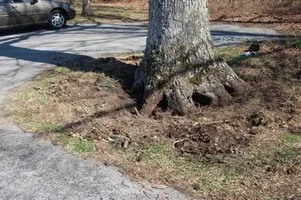
The root zone. It's been a hard life...Time to die with dignity?

271970-DSC_0062.jpg
 

Attachments

  • 271970-DSC_0062.webp
    271970-DSC_0062.webp
    36.8 KB · Views: 26
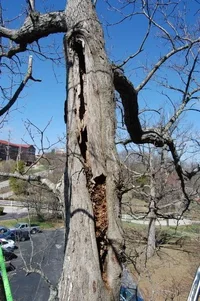
One of the two leaders. Lightning strike? There are the remnants of a broken out 8" diameter leader above it. Nice home for squirrels.

271972-DSC_0044.jpg
 

Attachments

  • 271972-DSC_0044.webp
    271972-DSC_0044.webp
    74.2 KB · Views: 27
I wouldn't be holding on to that tree if it was under my care, based on all the photos and description. Hopefully you can help the campus establish (or at least enforce) tree protection guidelines for construction around trees. Thanks for the photos and followup.

jp
grin.gif
 
Nice work. re trunk damage, that's a wound from a codominant stem tearing out, aka a codom tearout. Not lightning, but not good either cuz it leads to heartrot every time.

Good work not bothering the living roots too much. yup, that's a hollow tree, but it is leaning away from the target. If it could fall toward the parking lot only in severe weather, what is the likelihood that a person would be there then? Pretty slim. All this is just part of rating the target. Do they drive BMWs, or Kias?

Those bug holes look like they are just in the bark, and not a pest. Was there fine brown dust around there? Did the sounding test with the mallet show any patches of dead bark, or just give hollow sound from the interior decay? Are all the existing buttresses still alive on the outside?

I don't see any aggravating factors to go with the slight lean and the hollow. Until any evidence shows up, it looks like you could clean, and reduce it by 10%, and monitor.
 
The tree may be leaning toward the woods as a whole. This might lead a person to believe that if the whole tree failed it would fail in that direction (away from the cars). However, what if just one leader broke out. How about the leader he photo'ed that shows the extensive decay. Looks like that leader would fail straight towards the cars in the photo. Are you really suggesting that a smashed Kia might be acceptable but a smashed BMW might not be acceptable? Tell that to the Kia owner. I haven't seen the tree in person, but I'm gonna go out on a limb here and say turn that tree into a pile of chips. Not my call, but in my world it's not worth the risk of failure or the money required to babysit it for the next however many years. Plant a few more trees on campus somewhere else. Pull test if you want. Might tell you something, might not. If it doesn't, you still have a decision on your hands.
 
[ QUOTE ]
Are you really suggesting that a smashed Kia might be acceptable but a smashed BMW might not be acceptable? Tell that to the Kia owner.

[/ QUOTE ]

He's likely saying a Kia owner would be an acceptable risk while a BMW owner not being one.
grin.gif


That tree needs to go!
 
Looks like you are doing a good job on data collection, and considering and seeking experienced advice/ instruction on this tree.


Looks like limbs attached to the decayed top would overhang the parking spaces themselves. Is this the case?

I'll bet an expensive BMW will be fully insured, whereas a cheap, beater Kia would not be as likely. People have to be in the cars to park them. People are not so easily fixed or replaced. The barely getting by college student, paying their own way, might not be able to get to their off-campus job, or commute without their beater Kia. I would think that falling on the Beemer would be better in some ways.


Is this a species that has occurance of summer limb drop? Is this aggravated, neutral or helped (lighter core) by decay?


Guy, its great to be the advocate for the trees. I suspect, and might be wrong here, that part of you is the devil's advocate pushing people to thoroughly examine the risk factors and options, rather that just say "there's mushrooms on a large tree, should I recommend removal?" without really looking into it.

What do you think of the legal implications if this tree failed and killed or permanently disabled someone, especially after intervention (10% reduction and monitor)? I would bet the lawyers would have a field day with it, especially since someone is paying a ton of money to attend the school.


I thought co-dominant tearout. Looks like the top of the cavity has the trunk bark ridge. Is this a spiral grained tree? From what I've seen (and we don't get much lightning here), spiral lightning scars are generally much narrower. Thoughts on that???
 
I'm only advocating for systematic assessment, and defendable conclusions; I don't know the tree from Adam, or Eve. How much higher would liability be if the tree was worked on? not much imo--this argument seems to be a corollary to the idea that ignorance is the best defense, which has been shot down in several cases.

Yes the tearout wound is severe, but how much load is above it, and what are the pruning options? Sean i agree that lightning scars are typically narrower, but as you point out it is the bark ridge and the inner grain pattern that verify it's a codom tearout.
 
Pull testing strategically located ropes would give you a good idea of the strength of both the component parts or the tree as a whole. I think there are still unanswered questions related to the integrity of the tree.

Value affects risk assessment. Is there a higher risk rating when there are more 'valuable' targets threatened by the tree, absolutely. Its not a moral or ethical judgement, simply a reality check into the target rating. Try not to get too emotional about it. I think Guy is simply trying to illuminate his approach to risk assessment, and its good to see that his reaction is not a knee jerk. Looks like arborphobia can get the best of anyone.
 
"Time to die with dignity?"

Well than cut it down with Dignity . Half day( erased) Hoagies and Pizza . Smack that tree . Somebody Please , take that tree down ! PLEASE
 
I met with those above me today regarding this tree. I was able to give a much more thorough explanation of the situation to them because of all the help from everybody here. I gave you guys credit for the info I was passing along. Thanks!

Their immediate reaction was: Remove it!

I was able to play the devil's advocate some with the considerations you all have given me. They crossed their arms, scratched their chins, looked up at the crown, looked down at the roots...said hmmm...

But, their final decision was to remove it for risk and liability reasons.

So, my final question is for Riggs: when I do climb and start cutting, will you be waiting at the bottom when I'm done with the hoagies and pizza? I haven't been to Philly since Christmas, so I could use a cheesesteak, if you don't mind...
icon14.gif
 
Last time a climbed a tree like that in a parking lot , surrounded by black top , I felt like an ahole . Climb that tree , take it down I'll get you a hero sandwich . 2011 , I'll buy you cheesesteaks , hoagies and beer . Take that tree down climbing , it's because of money . A bucket truck would lite that tree up , the tree is in that kind of condition because they waited for some fool with a rope and saddle to hook them up . Let me know when your n Philly , I'll let you eat your cheesesteak while your flying in a bucket , the good life , 2011 . I'll fatten you right up . In the mean time , Please show me a picture of the stump !
 
Picture comin' for sure...

You're one in a zillion Riggs.

I am fool with a rope&saddle, and this 128 lb wonder needs some fattening up.

Cheesesteak in a bucket truck.

One hand on the steak, one hand on the 200t, throttle screaming.

See you in Philly, Christmas, '011.
 
Guy is right to encourage the examination of old big trees that have "problems." If you have other trees like this on campus, I would encourage you to learn as much as you can from the Europeans, who are dealing with much older trees. Here in NA we are very quick to remove trees that have "pathogens," decay, and old wounds. Reduction, cabling, moving targets away from the tree, inspections/monitoring are the way to go.
Dying with dignity is a great soundbite, but old trees like this with hollows, broken stems, and other conditions are increasingly valuable to the entire ecosystem.

A good resource for this is the paper on Conservation Arboriculture and another on Non-Defensive Arboriculture:
http://treeworks.co.uk/downloads/publica...G_NF_060907.pdf
http://treeworks.co.uk/downloads/Veteran%20Tree%20Populations%20Dynamics.pdf

Just to give you an idea of where the tree might be structurally, I ran the tree through the SIA modeling based on Wessoly's tree statics.

38" DBH
Height I guessed about 75 feet
Bark thickness a little less than an inch

The tree would have a Basic stability of 581 percent with a required residual wall of 2.8 centimeters.

I had to make some assumptions to run the numbers, and the SIA gives you a theoretical model to start with, but there it is. Old hollow leaning trees do not necessarily equate to hazards.
 
Hey Zeb,

Thanks for the post. This thread has taught me a ton about preserving old, hollow trees. When I started it, I assumed that most would say remove it, and several have. But I've heard lots of arguments from the other side now that make me realize my initial reaction was too hasty.

Seems to me that most of the voices on this thread are fairly knowledgeable tree folk who have different opinions on an acceptable threshold of risk. I have a lot of respect for you treebuzzers, and the different, some times opposing, opinions you share backed by your experience and knowledge.

It's unfortunate that those above me who actually make the decisions on whether or not to remove trees, including this tree, make decisions about trees with barely any tree knowledge at all. I guess that's where the tree person comes in - to educate and inform customers/supervisors/directors/homeowners/etc. to the best of our ability. I tried to present the facts clearly, without bias one way or the other, based on what I've learned thus far, although most of you could have assessed the tree and informed about it's condition much better than myself.

However, almost immediately after the decision makers saw the root crown, they had already made up their minds that it was not worth the potential lawsuit should it fall in the parking lot. The risk mitigation options I presented (reduction, support, mulch root zone, etc.) fell on deaf ears.

I can understand where they are coming from - the oversight of the facilities of a college campus is no small burden to carry. People's children come to our college for an education. Nobody at work and nobody here on treebuzz takes that lightly.

However, how many trees are brought down because of fears about litigation instead of scientific understanding? Kind of a sad thought. I'm not so much bummed about removing the tree, although kind of, as much as I am about the hastiness and lack of consideration with which the decision was made by my superiors.

The comment that killed me from those above me though, was, "It's an ugly tree anyway."

That's kind of a strange thing to say. Doesn't seem like that should play any part in the justification of killing a 100+ year old organism.

I was looking at some big trees at a professor's home yesterday (not charging fees or anything, just sharing some information and recommending some local, legit CA's to take care of the work they needed). Anyways, the prof's wife kept remarking that if they ever had to remove any of their HUGE trees for any reason - silver maple, sweetgum...not the most desirable for the front yard - that OF COURSE they would need to replant something for the future.

How often do we get to hear the average person on the street say something like that? It was cool to hear her say that. I wish more folks had that perspective, instead of the "Take that tree down! I have to steer my zero-turn mower around it!" mentality.

I can't say that I know much about the SIA modeling or the numbers you generated, but it looks like something I need to look into for the future.

I think my bag o' knowledge is packed a little bit fuller for the next hollow tree thanks to you all. I hope I just won the "longest-winded treebuzz post EVER". Nobody's reading at this point anyway!
icon14.gif
 
Robert- you did your job. You provided the information to your bosses and the different options they had. They made the choice. Also, that tree is not even close to 100 years old. IMO.
 
Good on you for asking good questions. The decision makers defaulting to a litigation/what if it kills someone reaction is very typical. The paper I referred to about non-defensive arboriculture helps us to understand actual vs perceived risk. An awful lot of very cool trees are removed due to perceived risk.
A good illustration of how defensive reactions don't work well was given during the first seminar I attended on the subject. The presenter showed a playground that was made safe by removing swingsets and installing a fence around the playground. They made it "safe" but no kids were playing there; they were out in the street.
Same goes for the mandatory removal of old trees with "defects." What are we losing by removing them from the system. We don't know. But we do know that it takes an awful long time for trees to grow, and many organisms only natural habitat is in the "bad parts" of old large trees. And many, many people feel very connected to the old, ugly trees. Preservation is always good on the PR front as well. A great place to put up a sign and explain the process to the public.

I bet that the public would not bemoan the loss of a few parking stalls if they knew they were helping to preserve a veteran tree.

I wonder what the arb who made the ugly tree comment looks like?
 
[ QUOTE ]
Just to give you an idea of where the tree might be structurally, I ran the tree through the SIA modeling based on Wessoly's tree statics.

38" DBH
Height I guessed about 75 feet
Bark thickness a little less than an inch

The tree would have a Basic stability of 581 percent with a required residual wall of 2.8 centimeters.

I had to make some assumptions to run the numbers, and the SIA gives you a theoretical model to start with, but there it is. Old hollow leaning trees do not necessarily equate to hazards.

[/ QUOTE ]

Zeb,

Thanks for adding to the science of this thread...but what does it mean to have a basic stability of 581%?

I agree that these trees do not necessarily dictate removal, however all trees have some hazard associated with them, however little or much. Would you share what you mean by "hazards", and what constitutes reasonable removal recommendations?


I do have to wonder when we look at actually failed trees, where they would rank in models. Of course models aren't perfect predictors, they are only tools.
 
Zeb - the "ugly arb" you refer to is no arb at all, but rather, my boss's boss. He's an good guy, trying to run a facilities department - plumbers, carpenters, hvac, cleaning, grounds all of us...not an easy job...

Zale - I removed a smaller tree - same species, Q. alba. 15 feet shorter, probably 8-9" smaller in dbh. I counted over 90 growth rings...really, really small growth rings. We are situated on top of a mountain where the winds are pretty significant. The exposure, I think, to the wind up here tends to stunt the height, and even the diameter, of a lot of the trees that sit on the crest of the mountain where we are. Just my guess, though, based on the other tree that I removed.
 

New threads New posts

Back
Top Bottom