[ QUOTE ]
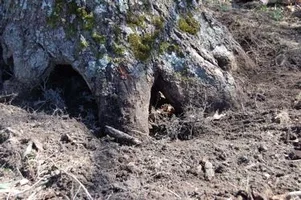
...How does one do this carefully? Just very slowly? Small tools, small bites of soil? Work as slowly as possibly like an archeological dig?
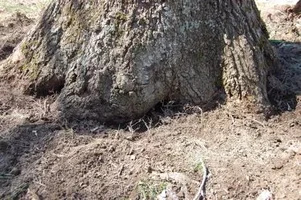
[/ QUOTE ]Yes you have the idea and no you don't need to find a consultant. Start prying the soil off the trunk with shovel first, then trowel. Remove loose stuff only around cavities and measure them. If a hose is handy that is great for the finish work.
Never thot of a shop vac...too heavy and noisy imo...just scoop out a swale on the downhill side to get drainage. i carried in 5 gal buckets on the last rcx i did; that worked.
Don't break barriers. Measure, document, take detailed pics!
INSPECTION
A basic issue in basic tree risk assessment is the need to distinguish tree health from tree structure. Tree workers and tree owners may see that the leaves are a nice shade of green, and conclude that the tree is safe. However, arborists understand that healthy foliage is not a reliable indicator of structural integrity. Judging a tree’s strength by how it looks at first is like judging a book by its cover.
Tree structure, not appearance, is the major focus of tree risk assessment. Visual tree assessment must be combined with hearing, smelling, touch, and judgment. When inspecting trees, use a checklist and stick to that system so you do not miss anything that should be included in the level of assessment that you have agreed to do. Basic inspection includes the site, the roots, the trunk flare, the trunk, and the branches.

Site. The tree's environment can lessen or increase risk of tree failure. If a tree is sheltered by other trees, it is more stable. Exposure to wind, snow, rain, and ice add to the loading that can cause tree failure. Saturated soil conditions and slope can also affect the risk of failure.

Species. Identify the type of tree that you are asked to inspect. Different species have different strengths and susceptibilities. For instance, most oaks Quercus can carry greater loads on their limbs than willows Salix or poplars Populus, but oaks may be more likely to uproot. By taking notes and pictures of trees that have failed, you can know what to expect from similar species in similar conditions under similar strains. By sending your observations to the International Tree Failure Database, you can gain access to observations from arborists around the world.

Shape. Look at the entire aboveground tree, checking for dead branches, sprawling branches that stick out from the rest of the crown, and overall branch structure. If the tree leans, determine whether the tree is adapting to that lean by growing branches in the opposite direction. If the top is curving back toward vertical, the lean is “self-correcting”.

Roots. Check for obstructions to root growth, such as curbs and foundations and water. Look for signs of trenching, and check to see how water moves through the site. Use a soil probe to check the location and health of roots. You might tap on the roots with a mallet, listening for a hollow sound. If the sound is suspicious, you can either dig or angle a probe toward the bottom of the root. Since roots often rot from the bottom up, getting under them can give you valuable information.

Trunk flare. A most vital area to inspect is the trunk flare, where the trunk expands or “flares” into the structural roots. If you cannot find the flare, remove mulch and soil and any small girdling roots until it is visible. Roots that encircle all or part of the trunk are known as stem-girdling roots. These not only damage plant tissues and circulation, but they can impair stability. They are commonly found on container-grown trees, but can occur on almost any tree. After the end of a root is cut off, new roots can branch off sideways. This growth in time may girdle the stem.

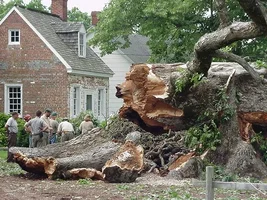
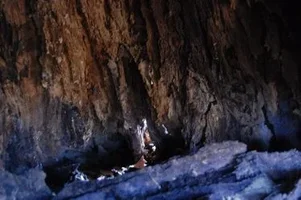
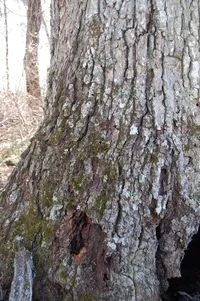
Trunk. If there is a hole in the trunk or root collar, you can gain information about that cavity by probing with a tool such as a screwdriver or a tile probe, a long, narrow fiberglass rod with a “T” handle. A ruler or yardstick will give you some idea how extensive the cavity is. If the trunk sounds very hollow but there is no soft spot or opening to probe and measure, then more advanced equipment may be used to determine how much sound wood is in the stem. Drilling and coring can measure the sound wood in one small area, so many holes must be made to get a picture of the whole tree. Drilling and coring invade healthy tissue, potentially spreading decay and decreasing stability. Practicing on fallen trees can provide valuable experience in the use of these methods.
Devices using radar and sound waves are not as invasive, but they cost a lot more.
Trunks can also be tested by pulling on the tree, using the Statics Integrated Method. All of these methods and devices require experience to interpret the results well enough to communicate the risk to the tree owner. Deciding how closely to inspect a tree is always a professional judgment, different for each assignment and each tree. Cavities over two-thirds of the diameter are sometimes considered “hazardous” and a reason for removal, but with close monitoring and care, trees with cavities over 80% of the diameter have been managed for many years.
pub ISA 2006