? number of spider legs = more stable.

Re: It\'s a mathematical point

Could an analogy be like building a four legged table vs a three legged stool? In a non-perfect four-legged table, one or two legs are shorter, and therefore share less or none of the load. In a three legged stool system, all the legs share part of the load.

It would seem to me that in most cases, a fourth strap would be unnecessary...I'm sure the situation exists, but it doesn't seem common.
 
Good questions. The hard part is that pics sometimes are not that usefull. On that cut the but dropped about a foot. It was a bit butt heavy because the center of gravity was not correct. The ball should have been just a bit closer to the butt and the tip slings should have had a slightly steeper angle to the right. Your second diagram the butt would have really dropped because the ball would be off cog to the right. #3 leg would have alot of tension but that would not stop it from dropping. It's all about cog. Usually when i am using more than 2 slings it's to prevent the load from rolling, not flipping.
 
[ QUOTE ]
Good questions. The hard part is that pics sometimes are not that usefull. On that cut the but dropped about a foot. It was a bit butt heavy because the center of gravity was not correct. The ball should have been just a bit closer to the butt and the tip slings should have had a slightly steeper angle to the right. Your second diagram the butt would have really dropped because the ball would be off cog to the right. #3 leg would have alot of tension but that would not stop it from dropping. It's all about cog. Usually when i am using more than 2 slings it's to prevent the load from rolling, not flipping.

[/ QUOTE ]

yes, exactly what I was saying.

I drew on the picture, not to show the correct placement. (correct placement would be as you described) I drew to show what you were trying to show in your original picture, more weight on that single leg on the butt. I exagerated it to really show it.
 
Re: # of spider legs.

[ QUOTE ]
... I like, and go out of my way to ensure that all my picks are vertically oriented. This is a courtesy to the crane operator in that it gives him a smaller footprint threading each pick safely to the LZ...

[/ QUOTE ]

There is nothing wrong with your motives. We all don't want to shock load a crane.

I tip tie and vertically stand many loads as well. Only because I am dealing a lot of excurrent trees. For example, I am removing about 90% Hybrid Cottonwoods. This tree permits me to do this technique a lot.

However, if you are dealing with many decurrent trees, then spider legging loads can be a must. Simply to prevent other trees or structures from getting clobbered from a flipping or rolling load.

Do you care if a load flips or rolls into other objects? Maybe you don't...
 
Re: # of spider legs.

Normally the main reason I spider leg anything is because there isn't enough room to stand the piece up and butt hitching won't work. This could be like Jamin said, that piece rolling into the trailer's roof in the picture.

Or it may be because there isn't enough boom height to lift the piece vertical, with a low boom angle for example.
 
[ QUOTE ]
I do agree that the steeper the angle, usually that leg has more tension/weight on it.

[/ QUOTE ]

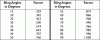
Any sling tied off or anchored at an angle of less than 90* will have more force on it than the actual weight it is holding.

A tie off of 45* has a load angle multiplier of .707, to show the slings new down rated capacity. Or if you want the weight of the load at the tie off, multiply the approximate weight it is supporting by 1.414.

A tie off angle of 30* has a multiplier of .500, to show the slings new down rated capacity. Or multiply by 2, to get actual weight at the tie off.

Example: A limb is naturally growing at a 30* angle upwards.
We want to remove it with a crane in 1 pick. Drop the ball to the CG, keeping the sling angles, from the hook, as vertical as possible. Due to the 30* growth angle, the butt tie off will have a shallower angle tie off than the tip end. The closer to 30* the tie off angle is, the more force there is at the tie off. Even though it's only supporting (butt tie) 1/2 the weight of the limb, the tie off is actually supporting the weight plus the load angle multiplier.

See attachment
 

Attachments

  • 164661-slinganglereference.gif
    164661-slinganglereference.gif
    5.4 KB · Views: 121
I have been watching this thread for the last few days I have not seen anyone talk about how these theorys work kbooms hook vs crane cable.For 10 years I have worked with both and I see that being a factor when setting up your rigging 1,2,or3 leggs.
 
There isnt a difference between kboom or a crane w/ a winch line. The load and slings all start at the hook and end at the attatchment point. So the type of crane wont make a difference on stability and load bearing of various # of attatching points.
 
[ QUOTE ]
There isnt a difference between kboom or a crane w/ a winch line. The load and slings all start at the hook and end at the attatchment point. So the type of crane wont make a difference on stability and load bearing of various # of attatching points.

[/ QUOTE ]

Perhaps no difference from the hook, however a crane's ability to give distance between it's hook and boom makes it more versatile in handling horizontally oriented picks without slapping the boom and perhaps breaking off branches over a target.

To me, that means a K-boom is better suited for vertically oriented picks than long horizontal picks.

jomoco
 
Not really. With horizontal picks and a kboom I utilize a sling and another hook on horizontal limbs to keep branches away from the boom. the second hook would then be the attatchment point.
 
[ QUOTE ]
Not really. With horizontal picks and a kboom I utilize a sling and another hook on horizontal limbs to keep branches away from the boom. the second hook would then be the attatchment point.

[/ QUOTE ]

But surely a K-boom hook swivels 360 degrees just like a crane hook does.

Maybe I'm not understanding your rigging that keeps the load away from the boom?

jomoco
 
i didnt read all posts so if im repeating sorry.we always use spider leg it has four equal ropes but 90%of the time i only use three.i like the spider leg because you can rig it so the limb hardly even moves
 
Re: # of spider legs.

[ QUOTE ]
Thanks for the apologies guys and for getting back on track. Very cool.

[/ QUOTE ]

There's a rumor going around that you like to beat people up so...
 
Re: # of spider legs.

????? Thought the rumor was he goes right for the future kids
ahhhhh.gif
 
Re: # of spider legs.

[ QUOTE ]
[ QUOTE ]
Who coined the term, "spider legs" anyway. Tobe?

[/ QUOTE ]

Good question...
thinking.gif


[/ QUOTE ]


Peter D. et al. used the term in the making of the ASPR workbook and videos. That was rope, friction device, and block and pulley work, but the term spread...
 
Re: # of spider legs.

[ QUOTE ]
I've done over 90 percent of all my thousands of crane picks with a single steel choker. I like, and go out of my way to ensure that all my picks are vertically oriented. This is a courtesy to the crane operator in that it gives him a smaller footprint threading each pick safely to the LZ.

I like to stand large laterals up with a tip grab, or butt hang them on a slow hinge.

High production and the KISS rules work well together when removing trees with cranes.

jomoco

[/ QUOTE ]

I am kinda with you on just standing the stuff up instead of hogtieing each limb but have been in places where I have set 3 straps for the pick.
Would you mind getting me a pic of this steel choker you are using. I am headed to stock up on some new big slings and straps and such for overhead lifting and rigging. I have shied away from chains and cable cause ,well, the stuff is heavy but maybe you could explain some good points to using the steel choker as well.Thanks.
 

New threads New posts

Back
Top Bottom