
Navigation
Install the app
How to install the app on iOS
Follow along with the video below to see how to install our site as a web app on your home screen.
Note: This feature may not be available in some browsers.
More options
You are using an out of date browser. It may not display this or other websites correctly.
You should upgrade or use an alternative browser.
You should upgrade or use an alternative browser.
? number of spider legs = more stable.
- Thread starter theXman
- Start date

Re: # of spider legs.
what's important to me in tree rigging is very little movement. (besides the limbs not breaking and the slings of course).
It makes sense to me that the more slings, the more likely you will prevent movement.
since i use a k-boom most of the time now, I have to get things pretty darn balanced if I don't want to see the pick move. this is because I don't have a long boom way up above the pick and a cable coming down.
another thing to keep in mind, we aren't picking up objects at the very top (like in my simple cube diagrams), trees are multi-demensional. they have weights above the tie points.
I haven't had crane training, I haven't had 12 certification courses for doing crane work at nuclear power plants. But I do have common sense when it comes to tree rigging and tree rigging with cranes.
what's important to me in tree rigging is very little movement. (besides the limbs not breaking and the slings of course).
It makes sense to me that the more slings, the more likely you will prevent movement.
since i use a k-boom most of the time now, I have to get things pretty darn balanced if I don't want to see the pick move. this is because I don't have a long boom way up above the pick and a cable coming down.
another thing to keep in mind, we aren't picking up objects at the very top (like in my simple cube diagrams), trees are multi-demensional. they have weights above the tie points.
I haven't had crane training, I haven't had 12 certification courses for doing crane work at nuclear power plants. But I do have common sense when it comes to tree rigging and tree rigging with cranes.
jim454
Participating member
- Location
- The land of Utopia
Re: # of spider legs.
is there suppose to be a full moon tonight?
is there suppose to be a full moon tonight?

jim454
Participating member
- Location
- The land of Utopia
Re: # of spider legs.


- Location
- Gibsons BC
Re: # of spider legs.
Hey c'mon peace and chicken grease or something like that.
Hey c'mon peace and chicken grease or something like that.

- Location
- Home of the New Jersey Devils
Re: # of spider legs.
Let's not take an educational thread and turn it into a bar fight. This started out as something worth reading and then turned into work for me. Let's learn from this and not repeat it please.

Let's not take an educational thread and turn it into a bar fight. This started out as something worth reading and then turned into work for me. Let's learn from this and not repeat it please.

Re: # of spider legs.
I've done over 90 percent of all my thousands of crane picks with a single steel choker. I like, and go out of my way to ensure that all my picks are vertically oriented. This is a courtesy to the crane operator in that it gives him a smaller footprint threading each pick safely to the LZ.
I like to stand large laterals up with a tip grab, or butt hang them on a slow hinge.
High production and the KISS rules work well together when removing trees with cranes.
jomoco
I've done over 90 percent of all my thousands of crane picks with a single steel choker. I like, and go out of my way to ensure that all my picks are vertically oriented. This is a courtesy to the crane operator in that it gives him a smaller footprint threading each pick safely to the LZ.
I like to stand large laterals up with a tip grab, or butt hang them on a slow hinge.
High production and the KISS rules work well together when removing trees with cranes.
jomoco

Norm_Hall
New member
- Location
- Wauconda, (Chicago),IL,USA
Re: It\'s a mathematical point
[ QUOTE ]
Not necessarily. It all depends on the center of gravity and sling angle.
[/ QUOTE ]
Absolutely!
[ QUOTE ]
Not necessarily. It all depends on the center of gravity and sling angle.
[/ QUOTE ]
Absolutely!

- Location
- Chapel Hill, NC
Re: # of spider legs.
[ QUOTE ]
Let's not take an educational thread and turn it into a bar fight. This started out as something worth reading and then turned into work for me. Let's learn from this and not repeat it please.
[/ QUOTE ]
Thank you.
[ QUOTE ]
Let's not take an educational thread and turn it into a bar fight. This started out as something worth reading and then turned into work for me. Let's learn from this and not repeat it please.
[/ QUOTE ]
Thank you.
Re: # of spider legs.
[ QUOTE ]
what's important to me in tree rigging is very little movement. (besides the limbs not breaking and the slings of course).
It makes sense to me that the more slings, the more likely you will prevent movement.
since i use a k-boom most of the time now, I have to get things pretty darn balanced if I don't want to see the pick move. this is because I don't have a long boom way up above the pick and a cable coming down.
another thing to keep in mind, we aren't picking up objects at the very top (like in my simple cube diagrams), trees are multi-demensional. they have weights above the tie points.
I haven't had crane training, I haven't had 12 certification courses for doing crane work at nuclear power plants. But I do have common sense when it comes to tree rigging and tree rigging with cranes.
[/ QUOTE ]
Depends on the type of movement, dynamic movement no, crane directed movement yes, and lots of it.
You can make those picks do anything you want them to, and movement in the direction you choose is a sign of good CO and climber communication.
If you know exactly where your pick is going, then move it, move it, move it already, highly controlled movement is the name of the game!
jomoco
[ QUOTE ]
what's important to me in tree rigging is very little movement. (besides the limbs not breaking and the slings of course).
It makes sense to me that the more slings, the more likely you will prevent movement.
since i use a k-boom most of the time now, I have to get things pretty darn balanced if I don't want to see the pick move. this is because I don't have a long boom way up above the pick and a cable coming down.
another thing to keep in mind, we aren't picking up objects at the very top (like in my simple cube diagrams), trees are multi-demensional. they have weights above the tie points.
I haven't had crane training, I haven't had 12 certification courses for doing crane work at nuclear power plants. But I do have common sense when it comes to tree rigging and tree rigging with cranes.
[/ QUOTE ]
Depends on the type of movement, dynamic movement no, crane directed movement yes, and lots of it.
You can make those picks do anything you want them to, and movement in the direction you choose is a sign of good CO and climber communication.
If you know exactly where your pick is going, then move it, move it, move it already, highly controlled movement is the name of the game!
jomoco
[ QUOTE ]
Tree parts are much different than fixed objects as everyone is different. If the legs are equalized AFTER the cut is made I would think the wieght would be distrubuted equally as long as the angles are simular. That should also reduce movment to very minimal. In this pic notice the leg closest to the cut. It has a steeper angle and will have more tension. This could be midagated by having longer slings on the tip end.
[/ QUOTE ]
hey Tod,
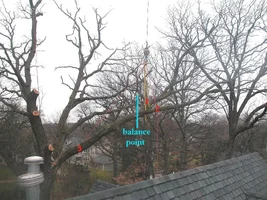
In that particular picture, from the camera view point, it seems like points 1 + 2 are actually close to the balancing point of that limb. (see attachment).
Therefor in that particular picture, the 3rd leg wouldn't be holding much weight. But, that leg is very important to keep that pick from moving. It just doesn't seem like it would have much tension on it.
that's the way it looks to me anyway. I've wanted to address this the first time i saw that picture, but I had other stuff to deal with.
I'm just discussing here, I'm not picking on your work, I would rig that very same way.
Let's say number 3 wasn't even on there, it looks to me that the butt would swing toward the house, but not violently. So how can that leg be holding that much weight?
I do see that the tree is dead or near dead and the tip ends are dry and light and the bigger wood is more solid; but it still looks to me that the balance point is about where I marked it.
It's like when loading logs with a single sling, if you don't quite have the balancing point, a man can keep it from tipping easily and keep it level with just a little help of his hand. I think that is what #3 is doing in that picture.
Tree parts are much different than fixed objects as everyone is different. If the legs are equalized AFTER the cut is made I would think the wieght would be distrubuted equally as long as the angles are simular. That should also reduce movment to very minimal. In this pic notice the leg closest to the cut. It has a steeper angle and will have more tension. This could be midagated by having longer slings on the tip end.
[/ QUOTE ]
hey Tod,
In that particular picture, from the camera view point, it seems like points 1 + 2 are actually close to the balancing point of that limb. (see attachment).
Therefor in that particular picture, the 3rd leg wouldn't be holding much weight. But, that leg is very important to keep that pick from moving. It just doesn't seem like it would have much tension on it.
that's the way it looks to me anyway. I've wanted to address this the first time i saw that picture, but I had other stuff to deal with.
I'm just discussing here, I'm not picking on your work, I would rig that very same way.
Let's say number 3 wasn't even on there, it looks to me that the butt would swing toward the house, but not violently. So how can that leg be holding that much weight?
I do see that the tree is dead or near dead and the tip ends are dry and light and the bigger wood is more solid; but it still looks to me that the balance point is about where I marked it.
It's like when loading logs with a single sling, if you don't quite have the balancing point, a man can keep it from tipping easily and keep it level with just a little help of his hand. I think that is what #3 is doing in that picture.
Attachments
I do agree that the steeper the angle, usually that leg has more tension/weight on it.
I just wanted to point out that there are other factors that play into it too.
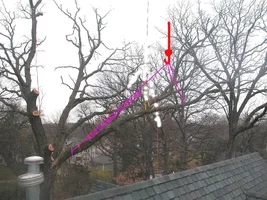
If it was rigged like this (attachment), then definitely that #3 (lone) leg would have a LOT of tension on it, much more than the others.
I know this is what you intended to show, I'm just discussing something else; if the two legs are already near the balance point (or COG as most of you seem to say) then I would think that there is not much weight on that 3rd leg.
right or wrong?
I just wanted to point out that there are other factors that play into it too.
If it was rigged like this (attachment), then definitely that #3 (lone) leg would have a LOT of tension on it, much more than the others.
I know this is what you intended to show, I'm just discussing something else; if the two legs are already near the balance point (or COG as most of you seem to say) then I would think that there is not much weight on that 3rd leg.
right or wrong?
Attachments
now, back to the 3 vs. 4 if you please.
Here is the situation that came to mind when first discussing this 3 vs. 4 and what is better. And this is what mostly made me feel that 4 must be better.
(Now, i do see the light and do see how 4 can put all the weight on two; I'm not discussing that again)
I am discussing other factors now, weight above the tie points.
There was a moment over a year ago, where I almost wanted to lift my brothers rayco RG 50 up over a fence with our crane instead of driving it all the way around the block to get to a gate; to enter a backyard.
I didn't even get to the point of putting the slings on, because when looking at the available attachment points, I didn't like the looks of it.
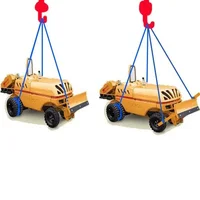
There was three main points that I could see that could be used. one between each dual wheel, then one in the center, low and behind the blade arms (a pin hole for securing the grinder on it's trailer).
That gave me three lifting points but I did not like the picture in my mind. It looked bad, scarry. Too much machine is above all of these points and I could see it maybe rolling over if I wasn't smooth on the crane movement.
It wasn't my machine and it wasn't worth the risk, so I didn't attempt it, I drove it around.
But I remember thinking, if it had two attachment points on that blade end of the machine, then I would have felt comfortable with it.
see attachment picture:
Here is the situation that came to mind when first discussing this 3 vs. 4 and what is better. And this is what mostly made me feel that 4 must be better.
(Now, i do see the light and do see how 4 can put all the weight on two; I'm not discussing that again)
I am discussing other factors now, weight above the tie points.
There was a moment over a year ago, where I almost wanted to lift my brothers rayco RG 50 up over a fence with our crane instead of driving it all the way around the block to get to a gate; to enter a backyard.
I didn't even get to the point of putting the slings on, because when looking at the available attachment points, I didn't like the looks of it.
There was three main points that I could see that could be used. one between each dual wheel, then one in the center, low and behind the blade arms (a pin hole for securing the grinder on it's trailer).
That gave me three lifting points but I did not like the picture in my mind. It looked bad, scarry. Too much machine is above all of these points and I could see it maybe rolling over if I wasn't smooth on the crane movement.
It wasn't my machine and it wasn't worth the risk, so I didn't attempt it, I drove it around.
But I remember thinking, if it had two attachment points on that blade end of the machine, then I would have felt comfortable with it.
see attachment picture:
Attachments
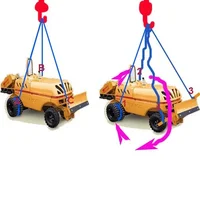
what i mean by the "roll".
pivoting on one dual tire leg and the one front mount leg, the machine could roll over and flip, finishing with the machine upside down; if there was an unstable movement by the crane operator, or maybe even if the machine isn't balanced evenly (as it is not).
again, since most of the machines weight is above the rigging points. It seems like 3 would be much less stable here than 4.
pivoting on one dual tire leg and the one front mount leg, the machine could roll over and flip, finishing with the machine upside down; if there was an unstable movement by the crane operator, or maybe even if the machine isn't balanced evenly (as it is not).
again, since most of the machines weight is above the rigging points. It seems like 3 would be much less stable here than 4.
Attachments
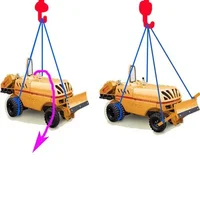
hmmmmm, but in a 4 leg rigging, if two happened to be slacked like in this diagram (leg 2 and 4 slacked), then the machine would roll easily on legs 1 and 3.
so now 4 looks worse to me.
I'm basically thinking out loud here on tree buzz, I figure some of us could learn something through this.
I guess best bet is to never lift something with the tie points below the majority of the weight. huh?
so now 4 looks worse to me.
I'm basically thinking out loud here on tree buzz, I figure some of us could learn something through this.
I guess best bet is to never lift something with the tie points below the majority of the weight. huh?
Attachments
New threads New posts
-
test
-
-

-
-

-
First time rope and harness tree climber shows the best attitude
- Started by moss
- Replies: 7
-


