Multiple leadered trees with no central tie in?

chep

New member
I spent saturday morning in a huge silver maple. The tree had about 5 leads starting at ground level and spreading from there. The inside of the crown was pretty hollow, in terms of tie in points. I was making reduction cuts at the ends of the house side leads and one over a driveway. More for homeowner "peace" of mind then anything. Anyways, I spent a lot of time flopping around. I think my climbing skills are solid, but I spend the majority of my time in trees with excurrent growth, and in smaller trees where I make cuts trying to encourage excurrent growth habits, or at least good branch structure. I weight 200 pounds and consider myself fairly nimble but certainly not a little monkey... Can buzzers provide me with some tips for making these sorts of climbs a bit easier and less embarrassing. I eventually got to where I needed to be, but it wasnt pretty and I was whupped!
thanks
 
Use of re-directs can help distribute your weight on your tie-in point. Oh, and lots of practice!

Your not alone in this issue. It requires a bit of DIFFERENT thinking on Physics. I have had a fair bit of practice doing this as I climb a lot of American Elms, and a few Multi-stemmed birches!
 
Re: Multiple leadered trees with no central tie in

redirects and a second tie at the same time....... ohh and confidence in your limbwalking abilities
 
Re: Multiple leadered trees with no central tie in

what works for me is double crotching from two strong leaders and using endless loops as foot holds along with a work positionong lanyard..
 
Re: Multiple leadered trees with no central tie in

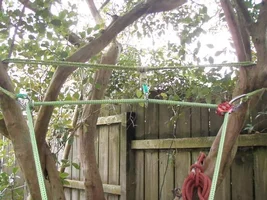
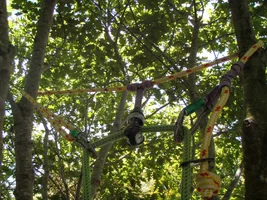
Setting up a false TIP can work too.

Set a rope between two high points and have a mid-line loop knot out in the middle. Use the loops as a TIP by putting a pulley in it. YOu can shift the false TIP back and forth for the perfect location.

Be aware of the loads that you're putting on the limbs.
 
Re: Multiple leadered trees with no central tie in

I hope you are using a nice friction saver and an advanced friction hitch with slack tending micro pulley for your climbing system... Going old school with a tautline is punishing on tough climbs like that... Also working with a tri-cut handsaw and leaving the chainsaw on the ground can make getting around a tree a lot easier, especialy when you are making a bunch of small cuts...

tie in higher than you normally would... footlocking your tail can be helpful in saving energy too..
sounds like a tough tree...

Lasst bit of advice might seem like it has nothing to do with climbing, but it really does.... Put a lot of $$$$ on jobs like that.... keeps you motivated and keeps your spirits high even when you are physically exhausted... nothing more demoralising than underbidding a really tough job... That makes it even harder as the mind keeps getting distracted about the $$$$
 
Re: Multiple leadered trees with no central tie in

Silver maples are often just plain difficult climbing.

A long (20'+ depending on the size of the tree) rope lanyard is a necessity, and a couple of loop runners for step are good to have as well.
 
Re: Multiple leadered trees with no central tie in

you can make multi tips doin it this way using either your footlock lanyard or rope saver
 

Attachments

  • 201419-PA090902.webp
    201419-PA090902.webp
    67.3 KB · Views: 294
Re: Multiple leadered trees with no central tie in

Drew,

The setup that you have is a good idea. There is a real need to be aware of how the loads are being applied to those TIPs. If either side of the anchor fails all of the climbers load will fall hard onto the other anchor which could cause a total failure.

Rock climbers have setup anchors like this and they have very defined criteria for their construction. Using self-equalizing setups is critical.

Take a look at sling loading charts to see how the load is amplified. the load is not shared between the anchor points if you keep the anchor horizontal like in your illustration. The middle, where the pulley is hanging, should have more sag in it, like an "M".
 
Re: Multiple leadered trees with no central tie in

Drew,

If you didn't have the "center tap" this would be what's known as the ADT - American Death Triangle, or triangle of death. Because of the configuration, the ADT puts a lot more force on the TIPs than individual leaders from two TIPs.

I do like the 'center-tap', but I'm still thinking, even with it, there's a lot more force being generated on the TIPs than if two independent ties were used.

When I get some time, I'll try to do some calculations and see if I can get a better idea about the forces.

Very innovative though.
 
[ QUOTE ]
I spent saturday morning in a huge silver maple. The tree had about 5 leads starting at ground level and spreading from there. The inside of the crown was pretty hollow, in terms of tie in points. I was making reduction cuts at the ends of the house side leads and one over a driveway. More for homeowner "peace" of mind then anything. Anyways, I spent a lot of time flopping around. I think my climbing skills are solid, but I spend the majority of my time in trees with excurrent growth, and in smaller trees where I make cuts trying to encourage excurrent growth habits, or at least good branch structure. I weight 200 pounds and consider myself fairly nimble but certainly not a little monkey... Can buzzers provide me with some tips for making these sorts of climbs a bit easier and less embarrassing. I eventually got to where I needed to be, but it wasnt pretty and I was whupped!
thanks

[/ QUOTE ]

Setting multiple ropes in the tree before ascending is helpful for me. I have 3 climbing lines and occasionally, on climbs such as you describe, set all 3 before going up.
 
Dont be embarrased! Regardless of what alot of other tree guys that i have worked around act like you dont need an ego or show off to do a good job. Saftey should be first.As long as at the end of the day you finished your task and are safe you did a great job in my book. I hade a hard time climbing at first because not only was I learning new tecnics and trying to trust equipment but I was wooryed what my co workers thought.I would get looks from the other guys because maby I didnt look to gracefull. That would throw off my whole game and get me so frustrated that it was twice as hard to concentrate on my task. Tie in twice, carry as less gear as you can, and learn from every move.Good luck
 
i hear what your saying guys, cheers. a more ideal situation/setup would be to choose one of the TIPs as the primary anchor and so slide the centre webbing towards it and attach a shock absorber to the secondary in case it gets shock loaded in case of the primary failing. i havent got a shock absorber though!! is that what you meant?
 
A shock absorber is kind of a patch to a system. Letting slack in the two TIPs would help so that the upper legs are more vertical, like the inside legs of the letter 'M' instead of horizontal. Or...like Norm says, set two false crotches/ropes.

No doubt, Ron will be back with the actual load numbers and we'll get a hard look at the actual loads.
 
It's not as bad as I thought, although it's not good either. I had to estimate angles of course, but using 80° on the lower ropes (with respect to the near horizontal section) and shallow angles for the upper rope, forces approaching 1.5 the climber's weight (and more depending on the specifics)could be generated on each TIP. That's not good.
 
Just to mention that the "M" method is very good, however, if either TIP were to break, the slack would move to the other TIP and drop the climber significantly.

If two independent systems (or both ends of the same rope, double crotched) were used, a TIP failure would not introduce slack into the other system. The climber would still swing.

In rock climbing anchoring, the SRENE (serene)principle would not hold with "M" system (Solid, Redundant, Equalized, NO EXTENSION). Tree work doesn't have the Redundant aspect required, so no equalization or lack-of-extension is part of every system.

Auto-equalization is pretty mutually exclusive with no-extension.

So again, while the "M" method is good and probably way, way easier than two systems, be sure both TIP are solid.

This "M" or Double-independent-crotch removes the "American Triange" / "Death Triange" force multiplication.
 

New threads New posts

Back
Top Bottom