
Navigation
Install the app
How to install the app on iOS
Follow along with the video below to see how to install our site as a web app on your home screen.
Note: This feature may not be available in some browsers.
More options
You are using an out of date browser. It may not display this or other websites correctly.
You should upgrade or use an alternative browser.
You should upgrade or use an alternative browser.
Monkeypod, Samanea saman
- Thread starter treesandsurf
- Start date

- Location
- Titirangi, Auckland, NZ
How did I miss this thread? Albizia saman (yes sorry they're Albizia's now) are how we make a living, have spent the last 16yrs looking after various collections of pretty old trees. Years ago used to remove the epicormic suckers as well now we are much more circumspect about it. Remember that the tree (or very large limb) that is producing epicormic growth reflects an alteration in the flow and control of Auxin and gibberellin, to remove all such suckers from the internal structure of the limbs, whilst it satisfys the clients' demands really is doing no favours to the tree.
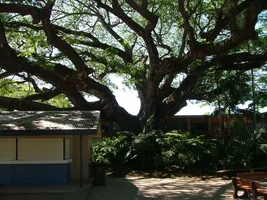
The reason why A. saman are able to persist despite excessive lionstailing (not a comment on your photos but generally) and much much worse relates to the growth nature of the species. Massive horizontal scaffold limbs (37.5m stem to canopy edge was the longest one I've worked on) are almost entirely autonimous in mature trees, and carry enormous carbohydrate reserves. The only trees I've worked on that are tougher than A. saman are Ficus spp. The internal arrangement of tension and compression wood is a physicists dream, I'll post a heap of photos of some of my babies starting with the 75m wide monster, the limb you're looking at is 1.9m in diameter top to bottom and 35m long, I estimate its weight at around 12Tonnes, imagine trying to engineer a steel beam that size and wieght...good luck.
The reason why we stopped removing all epicormics on some of our babies was that with such large autonimous structures within the larger unit of the tree when problems arise..longicorn borer, root damage, soil compaction etc the epicormics can and do provide additional energy supply precisely in the area of the limb where the cambium has detected trouble. You'll see what I mean in later photos.
PS I have to agree with Leon....relax people, you know the biggest problem with reading posts is that you can't hear the inflexion in the voice of the person typing (of course) so we place emotion and intention into lots of what we read that may well not have been there whe the post was typed.
The reason why A. saman are able to persist despite excessive lionstailing (not a comment on your photos but generally) and much much worse relates to the growth nature of the species. Massive horizontal scaffold limbs (37.5m stem to canopy edge was the longest one I've worked on) are almost entirely autonimous in mature trees, and carry enormous carbohydrate reserves. The only trees I've worked on that are tougher than A. saman are Ficus spp. The internal arrangement of tension and compression wood is a physicists dream, I'll post a heap of photos of some of my babies starting with the 75m wide monster, the limb you're looking at is 1.9m in diameter top to bottom and 35m long, I estimate its weight at around 12Tonnes, imagine trying to engineer a steel beam that size and wieght...good luck.
The reason why we stopped removing all epicormics on some of our babies was that with such large autonimous structures within the larger unit of the tree when problems arise..longicorn borer, root damage, soil compaction etc the epicormics can and do provide additional energy supply precisely in the area of the limb where the cambium has detected trouble. You'll see what I mean in later photos.
PS I have to agree with Leon....relax people, you know the biggest problem with reading posts is that you can't hear the inflexion in the voice of the person typing (of course) so we place emotion and intention into lots of what we read that may well not have been there whe the post was typed.
Attachments

- Location
- Hawaii
[ QUOTE ]
The reason why we stopped removing all epicormics on some of our babies was that with such large autonimous structures within the larger unit of the tree when problems arise..longicorn borer, root damage, soil compaction etc the epicormics can and do provide additional energy supply precisely in the area of the limb where the cambium has detected trouble.
[/ QUOTE ]
I completely agree. In this situation, the customer was giving tours through her estate and wanted 1. most importantly, all dead wood removed and 2. secondly, all the interior growth removed to make it more cosmetically appealing and to allow sun to come through the canopy, which creates a nice effect on the lawn. Strictly from a plant health care approach, I would say leaving the larger epicormics that were well placed would have been more desirable. Excellent post though, very informative! It's cool to see someone on a completely different part of the world working on the same species of trees.
jp

The reason why we stopped removing all epicormics on some of our babies was that with such large autonimous structures within the larger unit of the tree when problems arise..longicorn borer, root damage, soil compaction etc the epicormics can and do provide additional energy supply precisely in the area of the limb where the cambium has detected trouble.
[/ QUOTE ]
I completely agree. In this situation, the customer was giving tours through her estate and wanted 1. most importantly, all dead wood removed and 2. secondly, all the interior growth removed to make it more cosmetically appealing and to allow sun to come through the canopy, which creates a nice effect on the lawn. Strictly from a plant health care approach, I would say leaving the larger epicormics that were well placed would have been more desirable. Excellent post though, very informative! It's cool to see someone on a completely different part of the world working on the same species of trees.
jp

- Location
- Venice, FL
Sean, Great photo. I see it must be at a school or park of some kind. My question would be ... I see considerable decay at some of the pruning cuts... is there a concern of extensive decay? Also, can these Albizia withstand that decay, and keep the branches together? We have Laural Oak in FL, and if decay like that shows up, the tree will start shedding branches.
- Location
- Titirangi, Auckland, NZ
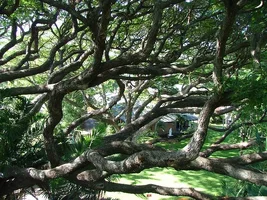
My experience of working with them as both landscape planted specimens and self sown trees is that left alone they have very little interior branching structure, except in the event of storm damage severe pest/pathogen attack (or human interference)Then they have the ability, ove time to reestablish the upper canopy on very rapidly elongating epicormic sprouts. In ideal conditions very few of these sprouts/shoots survive more than 2/3yrs the canopy cover above them is so dense that they can't produce enough energy to sustain themselves, you see a great many failed epicormics along larger limbs of long negleted trees.
Interestingly the natural form of the tree is to touch the ground with the lowest limbs and then to bounce (as it were) back up, using the ground contact as a support for further horizontal growth...have never seen roots emerge from this contact but can't see why it wouldn't occur given enough time.
The photo is taken at 27m up in the canopies of five trees during bi-annual d/w removal for risk management, only '/w over 25mm dia and with target removed.
Interestingly the natural form of the tree is to touch the ground with the lowest limbs and then to bounce (as it were) back up, using the ground contact as a support for further horizontal growth...have never seen roots emerge from this contact but can't see why it wouldn't occur given enough time.
The photo is taken at 27m up in the canopies of five trees during bi-annual d/w removal for risk management, only '/w over 25mm dia and with target removed.
Attachments
Sean, I have also found that most epicormics don't survive more then a few seasons. This is one reason that I feel it is acceptable to remove most sprouts after they've done their thing for a season, but to leave those that have the potential to become permanent branches. This goes a long way towards pleasing the client as well, of course.
Morningwood, monkeypods are exceptionally strong trees. They are also very good at compartmentalizing decay. Limb failures are very rare, except during extreme weather events.
Morningwood, monkeypods are exceptionally strong trees. They are also very good at compartmentalizing decay. Limb failures are very rare, except during extreme weather events.
- Location
- Titirangi, Auckland, NZ
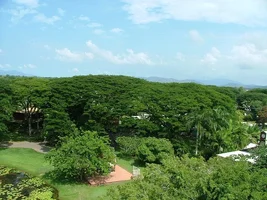
Yes you're right it is a school quite large private place with 15 very large raintrees.
You're question is very astute, this is a very common response to even the best pruning cuts, I believe its partly the dead or nectrotic area under the collar that Shigo spoke about in larger branch removals, the dark staining is kino and will flow for as long as 3yrs on larger cuts it also flows and drips down where branches conflict and eventually graft, for any cars underneath can be very expensive as it damages the paint work..but hey they shouldn't be parking on the root plate anyway.
Deacy is not a major concern though of course you get decay and I would classify them as moderate compartmentalizers, walls 2 and 3 in the model seem weak in raintrees. the biggest issue for the trees inthese photos is longicorn beetle, which leads to the conclusion the real problem is more systemic, and it is....soil compaction and root damage from cars, roadways, turf did I mention cars!
A. saman don't easily shed branches again a reflection on the amazing internal wood cell and fibre arrangements..we're continually battling owners of these trees in relation to the percieved risk from such massive limbs projecting horizontally so far. They are quite simply one of the most amazing trees I have had the privilige to climb and work in.
You're question is very astute, this is a very common response to even the best pruning cuts, I believe its partly the dead or nectrotic area under the collar that Shigo spoke about in larger branch removals, the dark staining is kino and will flow for as long as 3yrs on larger cuts it also flows and drips down where branches conflict and eventually graft, for any cars underneath can be very expensive as it damages the paint work..but hey they shouldn't be parking on the root plate anyway.
Deacy is not a major concern though of course you get decay and I would classify them as moderate compartmentalizers, walls 2 and 3 in the model seem weak in raintrees. the biggest issue for the trees inthese photos is longicorn beetle, which leads to the conclusion the real problem is more systemic, and it is....soil compaction and root damage from cars, roadways, turf did I mention cars!
A. saman don't easily shed branches again a reflection on the amazing internal wood cell and fibre arrangements..we're continually battling owners of these trees in relation to the percieved risk from such massive limbs projecting horizontally so far. They are quite simply one of the most amazing trees I have had the privilige to climb and work in.
Attachments
- Location
- Titirangi, Auckland, NZ
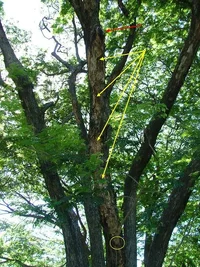
Here's a poor photo (my best shots are on another computer currently in the shop..again 3rd time!!!) showing what I was saying about the role of epicormics in reponse to declining health in particular areas of a limb. The red circle is an old pruning cut, not bad cut with the distinctive teardrop shape as tissues below the cut have died after the cut was made (Shigo's necrotic area under cuts on relatively poor compartmentalizers) The yellow arrows point to very clear areas where longicorn beetle larvea have had a gay old time eating their way through the bark cambium to the point where the tree has actually shed the bark. (This is often when clients call in tree companies and ask for limbs to be removed) Note that woundwood is forming along the edge of the insect attacked regions. the yellow circle shows of course the epicormic shoot at the base of this devastated region of bark and cambium.
In my better photos I have comparative shots showing scars where past insect attacks have now been grown over, very distinctive scarring...I really do feel that the epicormics are playing a role in providing exttra energy in the formation of woundwood, and the closure of these damaged zones.
In my better photos I have comparative shots showing scars where past insect attacks have now been grown over, very distinctive scarring...I really do feel that the epicormics are playing a role in providing exttra energy in the formation of woundwood, and the closure of these damaged zones.
Attachments
- Location
- Hawaii
You see that quite a bit on the monkeypods here in hawaii, but usually it looks like a result from improper pruning cuts, I've got a perfect example I'll take a pic and post from punahou stree right outside my apartment. One whole side of the tree has lost it's bark.
jp
jp
- Location
- Hawaii
BTW, Leon got you beat on 1 posts, 483

jp
jp
- Location
- Titirangi, Auckland, NZ
Yes it is serious, but the real problem is what's happening to the soil and roots. This photo is the back side of the same tree, the road was relaid 7yrs ago, massive root damage, egde of road 1.2m from base of tree...no tree protection undertaken at all. Make matters worse the parents park cars both sides of the tree every morning and afternoon, sometimes two cars deep the ground is like concrete...beginning to see the problem? These trees are bale to cope with appauling abuse, and enormous insect and pathogen pressures but everything has its limits.
I've been pushing for the root plates of all the roadside trees to be fenced mulched and decompacted for 4yrs now.
But its not all bad they are employing us and they do listen (within limits) to our recommendations.
I've been pushing for the root plates of all the roadside trees to be fenced mulched and decompacted for 4yrs now.
But its not all bad they are employing us and they do listen (within limits) to our recommendations.
Attachments

Ah if Samanea=Albizia then I think I have seen this tree, or at least some other big bean like it.
If you have epicormic branching then there is a reason for it. If these shoots last 2-3 years generally than I wonder if this is how the tree naturally grows, ergo removal of epicormics is wrong in a biological sense.
Huge long branches touching ground and creating their own prop makes perfect sense from a biomechinical view.
If you have epicormic branching then there is a reason for it. If these shoots last 2-3 years generally than I wonder if this is how the tree naturally grows, ergo removal of epicormics is wrong in a biological sense.
Huge long branches touching ground and creating their own prop makes perfect sense from a biomechinical view.
- Location
- Titirangi, Auckland, NZ
I'll find a shot of an extraordinary example...the tree broke in half with one side on the ground in 74' completely on its side, then over the years untouched began to grow back up again resulted in a very unusal looking raintree.
- Location
- Titirangi, Auckland, NZ
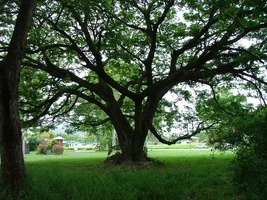
Here is a photo not one of my babies, but a tree on council land ergo neglected, note the prolapsing limb, the curve is the result of smaller branches being cut off by guys on mowers to prevent conflict with tree, but you get the idea of what the effect would look like on a much older tree.
Attachments

- Location
- urbana, il.
Hey Sean Freeman, I like what you said about the epicormics/ watersprouts contributing to health! They especialy help on hot days when the tree is at a high transpiration rate and the sun leaves shut down! The epicormic shoots and interior branches w/ shade leaves are still "photosynthing"
- Location
- Titirangi, Auckland, NZ
Thanks Mike, its always hard to meet the expectations of cliants particularly when like in the case of the trees for surfandtrees the area is a garden and park area in which aesthetics are paramount, people love the look of clean limbs and branches with the foliage out on the ends, I understand that fully, its the same with most of our clients too. We try to make a compromise so like others have said removing those that we judge as having very little chance of survival but retaining those that look like becoming a new part of the branch architecture....very much like Gilmans advice for restorative pruning, selection is based on how we predict the shoots will develop and which ones we believe to best placed to make for a strong resiliant structure.
Those trees that are experiencing stress if not strain however are another thing entirely...if only they would stop the parking of cars and treat the soil...
Those trees that are experiencing stress if not strain however are another thing entirely...if only they would stop the parking of cars and treat the soil...

Roger_Barnett
Participating member
- Location
- Seattle, in the PNWet
Thanks to you all for this great thread and discussion. I am really looking forward to the conference as it will be my first Hawaii visit.
I hope to be able to spend some extra time sightseeing, and of course shooting pics of the many great island attractions. Reckon I'll might need over 50 gigs of hard drive space.
I hope to be able to spend some extra time sightseeing, and of course shooting pics of the many great island attractions. Reckon I'll might need over 50 gigs of hard drive space.
New threads New posts
-
test
-

-
 Alternatives to standard asphalt around roots
- Started by southsoundtree
- Replies: 12
-
-

-

-

