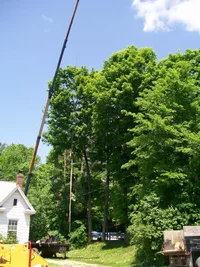
Manitowoc UTC 1700 JBT Crane

"From Professor Gene Wengert, forum technical advisor:
The amount of sap in a tree, or the moisture content, is essentially the same throughout the year. This has been measured time and time again, especially by pulp companies that buy wood by weight and are sensitive to the amount of water in the tree when pulping.

The sap does not go into the roots in the winter. In fact, with some species we see a 1% MC increase in the wood above ground in the wintertime. The difference between summer and winter is the flowing of the sap.
However, anyone who has tapped maple trees knows that the best flow occurs before the buds have even begun to swell, like in February, with freezing nights. In fact, with this warm winter, maple flow has begun and may actually be poor.
When sawing, because the logs dry some in warmer weather, at the mill, the MC is lower in the summer.
Also, a similar issue is that the sap does not freeze in the wintertime in the tree. It has natural anti-freeze. We may get some freezing under -40 F and then trees will get so-called frost cracks due to expansion of the ice."


http://www.woodweb.com/knowledge_base/Seasonal_Sap_Flow_and_Moisture_Content_in_Trees.html
 
So, is the increased chance of mature hardwoods uprooting in the south during the rainy season (spring) due to increased levels of moisture in the soil or increased weight of the crown due to moisture absorption?
 
From someone who learned to operate on a 15t 63 footer and now an 18t 70 footer a lot of times all you have height and capacity for is one choker. Sometimes you can't reach the back side of the tree good enough to just balace one out, it might take standing a pick up so you can get a better chart. We normally put 2 fixed length slings on the ball of the same length, sometimes we use one sometimes both. After time you can get good with one sometimes it's ugly but 99% of the time it's pretty smooth.

Sent from my SM-G900T using Tapatalk
 
"From Professor Gene Wengert, forum technical advisor:
The amount of sap in a tree, or the moisture content, is essentially the same throughout the year. This has been measured time and time again, especially by pulp companies that buy wood by weight and are sensitive to the amount of water in the tree when pulping.

The sap does not go into the roots in the winter. In fact, with some species we see a 1% MC increase in the wood above ground in the wintertime. The difference between summer and winter is the flowing of the sap.
However, anyone who has tapped maple trees knows that the best flow occurs before the buds have even begun to swell, like in February, with freezing nights. In fact, with this warm winter, maple flow has begun and may actually be poor.
When sawing, because the logs dry some in warmer weather, at the mill, the MC is lower in the summer.
Also, a similar issue is that the sap does not freeze in the wintertime in the tree. It has natural anti-freeze. We may get some freezing under -40 F and then trees will get so-called frost cracks due to expansion of the ice."


http://www.woodweb.com/knowledge_base/Seasonal_Sap_Flow_and_Moisture_Content_in_Trees.html
Is that calculated at the mill or on site before the logs have a chance to bleed out? It seems at times the same species can be heavier after a couple days of rain when moving wood by hand. Speaking of hand, I hope your healing well. I'm doing much better myself.
 
This is a good thread. Only disagreement I have is with the comment of a load chart being useless in tree care. My old crane and my current crane have load charts but neither had an lmi or anything else to tell me what the piece weighed. But through green weight charts, experience, and staying on the good side of caution I have been able to do trees with cranes since 1989.... The chart tells you what the crane is good for and never brakes or malfunctions. It can however be overridden with poor education and judgement to a bad outcome. Understanding the load chart of a crane is the most critical point of knowledge needed to work with cranes in my opinion.
 
This was my 12 ton RO TC-125 92' with the swing out jib and the pull out extension. Did a lot of work with it.
I hear many people who think a jib is dangerous and wont use it or don't like to. This is ridiculous! A jib or extension is much safer because it allows you more reach so you can pick a smaller piece if need be.
 

Attachments

  • 100_0427.webp
    100_0427.webp
    730 KB · Views: 29
I may see the misunderstanding. He told me not to worry about the load chart. He uses it but said it isn't necessary for me to commit it to memory already. He didn't say he doesn't use it. It was more like hey don't worry about it, I've got that you worry about climbing. He was on a job day before yesterday with a tape measure making sure he could handle the pole I was stripping out. I assume measuring distance from the turntable.
 
This is a good thread. Only disagreement I have is with the comment of a load chart being useless in tree care. My old crane and my current crane have load charts but neither had an lmi or anything else to tell me what the piece weighed. But through green weight charts, experience, and staying on the good side of caution I have been able to do trees with cranes since 1989.... The chart tells you what the crane is good for and never brakes or malfunctions. It can however be overridden with poor education and judgement to a bad outcome. Understanding the load chart of a crane is the most critical point of knowledge needed to work with cranes in my opinion.

My comment was meant as, what good is a load chart if you don't know the actual weight of the pick once it is cut. If you look at your load chart and it tells you your good for 4500 and then you make the cut with out an LMI that piece could weigh more than 4500 and you would never know. How would you know? All the load chart tells you is what your able to pick. If you were picking an AC unit that had the weight stamped on the crate then the load chart is handy.
 
Royce,
I still disagree. The overload system on my new crane will let you know if you picked too big a piece...I look at it the opposite way. If you don't use the chart and take too big a piece what good is knowing what it weighed then. An lmi is just easier to look at and gives you an immediate read out.
I think it is extremely helpful to know the weight after each pick don't get me wrong
 
Royce,
I still disagree. The overload system on my new crane will let you know if you picked too big a piece...I look at it the opposite way. If you don't use the chart and take too big a piece what good is knowing what it weighed then. An lmi is just easier to look at and gives you an immediate read out.
I think it is extremely helpful to know the weight after each pick don't get me wrong

I guess I am thinking that if you only had a load chart. With out knowing what the piece weighs once it is cut what good is the load chart? Sure it tells you that your good to pick 4500 pounds. But if you can't check to see if you actually picked that much weight what good is the load chart?
 
I guess I am thinking that if you only had a load chart. With out knowing what the piece weighs once it is cut what good is the load chart? Sure it tells you that your good to pick 4500 pounds. But if you can't check to see if you actually picked that much weight what good is the load chart?
To stay within a safe margin. A load chart is one critical piece of information that allows you to make safe judgements. Think of it as another tool. It alone isn't going to keep you safe but without its understanding you won't know what safe really is.
 
To stay within a safe margin. A load chart is one critical piece of information that allows you to make safe judgements. Think of it as another tool. It alone isn't going to keep you safe but without its understanding you won't know what safe really is.

I agree with all that. But my point is, without know the weight of the piece cut how will you ever know if your being safe or not.

Look at this picture. What does this top weight? My chart says I am good for 3K pounds. Am I being safe? Am I within my limits? How would you know?

My point is that unless you know exactly what the piece weighs once it is cut, it's just a guess. I understand that operators who do this all the time can estimate pretty close to the actual weight. However, every crane operator I have ever worked with has taken a piece that weighed more than they thought.
 

Attachments

  • crane top .webp
    crane top .webp
    409 KB · Views: 22
If you overload the pick, the crane might take it. Once, twice, maybe more. But at some point things will go bad. The load chart lets you know what it's capable of and the lmi tells you whats your picking. Kinda like what Limbcontrol said. They are two tools that work very well together.
 
My comment was meant as, what good is a load chart if you don't know the actual weight of the pick once it is cut. If you look at your load chart and it tells you your good for 4500 and then you make the cut with out an LMI that piece could weigh more than 4500 and you would never know. How would you know? All the load chart tells you is what your able to pick. If you were picking an AC unit that had the weight stamped on the crate then the load chart is handy.
you need to become adept at using the green log weight chart and make conservative cuts in relation to the values shown on the log chart. the load chart on each individual crane i.e. the most important safety device provided by the manufacturer. its up to the operator to understand and implement its use.
 
I agree with all that. But my point is, without know the weight of the piece cut how will you ever know if your being safe or not.

Look at this picture. What does this top weight? My chart says I am good for 3K pounds. Am I being safe? Am I within my limits? How would you know?

My point is that unless you know exactly what the piece weighs once it is cut, it's just a guess. I understand that operators who do this all the time can estimate pretty close to the actual weight. However, every crane operator I have ever worked with has taken a piece that weighed more than they thought.
in tree work, if you try to make capacity picks for the best production you are destined for failure. if you try to make picks 70% of capacity at most, there is enough extra capacity usually to accommodate slight misjudgments.
 
you need to become adept at using the green log weight chart and make conservative cuts in relation to the values shown on the log chart. the load chart on each individual crane i.e. the most important safety device provided by the manufacturer. its up to the operator to understand and implement its use.

your totally not getting what I am saying. I agree with you 100%. Yes, use your load chart and do not take a pick that is close to your max weight. I am not new to crane work. This post was started with someone saying that their crane does not have an LMI. I made a comment that not having anyway to determine what the piece weighs once it is cut is going to make the load chart useless. Great your chart says your good for X amount of weight. But once the cut is made and you have no way to see where it falls in regards to your load chart, then what good is the load chart. That was really my only point.
I think some are thinking that I am saying a load chart is useless all together. I am saying the opposite. It's the best piece of knowledge you can get when operating a crane. But having an LMI that tells you the weight of the pick IMO is the winning combination. Even if all your LMI did was tell you the weight picked, like a load cell. Then, you could refer to your load chart and then take a 70% estimated pick weight of that load chart number and then refer to the load cell, or weight on the ball to confirm that your pick is within the capacity. Then wash, rinse, repeat.
 
I understand you completely Royce. Used it friday for the first time. It was interesting working with such a small crane. Kinda freaks me out a little bit. Strange having to adjust the cuts because the ball is next to the load instead of above it. It was pretty much guess work on the weights. One pic was pretty much at the max and he had to bounce the base section across the yard to the log truck. Alarms screaming the whole time. I would have loved to have know what the actual weight was. Gonna take a while for me to get used to this.
 

New threads New posts

Back
Top Bottom