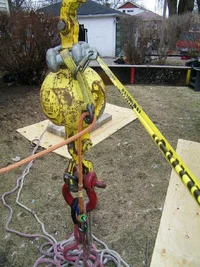
Legal TIP on the ball

rfwoodvt

New member
I tried searching even loading the phrase in quotes but I got hundreds of irrelevant hits so I apologize if this question has been asked before and otherwise beaten to death.

Just picked up a sweet stainless clevis with locking pin to use for the TIP above the ball on our crane.

Now I'm looking for something to hang off it for the other part of the TIP.

Most of what I've seen used are the flat web buckingham type friction savers. Any particular reason that is the most common?

Any reason to not use Tenex in half inch, 9/16ths or 5/8ths in an eye & eye config? What about a stable braid eye & eye? Are those just as acceptable?

Any other setups being used?
 
Probably because the heavy stitched nylon will be less susceptible to picking and cutting than rope, making the assumption that there may be burs or sharp spots on the ball?
 
Jeff's answer makes sense, and that's why I'd thought of inserting the FS through some Cobra hose as well.

I'm sure others can answer this question better than me.

I'd thought that a heavy rated chain with different size quick links on the ends would be smart.
 
I think I saw that the FS was girthed as well in one of Tod's photos yesterday, perhaps to limit movement for the same reasons Jeff points out.

-Tom
 
A shackle over the ball. Fix the pin with a wire. FIx the cambiumsaver with two cable tiers (if its the right word), which you take off by the end of the day.
I use to add a backup: I girthhitch a sling to both the cambiumsaver as well as the crane hook.
Can't see why not adding this extra backup :-) It doesn't get in the way.
The whole setup takes less than two minutes...
 
The shackle I'm using is 5/8" forged stainless with a 3 ton WLL stamped in it. The pin is threaded, uses a non-locking nut (which I might change) along with cotter pin to keep it from backing out. If I don't swap out the nut for a locker I'm going to back the nut up with locktite.

Still debating over whether to use a flat strap friction saver or a larger diameter rope style FS. Not so keen on the chain idea though. Dunno why, just doesn't sit well in the old mind.

Sounds like the flat strap FS is in use more because of path-of-least-resistance to use rather than any deliberate or clear benefit over the rope style.
 
This system is OSHA approved.
1. 17 ton screw pin shackle
2. 2 foot Buck ring & ring, not girth hitched
3. Petzl Kador (with gate facing up) to capture the FS and prevent the pin from unthreading

Any system coming in contact with the load line will not be approved.
 

Attachments

  • 266013-100_0930.webp
    266013-100_0930.webp
    226.3 KB · Views: 353
Sounds like you have a shackle with a hex head bolt and nut. A webbing type FS would be better than hollow braid on a bolt. Plus, in order to be OSHA approved, a hollow braid FS would have to have a Manufacturer label on it, with all the criteria.
 
[ QUOTE ]

Most of what I've seen used are the flat web buckingham type friction savers. Any particular reason that is the most common?

[/ QUOTE ]

I use this, as in Norm's set up, because a Buckingham FS was the only one I could find with load ratings designed for use by a tree climber. Designed for purpose!

Tony
 
We use a shackle just above the ball thru the "swivel" rotation area. The shackle holds an egg shaped polished steel ring that rests on the ball and clears lifeline from contact. The shackle is wired shut. Not sure if it's legal or not, but I check it every so often and it never has failed me.
 
I spent the first day (of 5) with my guy who is a "authorized OSHA Outreach Instructor, Rigging Qualification Trainer, and a bunch of other type ratings for certifying and whatnot. I am doing this in anticipation of Idaho's upcoming required crane operator sertification requirement, currently, all you need are the keys.

Keep in mind I'm just a taxi crane guy who does not do arborist work, but hang here from time to time to get my crane fix! BUT, today, it caught my attention when he said "OSHA changed their mind, now you can hang a man (or women) below the hook, OFF the hook, even from a length of rigging". That sound right, I swore that's what he said....less restrictions??? Hard to believe, but he says so. DON'T take my word for it, feel free to call BS.
 
Allmark, I will try to get a photo, this snow has slowed us down plenty. All our jobs require driving our equipment through it. I am out of work for this week, anyway, I will get one early next week.
 
Norm, why no girth hitching of the friction saver, what is the safety concern? It can't be that the girth hitching weakens the friction saver at all I wouldn't think? I know all knots cause some weakening but it can't be so significant to be a safety concern, could it?
 
I don’t like the Idea of any attachment point being attached to any part of the crane that has a safe working load less then the allowable winch pull. I know it would be a rare situation but it is conceivable that any part of the rigging, ball, Becket, hook, shackle, friction saver, or whatever could end up getting pinched or loaded. Our crane has a single line pull of 10,000lbs, if you have a friction saver attached to the hook, ball, Becket, or load line, you could end up damaging or overloading it without ever knowing it. Most friction savers have breaking strength of 5000lbs. We use a large master link and a large safety shackle with a locking nut and a cotter pin, both are rated for more then 8 tons, I chose nothing under 8 tons because that is what our hook/ball is rated for. The climber runs his climbing line thru the shackle, the shackle is positioned in a way so the line runs on the curved part of the shackle and not the pin.
 
Norm, if your system is approved by OSHA could you please provide the name of the individual or any documentation that you received from OSHA showing that is the case. It is not that I have any doubt it is just that it would be very helpful in a situation that I am involved in. I appreciate you time.
 

New threads New posts

Back
Top Bottom