leaning trees

treevet

Branched out member
Location
Cincinnati, Ohio
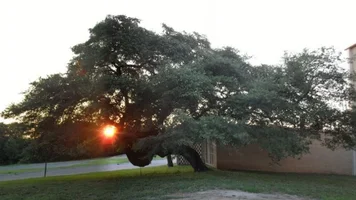
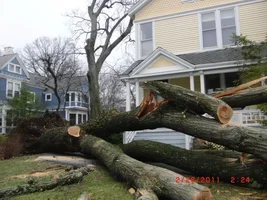
A subject that maybe deserves a little more discussion is that of leaning trees. In the last week with saturated soils we have removed 2 huge trees that had seemingly inconsequencial leans. The pictured one was actually hanging over the house and the ho's bedroom and daughter's adjacent bedroom and somehow by the grace of God....turned sideways and missed the house.

This tree was about 120 feet tall measured and 48" measured dbh. People likely would have died in bed if the tree had not turned sideways.

Yesterday I looked at a 90 plus foot leaning sugar maple with a large part of the house in it's target sights. This tree had no signs of recent soil disruption or root plate movement. But with additional weight put on over the years to make this situation more dangerous, judiciousness is in order. It is a new homeowner with no knowledge of the history of the tree.

I am not going to remove the tree but put a "guage" on it that I often use where I put a stake in the ground and put a mark on the stem and monitor it for movement of these 2 relative points. Another method is to hang a weight from a limb and monitor the distance from the ground to the weight periodically.

In this link it is said "A leaning tree may or may not be a substantial hazard. (By Mattheck and Broeler 1994 in a study of 800 broken and standing trees). Natural lean and Unnatural lean (recent root plate upheaval or soil movement) are discussed as well as 15 degree or 45 degree thresholds. Reaction wood ofcourse enters into the discussion as well.

"Trees that develop naturally with a lean may be as strong and stable as upright trees ..." (Eval of Hazard Trees...Matheny/Clark). But IMO with more and more mass in the lean hazard a stable situation with accompanying soil saturation and root suffocation can lead to a increase in risk.

I recall study decades ago at Rutgers U. in Tree Maint./Pirone...where roots on leaners were exposed with heavy pressure hydraulic units and found much larger and higher quantity root mass on the opposite side of a lean.

http://www.forestpathology.org/hazard.html
 

Attachments

  • 271953-005.webp
    271953-005.webp
    74.2 KB · Views: 182
Yeah I like the idea of hanging a weight from the tree. Thanks for the tip. I suppose the type of string/cord used is important (no stretch with age, temp., moisture) to get accurate measurements.

Boy the tree in the photo didn't miss that house by much huh? Someone must be livin' right.
 
I think one of the best ideas for checking the change in lean of a tree was placing two long drywall screws in a tree trunk and set them so an electronic level reads vertical. The screws can then be checked every year or so to note any change from the vertical.

Kim Coder gave an interesting talk on leaning trees at UGA. He mentioned that once a leaning tree's center of gravity no longer falls over the root plate that every time the ground is saturated the tree moves a little. In other words it is in the process of up-rooting and is slowing falling over.
 
I thought of a plumb bob and a piece of re-bar in the ground would be a good indicator.

I recommend people to select photo-points and take digital pictures of their trees every year. These will give a time lapse record. How many times do the tree owners go back and forth on what it did or didn't look like in the past.
 
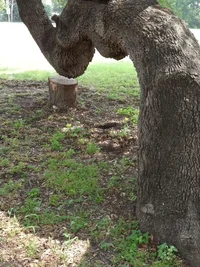
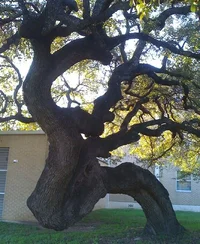
I used a tube in tube depth gauge to measure how much the tree moved at the low point. After a month of measuring with one really windy and rainy weekend I found that it moved about 3.25". There was a chunk of live oak in the wood dump so I made a prop and slid it under the elbow.

Since I put the prop in there a year ago I've talked with three people who wondered 'how did that tree grow under there?' It's hard not to chuckle...but I explain to them that it's a prop 'just in case'.
 

Attachments

  • 272041-CR-prop.webp
    272041-CR-prop.webp
    105.3 KB · Views: 68
[ QUOTE ]
I think one of the best ideas for checking the change in lean of a tree was placing two long drywall screws in a tree trunk and set them so an electronic level reads vertical. The screws can then be checked every year or so to note any change from the vertical.

[/ QUOTE ]This is Dr. Smiley's approach, published in Arborist News a couple years back. [ QUOTE ]


Kim Coder gave an interesting talk on leaning trees at UGA. He mentioned that once a leaning tree's center of gravity no longer falls over the root plate that every time the ground is saturated the tree moves a little. In other words it is in the process of up-rooting and is slowing falling over.

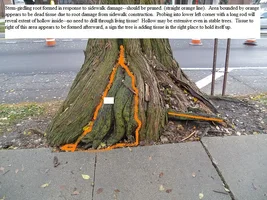
[/ QUOTE ]Dr. Coder may have been talking about one specific tree, but this is most certainly NOT a general rule. We all see many trees leaning but not uprooting. The worst kind of leans are the anthropogenic ones, from overpruning one side of the tree. Then there is root damage, like the attached.
 

Attachments

  • 272042-kewaneebasesidewalkview1.webp
    272042-kewaneebasesidewalkview1.webp
    150.5 KB · Views: 67
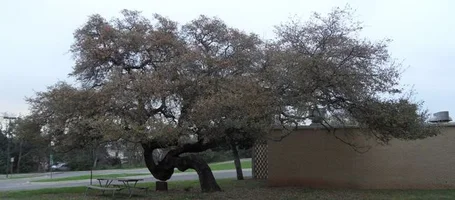
If I ever decide to get a tatto...not likely...this tree will be on my left shoulder. The outline would be a two strand Celtic braid. One braid will be vines of some sort...NOT poison ivy :) The other will be the pattern of my favorite rope at the time. Right now it would be Tachyon.
 

Attachments

  • 272043-CR-fromnorth.webp
    272043-CR-fromnorth.webp
    100.6 KB · Views: 85
You can substitute aluminum nails, instead of drywall screws ( easier on the saw doing the removal, down the line ) and use a digital level.. just record whatever attitude the level indicates and use it as a reference point. No need to find a perfectly vertical reference point.
 
[ QUOTE ]


Kim Coder gave an interesting talk on leaning trees at UGA. He mentioned that once a leaning tree's center of gravity no longer falls over the root plate that every time the ground is saturated the tree moves a little. In other words it is in the process of up-rooting and is slowing falling over.

[/ QUOTE ]

[ QUOTE ]
Dr. Coder may have been talking about one specific tree, but this is most certainly NOT a general rule. We all see many trees leaning but not uprooting. The worst kind of leans are the anthropogenic ones, from overpruning one side of the tree. Then there is root damage, like the attached.

[/ QUOTE ]

He was quite clear in his presentation. Every tree that has a center of gravity that does not fall over it's supporting root plate is slowly falling over. Friction between the roots and soil is greatly reduced during soil saturation and the tree is much like a lamp on a table. It may only move micrometers at each such event but it IS slowly going over. Ditto for arborist.
grin.gif
 
[ QUOTE ]
You can substitute aluminum nails, instead of drywall screws ( easier on the saw doing the removal, down the line ) and use a digital level.. just record whatever attitude the level indicates and use it as a reference point. No need to find a perfectly vertical reference point.

[/ QUOTE ]

I think a neat part about using screws it that they can be adjusted out as the tree tries to swallow them with growth. Of course the initial set up does not have to be vertical but starting out vertical sure makes a handy starting point.
 
[ QUOTE ]
I think a neat part about using screws it that they can be adjusted out as the tree tries to swallow them with growth.

[/ QUOTE ]In many trees I find this to be difficult due to screw getting stuck by lignin and pressure. Plus, wouldn't turning the screw be wounding the tree?

"Every tree that has a center of gravity that does not fall over it's supporting root plate is slowly falling over."

That statement is patently false, unless in the global sense that all trees are in the process of falling over because one day they will. In this case, the quoted(?) speaker may be in more danger of falling over than the trees described.
 
Putting a small screw in a tree wouldn't cause any more of a wound than clipping off a small epicormic shoot. And, as in the epicormic shoot, if you're worried the tree might be slowly falling over, it's worth causing the wound to gain the end result - in this case data supporting or refuting increasing lean.
 
Dan, nowhere in that link is the quote you used. 2 statements were, that make me wonder about the context. With the emphasis on "defendable", could a liability-fearing bean counter at UGA persuaded these criteria?:

">25% lean = priority removal"

"Height is not important in failure initiation"

I'd like to ask him where these 2 opinions come from; I saw no research cited in support.
 
Tom,

I would say that an even low canopy along with good reaction wood on the lean side is a start..


When I want to measure movement on a tree I put a stake in the ground fore and aft at the same distance from the trunk an record the movement and if working the tree I tie on a piece of tape that I can see whilst up in the canopy.
 
[ QUOTE ]
Dan, nowhere in that link is the quote you used. 2 statements were, that make me wonder about the context. With the emphasis on "defendable", could a liability-fearing bean counter at UGA persuaded these criteria?:

">25% lean = priority removal"

"Height is not important in failure initiation"

I'd like to ask him where these 2 opinions come from; I saw no research cited in support.

[/ QUOTE ]

The Coder quotes came from an hour lecture he gave on the subject at UGA and contained more information than the publication. Coder's publication contains some pretty firm physics that doesn't require the presence of bean counters to make sense. I do wonder how he can lecture and write about arboriculture without dropping the names of the TCIA or the ISA every few minutes though ...... I guess his material is questionable.
 
Tom, to me it looks like it has a good amount of extra canopy weight on the side away from the lean. And, isn't that something to consider as well? Most times, it seems that naturally leaning trees seem to counterbalance themselves, or try to, in some way. Ones that lean hard and don't seem to be trying to do this freak me out a little more.
 

New threads New posts

Back
Top Bottom