leaning trees

Have you read Colin Tudge's book, "Tree"? He writes quite a few graphs on the coconut's root strength and growing acrobatics. It's a pretty good book, too. But, I'm sure living where you live you get a first hand education on coconut palms.
 
[ QUOTE ]
Tom, to me it looks like it has a good amount of extra canopy weight on the side away from the lean. And, isn't that something to consider as well? Most times, it seems that naturally leaning trees seem to counterbalance themselves, or try to, in some way. Ones that lean hard and don't seem to be trying to do this freak me out a little more.

[/ QUOTE ]

Good post. Tom's tree has counterbalanced itself nicely. Exemplarily! And Dan to be fair the pub date was 2000 and a lot has come to light since then. As for the physics it does not quite all add up for me-- the tables and diagram I am not sure where that all comes from or goes to and how it led to conclusions-- but that may be my problem and not the data's, or the concluder's.
 
[ QUOTE ]
Have you read Colin Tudge's book, "Tree"? He writes quite a few graphs on the coconut's root strength and growing acrobatics. It's a pretty good book, too. But, I'm sure living where you live you get a first hand education on coconut palms.

[/ QUOTE ]

yeah, its unavoidable here. if your a tree company chances are your gonna trim 50 coconuts a year and for the most part each coconut gets a trim and clean out once every 6 months. guys here don't know how to properly prune a coco palm. the right way to trim a palm is to make sure the lowest fronds are level with the horizon. i have seen lots of palms that started out straight but because of improper pruning they start to lean. the shift in center of gravity when the crown is too thick on any side influences the stem to grow in the direction with the most weight. also on another note, your supposed to leave at least 12-14 fronds minimum.
 
Eaten a couple of coconuts, never even seen the tree they originate from. Cool stuff. It's also cool how they can travel miles and miles on that floating seed to germinate! Not all of us are as lucky as you are joshuatrees, to live in Hawaii!
 
The tree in my pics was bent over in a hurricane in '22.

After spending lots of time looking at the structure and the bark formation I have a theory of what the tree looked like before the 'cane. Other arbos who have been on campus have come up with pretty similar theories.

After studying the cross section of the trunk and limbs I can see where reaction wood is growing. That has helped me 'map' the ages of some parts of the crown.

The prop is there just in case there is a severe wind or ice storm sometime. If the tree uprooted or broke it would likely have to be removed.
 
[ QUOTE ]
Have you read Colin Tudge's book, "Tree"? He writes quite a few graphs on the coconut's root strength and growing acrobatics. It's a pretty good book, too. But, I'm sure living where you live you get a first hand education on coconut palms.

[/ QUOTE ]

Funny! I was trolling through my copy just now. How strange is that? Was just rereading about palms incredible strategies for staying anchored in shifting sands.
Was also looking (unsuccessfully) for the account of blowdown of oaks in England and how the middle-aged oaks (500 yrs or so) did not weather severe storms as well as the really ancient hollow ones which had basically re-engineered themselves - by hollowing and growing roots inward and down through the rich rotten middle.

I originally just wanted to say that I think this is one of the best threads in recent weeks. I have already learned lots.
 
Interesting theory.....adventitious roots and decay as a STRATEGY to remain erect in ultra mature oaks. I have a 500 year old plus (increment borer) oak in my care that is going to be dissection material in my lifetime probably. Gonna give that some consideration when it is removed.

The big uprooted oak in my ip had astoundingly few lateral support roots likely from repeated droughts followed by saturated spring soils over recent decades.

I do not know of any way to diagnose or pre read this condition other than intuition without any indicators giving cause for concern. With any kind of tree risk conditions, I generally tell the client to make sure they are covered in the event of any tree damage whether it be wind, ice, lightning or other reasons (subtle on the possibility of rotten roots as that will relieve the insur. co. of liability). There was no reason to suspect decayed roots on this tree as it was full and lush (when in leaf....not when it fell) and no apparent infections.

Suggesting they review their insurance policy also in effect diminishes you (arb) in the liability category by putting the risk ball in their (and the insur. co.'s) court. Also how you conduct yourself and speak should be geared to the ho carrying the risk, not you, after your expert information is provided and you do anything suggested/approved to mitigate the perceived situation.

Sometimes I look into other trees to put support cables opposite the lean and even have solicited use of the neighbor's tree/trees but am not always successful with that one. I have put many in and years ago saw many in NY Central park supporting entire trees from other trees.
 
[ QUOTE ]
But, I'm sure living where you live you get a first hand education on coconut palms.

[/ QUOTE ]

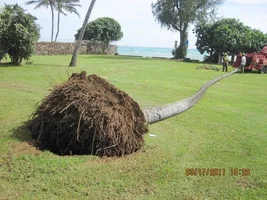
Speaking of coconut palms... this was yesterday.

jp
grin.gif
 

Attachments

  • 272249-IMG_0655.webp
    272249-IMG_0655.webp
    84.1 KB · Views: 55
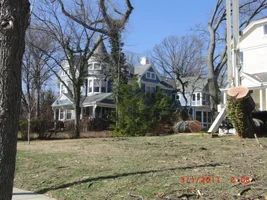
couple of picts I found in the next group with kind of an interesting house I work on next door owned by a Railroad guy and there is an outside train set up between the houses.
 

Attachments

  • 272571-030.webp
    272571-030.webp
    91.6 KB · Views: 54
Here's a pict of the uprooted stump about 12' root plate with few major roots to be seen. Lucky people. I will re learn how to embed again if I get embedded on this forum. I used to know how to do it.
 

New threads New posts

Back
Top Bottom