Is a Spider Leg considered a Sling according to OSHA?

No but it does say a knot cannot be used in lieu of a splice
These standards are so frustrating. It does say that, but there's also language about hitches, which, to me, means that the "not knot in lieu of splice" means the part on the hook, and the hitch, by definition, refers to the load.

Sent from my XT1080 using Tapatalk
 
I went to my local manufacturer this morning and got a copy of the 2010 ASME 30.9-2010. He is going to get me the 2014 in the near future but told me not much has changed . what I do see different is the rope type used which is why I deleted my post above.

9-4.2.1 Synthetic Ropes
(a) Synthetic Fiber Materials covered for use in synthetic ropes are nylon and polyester. Rope constructions shall be manufactured and tested in accordance with one of the following applicable cordage institute specifications:
Rope Type Designation
Nylon three-strand laid CI 1303
Nylon eight-strand plaited CI 1303
Nylon Double braid CI 1306
Polyester Three strand laid CI 1304
Polyester three-strand plaited CI 1304
Polyester Double Braid CI 1307
Polyester single braid CI 1305

9-4.2.4 Other materials
Synthetic Ropes and components other than those listed in paras.9-4.2.1 and 9-4.2.3 may be employed. When such materials are employed, the sling manufacturer or qualified person shall provide specific data.
these slings shall comply with all other requirements of this chapter.


So this opens up the use of materials not listed.
 
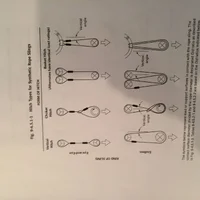
In my conversation with the manufacturer he stated knots are not allowed as attachment points. Reason being; the hitch type must be tested and included in the labeling for working load limits. In the B 30.9 there are diagrams showing the types of hitches. So the above sling I posted would not fit in the guide lines because the ratings for the hitches shown would not accurately describe the hitch being used. they would need to be rated for the cow hitch; clove hitch; running bowline, for example.
 
This is a funny situation for sure. I look at the "no not" because shortening a sling by tying a knot in the middle of it will weaken it. I also interpret the no knot in lieu of a splice because making a loop in the end of a sling is weaker as well.

As for the ratings, I look at the ratings for a cow hitch as being equal or stronger than a choker configuration since there are 2 parts of rope in the eye rather than one.
 
This is a funny situation for sure. I look at the "no not" because shortening a sling by tying a knot in the middle of it will weaken it. I also interpret the no knot in lieu of a splice because making a loop in the end of a sling is weaker as well.

As for the ratings, I look at the ratings for a cow hitch as being equal or stronger than a choker configuration since there are 2 parts of rope in the eye rather than one.
This is exactly how I view it. The question is how does Osha interpret it.
As for my work practices I will continue with this practice using cow hitches as stated above.


Although I am confident with clove hitch use,with crane work I feel the cow hitch is better because it loosens up much easier. I have had the clove tighten to the point of needing a hammer to untie.
 
I researched this issue quite a bit in the past few months as I was planning to buy a set of spider slings after last storm season.

I was only able to find one research document that talked about strength loss of a clove hitch and surprisingly it was 35-62% strength loss, especially with high tech fibers such as endura.

http://www.neropes.com/Resources/sail_reprint.pdf

I talked with a state employee who is familiar with the crane industry and he directed me towards the general industry rules, and vertical standards which have been sited already. He also noted that since there isn't a rule specific to arboriculture ANSI Z133 could be considered which does not mention the knots. I believe it says something to the effect of "use according to manufacturers specs and instructions".

I think part of the issue with knots is that they must be tied, dressed, and set properly for consistent results.

I keep hoping to see a sling set rated for treework... The set linked above is clearly sold for tree work, but how do the ratings apply?

Straight?
Choked? Maybe tail through eye around load and then how does it attach to the hook?
Basket?

My friend who works at the state OSHA did say that usually if you can defend your decision to go outside the rules as " safer ", especially when the rules consider advances in an industry you may be able to avoid citations... You will have to be able to explain it, and defend it.

The only set I can see passing an inspection without a doubt is what wesspur and sherril is selling. They sell a set of 3 slings, 1 large sling has 2 eyes, one tight eye chocks the load with a shackle. The 2 smaller slings are balancer slings that are not relied upon for load holding, only for balance. That way even though there are knots, they are not part of the critical sling.

My main issue with that is that if I could just use 3 sepersate slings, I am backed up 2 times, whereas with the above-mentioned set I am fully dependant on the 1 sling. In either case I would limit the load to the WLL of 1 sling.

I think in the end I settled on that I was going to use the rigging I concluded was safe and I would derate it by 60% for the clove hitch. I haven't had to purchase the rigging yet...

 

New threads New posts

Back
Top Bottom