
Roger, yes that it a large clevis above the ball with a ring and ring friction saver. It seems like when the cuts close it would brake, but since the back cut is so far back it seems to hold well. This is not a cut that I tought Juan and Fransico, I'm just learning form them. Now lets all play nice.

Navigation
Install the app
How to install the app on iOS
Follow along with the video below to see how to install our site as a web app on your home screen.
Note: This feature may not be available in some browsers.
More options
You are using an out of date browser. It may not display this or other websites correctly.
You should upgrade or use an alternative browser.
You should upgrade or use an alternative browser.
Interesting cuts
- Thread starter tod_k
- Start date

TreeCo
Carpal tunnel level member
[ QUOTE ]
It works same as a felling cut. Hinge will hold until the notch closes. the difference is in the place ment of the notch and hinge. The notch and hinge should still be horizontal to be most effective.
[/ QUOTE ]
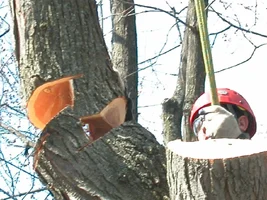
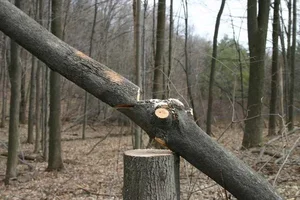
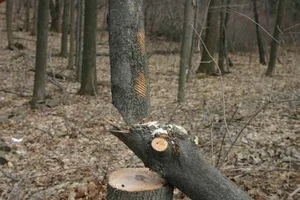
Allmark I think you are wrong here as there is no 'hinge'. If the notch and snap cuts were horizontal this cut would be almost useless. This is a type of snap cut with the notch taken out so the butt of the removed piece can sit on the tree until lift off. If the snap cuts were horizontal there would be zero cradling effect and the butt would be free to slide off of the tree. The cradling effect is what this cut is all about and it looks like it's best use is on non vertical limbs.
It works same as a felling cut. Hinge will hold until the notch closes. the difference is in the place ment of the notch and hinge. The notch and hinge should still be horizontal to be most effective.
[/ QUOTE ]
Allmark I think you are wrong here as there is no 'hinge'. If the notch and snap cuts were horizontal this cut would be almost useless. This is a type of snap cut with the notch taken out so the butt of the removed piece can sit on the tree until lift off. If the snap cuts were horizontal there would be zero cradling effect and the butt would be free to slide off of the tree. The cradling effect is what this cut is all about and it looks like it's best use is on non vertical limbs.

allmark
Participating member
I think Im correct just not clear on my explanation. Ill take a couple of pics and see if we are doing the same thing and I am not explaining good enough or I may be incorrect and learn something new.
TreeCo
Carpal tunnel level member
[ QUOTE ]
Interesting stuff.
Eric, I find your criticism of MB hilarious.
[/ QUOTE ]
If MB had some foam tied to his butt as fall protection.....now that would be hilarious!
One handed chain sawing in a tree using only one tie is not funny, it's just plain stupid.
Interesting stuff.
Eric, I find your criticism of MB hilarious.
[/ QUOTE ]
If MB had some foam tied to his butt as fall protection.....now that would be hilarious!
One handed chain sawing in a tree using only one tie is not funny, it's just plain stupid.
allmark
Participating member
allmark
Participating member
allmark
Participating member
TreeCo
Carpal tunnel level member
[ QUOTE ]
Treeco. Your explanation is dead on.
[/ QUOTE ]
Thanks. I was sticking my neck out a bit.
Treeco. Your explanation is dead on.
[/ QUOTE ]
Thanks. I was sticking my neck out a bit.
allmark
Participating member
allmark
Participating member
allmark
Participating member
allmark
Participating member
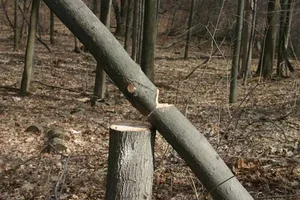
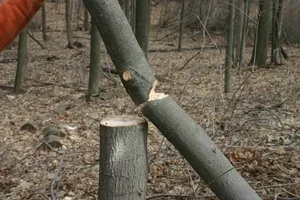
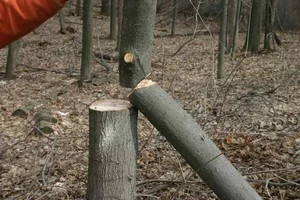
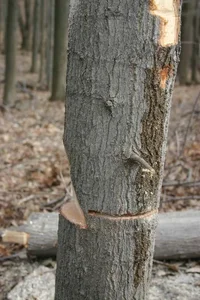
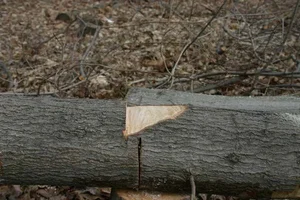
This is the same piece on flat. If it were a limb you chose to raise straight up with a crane grcs hobbs or what ever the wood still reacts the same. Whether the back cut is horizontal or in line with the apex of the notch you are still cutting the fibers up to the hinge, and not thru the hinge until it is straight up if that is what is desired.
Attachments

allmark I'm with you, Greg Good was working with our company one day, he was showing us your "level cut" on some big wood lifts with the GRCS, he called it a shelf cut, if you master the angles right the wood stands up and sits on the "shelf" till you lift it off. nice pics /forum/images/graemlins/cool.gif

- Location
- urbana, il.
todd k, thanks for sharing the photos. nice work! i couldn't agree more with butt hitching any pick overhanging:wires,houses, other trees,etc. i usually use a short 50'-60' line for this. sometimes i untie it from the tree and other times i just let it ride out to the chipper. this can make it easier to guide the butt toward the infeed. your cut works very well! i've only been using it the short time (since you told me about it) but can see the advantages over the plain snap-cut and standard hinge.
Now this is great and brings the new term ... shelf cut.
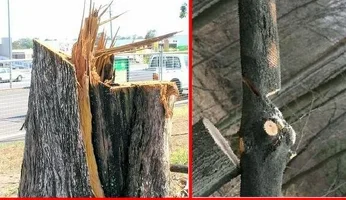
What I have done here is rotated a pic and put an angled back cut pick next to it.
When felling we are told the angled back cut is a no no ... the sample pic of the angled back cut was from a construction site and has some thick hingewood but please ignore those details it's the concept of the angled back cut rotated 45 degrees+ being called a shelf cut that has me wondering ...
Why is it a no no in the felling world when allegedly it's OK with crane jobs?
And according to the series of pics from Allmark there's no difference in the hinging capabilities yet it provides a shelf for the butt. I suppose with the technique used for felling a tree one could argue that it's butt protection too, the butt can't go past the angled back cut. Hmmm interesting hey.
If it's the fact that the crane is lifting it is also too a fact that the tree is leaning or pulled with ropes ....
.... I would just like to have this cleared up.
What I have done here is rotated a pic and put an angled back cut pick next to it.
When felling we are told the angled back cut is a no no ... the sample pic of the angled back cut was from a construction site and has some thick hingewood but please ignore those details it's the concept of the angled back cut rotated 45 degrees+ being called a shelf cut that has me wondering ...
Why is it a no no in the felling world when allegedly it's OK with crane jobs?
And according to the series of pics from Allmark there's no difference in the hinging capabilities yet it provides a shelf for the butt. I suppose with the technique used for felling a tree one could argue that it's butt protection too, the butt can't go past the angled back cut. Hmmm interesting hey.
If it's the fact that the crane is lifting it is also too a fact that the tree is leaning or pulled with ropes ....
.... I would just like to have this cleared up.
Attachments
allmark
Participating member
I was not showing a shelf cut. It is a hinge cut used to raise a limb verticle and only after it is, cutting the rest of the hinge to release the piece.
Theangle cut with reference to a felling situation restricts the use of wedges and by no means can prevent the tree from falling back. As far as keeping the but on the stumps there are other notches for that. I was simply showing you are cuting the same fibers in the flat or angled cut.It just takes more with an angle cut. when you get to the hinge in either cut you are left with the same hinge.
Theangle cut with reference to a felling situation restricts the use of wedges and by no means can prevent the tree from falling back. As far as keeping the but on the stumps there are other notches for that. I was simply showing you are cuting the same fibers in the flat or angled cut.It just takes more with an angle cut. when you get to the hinge in either cut you are left with the same hinge.

The angled back cut will usually not offer the protection that the operator who made it is looking for. If the tree sits back or needs much wedging you can get very screwed very quickly.
The "shelf" cut is just as (not) safe. The only reason the "shelf" cut is acceptable is because the weight is being (better be!) almost entirely carried by the overhead hoisting mechanism. If the hoist failed, you'd sure wish you'd used a back cut perpendicular to the stem!
The "shelf" cut is just as (not) safe. The only reason the "shelf" cut is acceptable is because the weight is being (better be!) almost entirely carried by the overhead hoisting mechanism. If the hoist failed, you'd sure wish you'd used a back cut perpendicular to the stem!

- Location
- Nashville, TN
right on Glens, this method should only be used on limbs that are horizonal(or close) and being lifted by a crane or GRCS, or other lifting device..... now if you are not carefull and the end of the limb is not symetrical, or choked right, you take the chance of the limb rolling and the butt falling off of the "shelf" .....
- Location
- Ontario, Canada
MR_ED I get the impression that you feel the use of a crane is a rare instance in tree work? In one season alone, last year we (my company and I) did 17 large removals with various crane sizes... I'm not bragging by any means, just stating that it's a regular part of a removal crews' working scheduale to have a crane job on the list perhaps once a month or so. Your comments really don't hold much water, other than perhaps jealousy - the father of poor critisism.
Anyhow, what I've noticed about limbs being pulled away from the cut by a lift is that if you leave a small amount of wood (on purpose or by accident) the effect of tearing instead of a clean breakaway can cause the limb to "rock" or "roll" from side to side as it is being pulled. Every action has a reaction, and a rocking limb is only going come back at you as it tears away... the crane operater can account for this and pull it away quick enough to be free of your work zone, but honestly, I don't want my life in the hands of another man while I'm hanging from a rope 50 feet up a tree. This is why, perhaps that MasterBlaster has developed (as my boss/co-worker does) the technique of hidding behind the trunk in deffence from the limb as he does the reach around one-hander (no pun intended). The extra piece of wood is the result of a bar which is too short (often the case with the little top handle saws)... rushing through the job because it costs $250 an hour for the crane to be there, not taking the time to has a larger saw sent up for the lager wood. It takes a little practice to get good at wrapping your cuts around big wood with a little top handle 12"er and can be more dangerous (one handing) but old habits die hard I supose.
I'm at constant battle (subconsciously and in good humor) with my boss and his self-taught / 19 years of experience / legend in his own mind way of doing things and the way I do things in a tree which were taught to me by pros in a full time two year college program (Flemming College, Lindsay Ontario, Canada). "Using a big saw in a tree to make proper cuts wastes time... you should be able to reach around and follow your cut through with one hand," says the guy who signs my pay check... "never use a saw with one hand at full reach with 800 pounds of wood at the end of it," says common sence. Maybe there is a fine line to be drawn between the two, in certian circumstance... maybe.
Anyhow, what I've noticed about limbs being pulled away from the cut by a lift is that if you leave a small amount of wood (on purpose or by accident) the effect of tearing instead of a clean breakaway can cause the limb to "rock" or "roll" from side to side as it is being pulled. Every action has a reaction, and a rocking limb is only going come back at you as it tears away... the crane operater can account for this and pull it away quick enough to be free of your work zone, but honestly, I don't want my life in the hands of another man while I'm hanging from a rope 50 feet up a tree. This is why, perhaps that MasterBlaster has developed (as my boss/co-worker does) the technique of hidding behind the trunk in deffence from the limb as he does the reach around one-hander (no pun intended). The extra piece of wood is the result of a bar which is too short (often the case with the little top handle saws)... rushing through the job because it costs $250 an hour for the crane to be there, not taking the time to has a larger saw sent up for the lager wood. It takes a little practice to get good at wrapping your cuts around big wood with a little top handle 12"er and can be more dangerous (one handing) but old habits die hard I supose.
I'm at constant battle (subconsciously and in good humor) with my boss and his self-taught / 19 years of experience / legend in his own mind way of doing things and the way I do things in a tree which were taught to me by pros in a full time two year college program (Flemming College, Lindsay Ontario, Canada). "Using a big saw in a tree to make proper cuts wastes time... you should be able to reach around and follow your cut through with one hand," says the guy who signs my pay check... "never use a saw with one hand at full reach with 800 pounds of wood at the end of it," says common sence. Maybe there is a fine line to be drawn between the two, in certian circumstance... maybe.
New threads New posts
-
test
-
-

-
First time rope and harness tree climber shows the best attitude
- Started by moss
- Replies: 7
-

-


