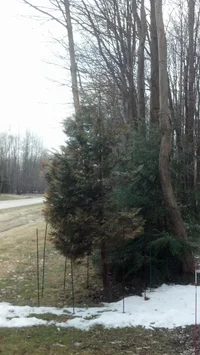
Incense Cedar with browning tips

GregManning

Super Moderator
Staff member
Location
Chardon, OH
Incense Cedar with browning tips.
Incense Cedar, ~3-4” Diam, ~10 ft tall.
Transplanted ~ 8+ years ago.
Location is NE Ohio. This winter has been colder than normal.

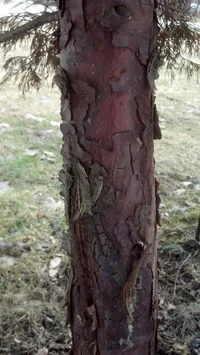
Trunk was girdled by deer ~5 years ago; but has nearly healed 100%.
No obvious bugs, threads, webbing.

Tree stayed green thru fall & winter.
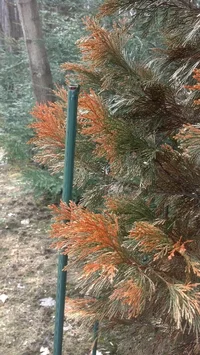
Lately, the tips (3-5”) have started to brown; mostly in the bottom 2/3 of height, but may be expanding.

This browning has not happened in previous years.

Any thoughts ?
 
Any pictures?
A view of the overall tree, the pattern on a branch, and a closeup of where the browning actually is on the needle (tip, splotches, diffuse, hardedged, etc.) would help. If it were here in Northern New England and with no other pictures or information, I'd say "winter injury" and await recovery (or not) in the spring.
 
I'm no expert here, but if you preview your post, there is an opportunity to upload attachments. That's better for me than having the photos "in-line" in the post itself. Not everyone agrees with that!
 
Flare visible on right but not left. ? Maybe rake away excess soil and aerate on downhill side to get better drainage; that would help if the browning is caused or aggravated by fungus.

Tight spot for a large-maturing (potentially) species. Hard to get good air movement next to a hemlock.
 
Healed area on trunk of Incense Ceder after damage (>1/2 diam) from deer:
 

Attachments

  • 387920-140325IncenseCeder052-1.webp
    387920-140325IncenseCeder052-1.webp
    352.8 KB · Views: 36
My guess is that this is a cold related injury--perhaps "wind burn". The tree is exposed and your climate is a bit colder than where Incense cedar is native to. We sure see a lot of browning out of the lower branches of Incense Cedar--but it always looks different than this (e.g. Gymnosporangium libocedri or Seridium canker). I am still mystified by Incense Cedars and their browning out. I had sent samples (of a browning out Incense Cedar) to O(regon)SU Plant Pathology clinic and they came back with nothing. I'm guessing wind burn and cold...just a hunch. :)
 
While we have the ear of some heavyweights here, is there any truth to the statement that tip blight is generally a symptom of a root problem?

It seems to me that cold damage would be localized on the plant, and confined to one 'side' if you will.

I have seen tip blight (with no disease present or detected) in drought stressed evergreens as well as evergreens with flooding/standing water issues, hence my hunch that the above statement has some truth to it.

Thanks in advance for any input.

-Tom
 
[ QUOTE ]

My guess is that this is a cold related injury--perhaps "wind burn". The tree is exposed and your climate is a bit colder than where Incense cedar is native to.

[/ QUOTE ]
Yep.
This was a Test Plant given to me by my local Holden Arboretum to try.
 
[ QUOTE ]
[ QUOTE ]

My guess is that this is a cold related injury--perhaps "wind burn". The tree is exposed and your climate is a bit colder than where Incense cedar is native to.

[/ QUOTE ]
Yep.
This was a Test Plant given to me by my local Holden Arboretum to try.

[/ QUOTE ]

The pic of the needles showed a linear, outside-in effect as from cold and polluted air.

Tom--no derails, you see how key a graphic is, post blighted tips and bad roots (or drainage?) on the same tree if ya got em.
cool.gif
 
Thanks Greg for the pictures. They help a lot. I'm still thinking "winter injury"...which for me is not just cold damage. I include dessication (wind)in that as well.

In northern Vermont and New Hampshire, the greatest winter injury we see follows late winter / early spring warmups that are chased away by normal cold. The warm spell causes a dehardening that renders branches and foliage susceptible to normal amounts of cold. Also, the warm spells promote moisture less...which is hard to replace from frozen soil!

I'm having trouble, and it's likely just me and my monitors, to see whether there is any "sidedness" to the symptom expression. Could salt spray be a problem?

I'll leave this to folks who know this species better than I do!
 
Thanks Kevin.

No salt on this road; only cinders.
Very low pollution. It's a rural area about 30 miles east of Cleveland, OH.
(Except for my pre-catalytic wood burning stove. ;-) )
It is the "snow capital" of Ohio w/ Lake Erie snow effect.

The brown tips are really pretty uniform around the tree circumference. (Bad pic on my part.)
There is more growth toward the open light (road) direction, as normal.
There is, very slightly, more damage on the open side (slightly more windy ???)
However, both sides of the road are heavily wooded (i.e. wind breaks.)
Don't think drainage is a problem since 1) it was OK until this year; 2) not in a wet area.

Today I will get some sample tips & examine w/ a microscope for any non-obvious symptoms.

Note: The cedar is near the middle of a double row of Eastern Hemlocks, planted 15 years ago. (600 foot row, w/ ~ 130 trees.) None of them have abnormal browning tips.
I guess this just means they are better suited to this winter.

As observed, above the Cedar is ~10 ft from the closest hemlock.


Thanks again.
 
Today I inspected 3 brown tip samples from the Incense Cedar, using a stereo microscope (15X & 30X).
The samples were ~ 3X5” each, and collected at front, side & back. Checked front & back of samples.
No bugs, crud or other unusual debris.

I did see a couple of very small forms (0.02” X 0.01”), but I think these were “normal” growth abnormalities.

The “needles” have a VERY cool structure.

Seems like I’m back to winter / dehydration damage, which I hope is recoverable, since most of the tree is still green.
 
per: Ethan Johnson
Plant Records Curator
The Holden Arboretum

Re: California incense cedar (Calocedrus decurrens)

I concur with the diagnosis of winter injury. Yes, the bucks rub the velvet off their antlers on our saplings too if we do not protect them with galvanized metal fencing.

Have been out documenting winter injury this month on The Holden Arboretum's trees & shrubs. A couple of our healthy Calocedrus decurrens planted in 1995 on well-drained soil on a ridge in the conifer collection have just minor winter burn and are in excellent condition, but a couple that were planted in 2008 in heavy silt loam and were only in fair condition going into the winter had a significant amount of winter burn mostly on the lower limbs, and a third group of 9 trees that were planted out in May, 2012 and never got well-established due to the drought that summer are all looking like they are candidates to "take a ride on the chipper truck", since they are all dead or dying.
I did a survey of American Conifer Society members as to which conifers sustained winter injury or were killed outright during the winter of 1993-94. One of my correspondents was Greg Williams of Vermont who emphasized that winter injury to conifers is often due to the condition of the plants going in to the winter which is often impacted by drought and other stress that the trees have been subjected to during the previous season(s). Of course, plants that are only marginally hardy in our climate like the California incense cedar are the ones which most often exhibit variable winter injury.

Glad that you reported your Korean pine (Pinus koraiensis) is doing well. Ours are too. Did you know that if you buy pine nuts in the grocery store, they are most likely to be from the Korean pine? The Korean pine also grows in China and that is where most of the pine nuts in the supermarkets around here come from.

NOTE BY GREG:
Holden is 15 miles from my Incense Cedar.
 
[ QUOTE ]
Tight spot for a large-maturing (potentially) species. Hard to get good air movement next to a hemlock.

[/ QUOTE ]
FYI
I reviewed literature from Holden Arboretum on my Incense Cedar “test plant”.

The tree will be:
Columnar
30 – 50 ft tall
8 – 10 ft wide
Therefore, 10 ft spacing seems quite good. (Lucky on my part ???)
 
Well that shows how deceiving a 2D image of a tree can be!

~50' x 10-12' was the size of the mature one at UNC that I guyed 20 years ago--22 actually. I expect it's still vertical...anyway good luck with yours!
 

New threads New posts

Back
Top Bottom