How does MA work?

all the people that claim that the pyramids were built by aliens never saw a couple of skinny arborists hoist 600 pound logs into the back of a truck with only ropes and pulleys. Those egyptians knew their rigging.

Ain’t no rigging anchor point above the pyramids


Does anyone have any good articles / books on an introduction to MA? I can set up different MAs up to 15:1 fairly easily but I’d like to understand more intricacies such as the differences between complex and compound
 
Last edited:
Standard is possible pulley positions :
on anchor is re-direct double loaded pull on anchor
on output against load places 2 pulls against load for more power at a loss of speed/distance
on input effort to divide it by 2, giving less power but faster
>>first is neutral, last 2 are like transmissions or a 10speed bike : choose power or speed from the input force volume.
.
These 'rolling levers' do have classes like thier rigid counterparts:
anchor pivot between input and out put as re-direct is 1st class lever just like rigid
anchor point pivot not between input/output and closest to output is 2nd class like rigid increases power.
anchor point not between input /out put but closest to input is 3rd class lever, reducing power just like rigid counterpart.
1st class lever is only type reversing direction, others input/output move same direction
.
All levers simply take force volume and re-direct it and/or adjust the input force volume of distance x power to antoehr ratio but same end volume of force
>>less conversion tax, for there is no 100% efficiency of conversion of targer, always some loss/conversion to heat etc. (to in total equal input volume,just not all against solo target)
.
Floating /complex pulleys to me are a Burton Effect, can divide or magnify force volume per position;
BUT seriously reduce available travel of input force, for travel stops when first pulley hits another etc. which is never the full draw.
.
pulleys.png


For me this is a feel, don't know of best resource.
The 2-handing a system i try to present is a form birthed from these pix and climber in DdRT!
But as DdRT does give the full draw!


work time.
 
Last edited:
.... Both moving pulleys move away from the load, but at different speeds. .....

View attachment 55187
A person should always, or most of the time if it is questionable, count the tensions. If that does not come up with the same number it is a complex system.
Let me address what you said when referring to the 4:1 on the left, "Both moving pulleys move away from the load, but at different speeds." Give that another thought, that pulley on the left is solidly attached to the load, right? How then could it be "moving away from the load"? That whole moving pulley concept confuses more people than it helps, IMO. If a person wants to use the "is the pulley moving" idea, it is important to do it relative to the load and force applied. You also approached that concept when you wrote, "orientation relative to the load", now just take it the next step, relative the load and force applied. It is that relativity that changes the MA.
We have been down this road when talking about a 3:1 yoyo climbing/limbwalking setup vs. the same setup when used as a hauling system. One is 3:1 the other 2:1
In your diagram, the 4:1 hauling system becomes a weird 3:1 complex climbing system. Again, look at this in reference to the load and force applied. Both pulleys would be moving relative to the hauler (force applied) vs. only one is moving relative to the climber (force applied).
On your complex 3:1 on the right. Reference to the hauler, yes a 3:1 (only one of those pulleys is moving toward the force applied but if a climber stands on the load and essentially becomes the load, it is a 4:1 and both pulleys will be getting closer to the climber (force applied) so relative to the climber they are both moving.
Some may be thinking, I'll never use this. I use it all the time on my lanyard for pick offs. Attaching a yoyo 3:1 on my doubledover lanyard becomes a 6:1 climbing system or a 5:1 hauling system. Typicality allowing me to lift up to (I've measured it) about 850 pounds. Enough to move limbs off a climber or install cabling etc. etc.
 
Last edited:
A person should always, or most of the time if it is questionable, count the tensions. If that does not come up with the same number it is a complex system.
Let me address what you said when referring to the 4:1 on the left, "Both moving pulleys move away from the load, but at different speeds." Give that another thought, that pulley on the left is solidly attached to the load, right? How then could it be "moving away from the load"? That whole moving pulley concept confuses more people than it helps, IMO. If a person wants to use the "is the pulley moving" idea, it is important to do it relative to the load and force applied. You also approached that concept when you wrote, "orientation relative to the load", now just take it the next step, relative the load and force applied. It is that relativity that changes the MA.
We have been down this road when talking about a 3:1 yoyo climbing/limbwalking setup vs. the same setup when used as a hauling system. One is 3:1 the other 2:1
In your diagram, the 4:1 hauling system becomes a weird 3:1 complex climbing system. Again, look at this in reference to the load and force applied. Both pulleys would be moving relative to the hauler (force applied) vs. only one is moving relative to the climber (force applied).
On your complex 3:1 on the right. Reference to the hauler, yes a 3:1 (only one of those pulleys is moving toward the force applied but if a climber stands on the load and essentially becomes the load, it is a 4:1 and both pulleys will be getting closer to the climber (force applied) so relative to the climber they are both moving.
Some may be thinking, I'll never use this. I use it all the time on my lanyard for pick offs. Attaching a yoyo 3:1 on my doubledover lanyard becomes a 6:1 climbing system or a 5:1 hauling system. Typicality allowing me to lift up to (I've measured it) about 850 pounds. Enough to move limbs off a climber or install cabling etc. etc.

Maybe it would make more sense to say that all moving pulleys move "in the same direction as the load"?
 
ALL LEVERS: Class_2 (power increasing) or Class_3(power decreasing)
rolling or rigid: input effort and output against load ALWAYS in same direction
only Class_1 levers reverse direction, and is between input/output , in rolling levers/pulleys for flexible devices:
>>reverses direction only, no change in power (rigid change in power by length ratio)
>>can be added to a base system to make a change in direction and give power from whole system.
.
Each leverage class has unique properties to identify it, as well as exploit:
Pulley on load places 2x line tension against load for more power, but slower: 2 legs to load have to be shortened at once by single leg input. class_2
Pulley on anchor places 2x line tension against anchor to reverse direction(possibly just to divide load or effort again) class_1
Pulley on input effort places 2 x line tension against input by dead ending part of input into pivot class_3
>>forcing half force wasted, but lengthens 2 lines at once for 1 pull against load so is 1/2 power 2x speed.
.
i simply think of it as funneling more distance into a smaller space for power, or diluting power over longer distance for speed.
.
Hydralic jack piston forces down small cylinder few inches, to feed large cylinder
>>conversion to spreadout force of more power, smaller lift distance than input downward
Volts x Amps can be manipulated to the same total watts.
.
No cheating, always the same volume total, either spread far across aquarium floor
>>or scrunched up into smaller distance but rising higher on glass/ placing more pressure on glass
>>and always some loss at each conversion point
.
**Using DdRT lessons as input can get : 8xEffort++ out of 5x1, and with less frictions tax than standard 8x1**

All pulley jig power ratings assume pure straight line input and each leg also.
>>So banjo sets have larger sheeve on 1side and and smaller on the other in like fig.8/banjo
>>2 sets smallers face each other and now purer power delivers as is more inline and not side by side pulleys.

edit:
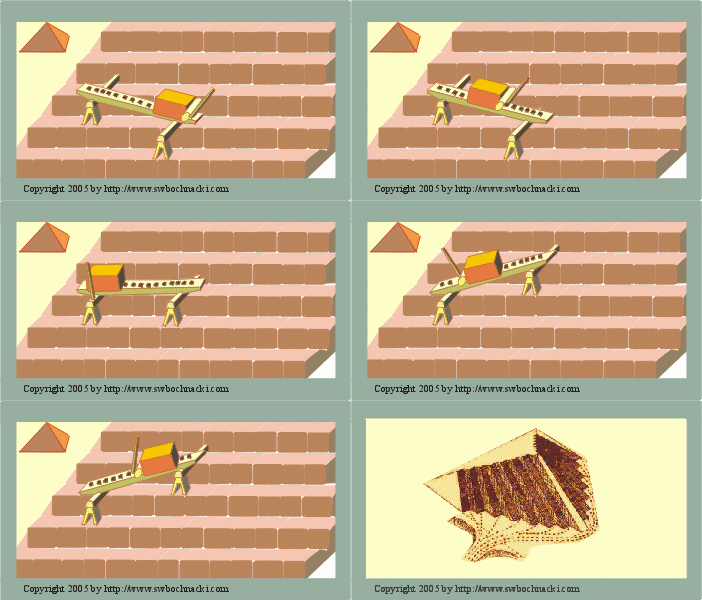
personal fave for ingenuity of man as applied to pyramid building:
pyramid.gif


Especially like how load goes out past higher support to then auto-lift longer end of ramp up.
>>compounding steps into compounding ramp into compounding lever
>>into trying to finesse constant flow to almost self walk with minimal, well timed effort!
 
Last edited:
,......Or is it simply the case that ALL Complex systems have at least 1 pulley that moves towards the load?
dsc_2345-jpg.55187
.
PERSPECTIVE is one view.
Where say is 4:1 compound against load
>> is at same time 3:1 complex against anchor support.
vice/versa
The service/ functions rotate: input effort/output against load/pivot machine anchor
>> but same force at each endpoint 1x, 3x, 4x that services rotate to
>>and thereby those points would remain compound/complex/mono(?) from the perspective of that service/function harvested at that point on rotation of position.
.
On a bad day, intended anchor pivot might give and become load, as load is pivot instantly. Into scenarios where finger gets drawn into pulley etc..
.
I always try to run model backwards for different view and parity/verifications cross checksum.
.
To me an inset system view is best for breakdowns, and most 'complex' is multiple inputs that are equal and opposite each other as an inset subsystem, to include the human body.
.
edit: perhaps would help to see same setup as 6 speed transmission but always same math per position 1x,3x,4x rotating input,output,pivot functions thru for different input : output ratios of power and reciprocal speed(distance achieved in same time slice)
.
With 1x position as non-moving pivot , have 2speeds: 3:4 and 4:3
With 3x position as non-moving pivot , have 2speeds: 1:4 and 4:1
With 4x position as non-moving pivot , have 2speeds: 1:3 and 3:1
Same machine, same math internally, external names just per how deployed.
.
Legs that don't connect both load and support are class_1 redirect lever functions.
>>input leg directly to load seen as 1 support in this view
 
Last edited:
Me too. But I got the info I was looking for, so thanks guys!
Just so my brain doesn't melt, I'm going to clarify "upside down" vs. location of attachment points, because in arbor work, our anchors are many times at our feet and loads above our heads. Regarding your sketch:
The complex system maintains only 3:1 with two pulleys because, while one of the pulleys is attached to a standing end of the cord going thru the sheave of another pulley, that pulley becket/eye is attached to the anchor (not the load) and therefore only 1/2 of the pulleys is movable.

The compound system on the other hand, gets the benefit of 4:1 with two pulleys because while one of the pulleys is attached to a standing end of the cord going thru the sheave of another pulley, that pulley becket/eye is attached to the load, and therefore both pulleys are movable.

Movable pulleys (top becket/eye is attached to a moving rope end or moving load) = mechanical advantage. Immovable pulleys = no mechanical advantage, only force redirection.

Cheers
 

New threads New posts

Back
Top Bottom