It work good!

Navigation
Install the app
How to install the app on iOS
Follow along with the video below to see how to install our site as a web app on your home screen.
Note: This feature may not be available in some browsers.
More options
You are using an out of date browser. It may not display this or other websites correctly.
You should upgrade or use an alternative browser.
You should upgrade or use an alternative browser.
How does MA work?
- Thread starter NickfromWI
- Start date

TheTreeSpyder
Branched out member
- Location
- Florida>>> USA
Welcome Mr. Brion.
i think i said the thing about the needed friction buffer for climber bending line for groundman to take up. i got the whole deal about sweating a line from your books. So, i can go with what ya say, but with the bend on one end of the line, and the takeup of purchase on the other, might not be usual sweating of purchase from line (talked about in your books)?
On the 2:1 on the load i try to stand off the load (so less weight for rig to lift/tension line agianst) by hanging on the control line by R.hand(making bodywieght help, not hinder lift; compound/pivotal adjsutment) while groundman(s) pull too, as my L.Hand also pulls up on line coming from pulley on load. So my own input into line tension is bodyweight on R.Hand x 2; pulls in R.Hand in excess of bodywieght x 3 or Body x2 + 1xpulls in R.Hand in in excess to that + the matching of those pulls (in excess of bodywieght) inputing into system with L.Hand.
The ship rig/ could be 10:1; but the pull of the smaller pulley system is on the tension line/ working on load/ not pulling on anchor for 13:1. If you grabbed handrail with L so that it was equal and opposite pull of R, as it pulled on the 13:1 input, you could then take the handrail pull in L.Hand and pull between the 2 pulley rigs comprising the system. So that the L.Hand pull circumvented the 2:1, but fed into the 5:1, for 18x or 13:1 from R.hand + 5:1 from equal and opposite L.hand(whose pulls skip 1 pulley set but feed into the other 5:1) pull into system.
In the climber hanging on line with R.hand, L. hand won't be quite equal and opposite. Concept easier to picture on horizontal pulls, where R&L are equal and opposite, vertical pulls can skew things with bodyweight giving more pull to 1 hand. But similarily with imagery of L&R as equal and opoposite pulls, on a horizontal 3:1/Z-rig, can get 4x R. hand pull or 3:1 + 1:1. On a 5:1, can get 8xR or 5:1 from R + 3:1 of equal and opposite L pulling from anchor on leg farthest from final pull on load. If you pull on the other leg of line coming from anchor pulley (that goes most directly to final pull on load) of the 5:1 with L(as R pulls regular input) you'd drop to 6xR.Hand pull or 5:1 from R.hand pull + 1:1 of equal and opposite L.Hand pull. That is just working the linear componenet of leveraging for gaining line purchase, not the superiour angular leveraging of sweating purchase from line as Mr. Toss alludes to. But, it is working that linear strategy a bit better i think; especially impacting with bodyweight 1 arm length drop added in.
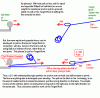
Pic is simplified version of this equal and opposite input into system for more power / was my reply to that a pulley on anchor couldn't help increase points of pull on load, only a pulley on the load can do that. The ship rig as 13:1 and not 10:1 is similar in that each just focuses all pulls possible onto target load.
i think i said the thing about the needed friction buffer for climber bending line for groundman to take up. i got the whole deal about sweating a line from your books. So, i can go with what ya say, but with the bend on one end of the line, and the takeup of purchase on the other, might not be usual sweating of purchase from line (talked about in your books)?
On the 2:1 on the load i try to stand off the load (so less weight for rig to lift/tension line agianst) by hanging on the control line by R.hand(making bodywieght help, not hinder lift; compound/pivotal adjsutment) while groundman(s) pull too, as my L.Hand also pulls up on line coming from pulley on load. So my own input into line tension is bodyweight on R.Hand x 2; pulls in R.Hand in excess of bodywieght x 3 or Body x2 + 1xpulls in R.Hand in in excess to that + the matching of those pulls (in excess of bodywieght) inputing into system with L.Hand.
The ship rig/ could be 10:1; but the pull of the smaller pulley system is on the tension line/ working on load/ not pulling on anchor for 13:1. If you grabbed handrail with L so that it was equal and opposite pull of R, as it pulled on the 13:1 input, you could then take the handrail pull in L.Hand and pull between the 2 pulley rigs comprising the system. So that the L.Hand pull circumvented the 2:1, but fed into the 5:1, for 18x or 13:1 from R.hand + 5:1 from equal and opposite L.hand(whose pulls skip 1 pulley set but feed into the other 5:1) pull into system.
In the climber hanging on line with R.hand, L. hand won't be quite equal and opposite. Concept easier to picture on horizontal pulls, where R&L are equal and opposite, vertical pulls can skew things with bodyweight giving more pull to 1 hand. But similarily with imagery of L&R as equal and opoposite pulls, on a horizontal 3:1/Z-rig, can get 4x R. hand pull or 3:1 + 1:1. On a 5:1, can get 8xR or 5:1 from R + 3:1 of equal and opposite L pulling from anchor on leg farthest from final pull on load. If you pull on the other leg of line coming from anchor pulley (that goes most directly to final pull on load) of the 5:1 with L(as R pulls regular input) you'd drop to 6xR.Hand pull or 5:1 from R.hand pull + 1:1 of equal and opposite L.Hand pull. That is just working the linear componenet of leveraging for gaining line purchase, not the superiour angular leveraging of sweating purchase from line as Mr. Toss alludes to. But, it is working that linear strategy a bit better i think; especially impacting with bodyweight 1 arm length drop added in.
Pic is simplified version of this equal and opposite input into system for more power / was my reply to that a pulley on anchor couldn't help increase points of pull on load, only a pulley on the load can do that. The ship rig as 13:1 and not 10:1 is similar in that each just focuses all pulls possible onto target load.
Attachments

- Location
- Retired in Minneapolis
ZKC,
In your illustration you show the use of a hitch ball as part of a MA system. I think that you're using your poetic license again. It's not a good idea to use hitch balls for any part of an anchor system, they're not strong enough. In real life it would be better to use another anchor. Slinging around the frame and using a heavy shackle or something else would be better.
I had a bollard that was built from 4" diameter tubing mounted on a receiver tube to use for an anchor.
In your illustration you show the use of a hitch ball as part of a MA system. I think that you're using your poetic license again. It's not a good idea to use hitch balls for any part of an anchor system, they're not strong enough. In real life it would be better to use another anchor. Slinging around the frame and using a heavy shackle or something else would be better.
I had a bollard that was built from 4" diameter tubing mounted on a receiver tube to use for an anchor.
TheTreeSpyder
Branched out member
- Location
- Florida>>> USA
i wuz just trying to show a slippery/ low friction anchor point; thanx.
knudeNoggin
New member
[ QUOTE ]
For instance, a 2:1 advantage, with the lead coming down from aloft requires two blocks, one aloft and one on the load. With this arrangement you can roughly double your body weight in power. But if you take the block off the load and put it on the ground as a redirect you can sweat it and/or pull up on the lead, in which case it can be easy to get 3:1 or more.
[/ QUOTE ]
I'm having trouble comprehending this. If you "take the block off the load ...",
then what is supporting/raising this load? --a direct hitch,
w/o any MA? --not getting 3:1 here!
??
For instance, a 2:1 advantage, with the lead coming down from aloft requires two blocks, one aloft and one on the load. With this arrangement you can roughly double your body weight in power. But if you take the block off the load and put it on the ground as a redirect you can sweat it and/or pull up on the lead, in which case it can be easy to get 3:1 or more.
[/ QUOTE ]
I'm having trouble comprehending this. If you "take the block off the load ...",
then what is supporting/raising this load? --a direct hitch,
w/o any MA? --not getting 3:1 here!
??
TheTreeSpyder
Branched out member
- Location
- Florida>>> USA
i think he is talking about taking angular leveage advantage in sweating a line in it's real leverage powerband. If climber assists in tightening the 2:1 and pulls down on input leg and up on line coming from pulley at the same time (bracing against the other hand's pull); we should be able to get 4:1 of 1 hand pull on vertical rig. Or hanging (horizontal rig)from line with R.Hand and pulling up with L.Hand would give 2xbodyweight + 4x L.Hand Pull from climber alone. i think a lot of the times the best thing the climber can do to preset the load on overhead support, is to get off the load, and hang on the line instead, giving compound adjustment from 1 'move'.
Zer0 degrees/"U"Shape of line we look at giving 2:1; is not real leveraged in the angular sense. 180 flat and Zer0 degrees are both inline positions, all others are angled/leveraged, but the named 2 equal and opposite degree positions are flat. So, if we take a pulley off load givng 2:1, and use it to capture purchase from angular/ leveraged sweat; it could then be put to better use.
Our inline 2:1 is just 2 180 degree legs of line, but they are straight legs; the force of the load is ushered/ channeled down the long axis of the line as a device properly. All other positions/degrees, force less of an inline channeling of the force down the line as a device/instrument.
i din't mean to come off wrong before, but i/we can't seem to get the knack of me pulling sharply above the hitchpoint of the rig, with a pulley 20' overhead that a ground crew is trying to pick up the purchase of 60' below. But, i've tried cuz i've L-earned and gotten a lot of utility and understandign from his book's description on sweating a line, when the capstan crank was lost or broken. so men would sweat the line through the capstan, out on open sea for dear life; milleniums before electricity was known.
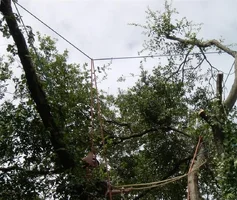
i use the technique evcery day. Pic shows a remote, retrievable 2:1 sweat. One of the reasons for 2 supports is to be able to leverage/sweat the line between the supprts like this, as pretightening, a force of pulls to get fold, tearoff, force stronger hinge, free up stuck limb etc. 1 of the uses fer JP's long lanyard idea for me is being able to get a 2:1 remote sweat(fasten snap to sling on anchor next to you and pull other end)on lines 10' or so overhead. Of course that could be 2:1 on R.Hand pull + L.Hand pulling up (to also help raise the amount that R.Hand was pulling into 2:1...) on line coming from anchor.
Thanks a lot Mr. Brion Toss!
Zer0 degrees/"U"Shape of line we look at giving 2:1; is not real leveraged in the angular sense. 180 flat and Zer0 degrees are both inline positions, all others are angled/leveraged, but the named 2 equal and opposite degree positions are flat. So, if we take a pulley off load givng 2:1, and use it to capture purchase from angular/ leveraged sweat; it could then be put to better use.
Our inline 2:1 is just 2 180 degree legs of line, but they are straight legs; the force of the load is ushered/ channeled down the long axis of the line as a device properly. All other positions/degrees, force less of an inline channeling of the force down the line as a device/instrument.
i din't mean to come off wrong before, but i/we can't seem to get the knack of me pulling sharply above the hitchpoint of the rig, with a pulley 20' overhead that a ground crew is trying to pick up the purchase of 60' below. But, i've tried cuz i've L-earned and gotten a lot of utility and understandign from his book's description on sweating a line, when the capstan crank was lost or broken. so men would sweat the line through the capstan, out on open sea for dear life; milleniums before electricity was known.
i use the technique evcery day. Pic shows a remote, retrievable 2:1 sweat. One of the reasons for 2 supports is to be able to leverage/sweat the line between the supprts like this, as pretightening, a force of pulls to get fold, tearoff, force stronger hinge, free up stuck limb etc. 1 of the uses fer JP's long lanyard idea for me is being able to get a 2:1 remote sweat(fasten snap to sling on anchor next to you and pull other end)on lines 10' or so overhead. Of course that could be 2:1 on R.Hand pull + L.Hand pulling up (to also help raise the amount that R.Hand was pulling into 2:1...) on line coming from anchor.
Thanks a lot Mr. Brion Toss!
Attachments


Ha! I was thinking the same thing; but I'll bet he's got callouses.
- Location
- Port Townsend, Washington
Hi again,
Sorry to have been so long in responding; the season has been so busy that, as of tonight, I will have worked clear through a badly-located vacation. Oh well.
Getting to your question, the answer(s) require a bit more space and computer ability than I have at my disposal. And there are so many variations and themes, especially in your trade, where you have to make up configurations on the spot. So I'm sorry if my previous post was a tease, but all I can do for the moment is:
•Direct you to my site, briontoss.com. Go to "Education", then "Fair Leads", and look up the one about mechanical advantage for blocks. I'm told it's an "aha!"-inducing essay.
•Suggest my book, the "Rigger's Apprentice", or any other good rigging text, like Rossnagel's, for instance, for further ideas. But that brings me into vested-interest territory, as I make part of my living selling books and video's and teaching workshops. So I'll talk to my office about placing a workshop ad here, rather than pollute a discussion board.
Fair leads,
Brion Toss
Sorry to have been so long in responding; the season has been so busy that, as of tonight, I will have worked clear through a badly-located vacation. Oh well.
Getting to your question, the answer(s) require a bit more space and computer ability than I have at my disposal. And there are so many variations and themes, especially in your trade, where you have to make up configurations on the spot. So I'm sorry if my previous post was a tease, but all I can do for the moment is:
•Direct you to my site, briontoss.com. Go to "Education", then "Fair Leads", and look up the one about mechanical advantage for blocks. I'm told it's an "aha!"-inducing essay.
•Suggest my book, the "Rigger's Apprentice", or any other good rigging text, like Rossnagel's, for instance, for further ideas. But that brings me into vested-interest territory, as I make part of my living selling books and video's and teaching workshops. So I'll talk to my office about placing a workshop ad here, rather than pollute a discussion board.
Fair leads,
Brion Toss
- Location
- Port Townsend, Washington
Hello,
Sorry I wasn't clear. On the load, the block would give you a 2:1 advantage; on the ground the lead would go up to the upper block, then down to the load, to be attached directly. This would be 1:1, but would potentially allow more power (legs, sweating the load).
Fair leads,
Brion Toss
Sorry I wasn't clear. On the load, the block would give you a 2:1 advantage; on the ground the lead would go up to the upper block, then down to the load, to be attached directly. This would be 1:1, but would potentially allow more power (legs, sweating the load).
Fair leads,
Brion Toss
Hi Brion.
[ QUOTE ]
·Direct you to my site, briontoss.com. Go to "Education", then "Fair Leads", and look up the one about mechanical advantage for blocks. I'm told it's an "aha!"-inducing essay.
[/ QUOTE ]
Does that mean http://briontoss.com/education/archive/miscjuly03.htm ?
Glen
[ QUOTE ]
·Direct you to my site, briontoss.com. Go to "Education", then "Fair Leads", and look up the one about mechanical advantage for blocks. I'm told it's an "aha!"-inducing essay.
[/ QUOTE ]
Does that mean http://briontoss.com/education/archive/miscjuly03.htm ?
Glen
- Location
- Port Townsend, Washington
Hi there,
Smith's drawing shows a classic means of setting up deadeyes, and of course the same configuration would be valuable in Arborland. The reason that the handy-billy is made off to the standing part of the stay is partly to save the effort of attaching it aloft, though it also adds some mechanical advantage.
Fair leads,
Brion Toss
Smith's drawing shows a classic means of setting up deadeyes, and of course the same configuration would be valuable in Arborland. The reason that the handy-billy is made off to the standing part of the stay is partly to save the effort of attaching it aloft, though it also adds some mechanical advantage.
Fair leads,
Brion Toss
- Location
- Port Townsend, Washington
Yup.
- Location
- Port Townsend, Washington
Hi some more,
Sweating, at least as practiced aboard ship, is a dynamic exercise, equal parts "frapping" leverage and ballistic body motion, plus variable friction at the belay. In other words you have to see it to understand it well. I don't think we quite captured it in the stop-motion picture in the "Apprentice", but the idea is to convert a sharp lateral motion, in a quick, smooth arc, towards the belay, before the slack you've gained is snatched away. Does that make sense?
Your wonderful picture shows an arrangement that is somewhat less skill-intensive, and looks perfect for many field applications, but if you can't get two support points, or if you can't get the line over the horizontal, it were good to be able to sweat at the belay.
Fair leads,
Brion Toss
Sweating, at least as practiced aboard ship, is a dynamic exercise, equal parts "frapping" leverage and ballistic body motion, plus variable friction at the belay. In other words you have to see it to understand it well. I don't think we quite captured it in the stop-motion picture in the "Apprentice", but the idea is to convert a sharp lateral motion, in a quick, smooth arc, towards the belay, before the slack you've gained is snatched away. Does that make sense?
Your wonderful picture shows an arrangement that is somewhat less skill-intensive, and looks perfect for many field applications, but if you can't get two support points, or if you can't get the line over the horizontal, it were good to be able to sweat at the belay.
Fair leads,
Brion Toss
TheTreeSpyder
Branched out member
- Location
- Florida>>> USA
Mr. Brion, that is quite a colorfull description, thank-you! And thanx fer a life of gathering and sharing! Your present evolved description of sweating more purchase form a line done with words; is truly beyond the picture as you say! i think i have found such 'rhythm' on occasion sweating into a ground friction device Porty/fixed capstan etc. in our tree werk.
i did get the idea the whole bending line to leverage from your Rigger's(or as i tell it sometimes Sorcerer's)Apprentice books. That i hope you find to be in good company with my copy of Chapman's; and the likes of Levy Smith, Ashley and Cyrus Day etc. i even used to try to catch PBS learn to sail; just fer Mr. Knot seequences! Also, have learned many lessons in knot strength and secrutiy, from how you maximize them in the strongest/securest example of 'knotting' in the splicing vid. i think in essence knots curve out of line to leverage lines so are inherently weaker; whereby a splice is an unleveraged/inline pull/ not weakening line in it's best, non-deforming application.
With the 'remote sweat' i pictured; your theories work so well, we can get a purchase of another few feet of the line in pretightening the system! i do try to get a quick snatch on the line, sometimes falling back sharply and then serve purchase purposefully to the men pulling, to maintain the tension. This can be just with hand pull/no devices on ground even; just me in tree setting line. With the frictional/non-pulley supports; we can't as easily have the ground crew pull slack on working/load end linearly by hand (from their 'standing part' position...)or even with pulley compression to fully pretighten(always a line leveraging helps in the frictional supports i think). But, we can non-linearly/perpendicularily leverage the line, then sneak that purchase behind a hold to maintain the tension of rope (or something like that). So as we go towards more frictional supports, change from linear advantage (pulley) to non-linear/perpendicular pull/leveraging strategy from your writings. Mostly i just leverage line by bending as ground control is pulling tight, from the climber's postion. Some very unique strategies and powers available in climber position at load rigged from overhead with control line draped down close by i think.
i did get the idea the whole bending line to leverage from your Rigger's(or as i tell it sometimes Sorcerer's)Apprentice books. That i hope you find to be in good company with my copy of Chapman's; and the likes of Levy Smith, Ashley and Cyrus Day etc. i even used to try to catch PBS learn to sail; just fer Mr. Knot seequences! Also, have learned many lessons in knot strength and secrutiy, from how you maximize them in the strongest/securest example of 'knotting' in the splicing vid. i think in essence knots curve out of line to leverage lines so are inherently weaker; whereby a splice is an unleveraged/inline pull/ not weakening line in it's best, non-deforming application.
With the 'remote sweat' i pictured; your theories work so well, we can get a purchase of another few feet of the line in pretightening the system! i do try to get a quick snatch on the line, sometimes falling back sharply and then serve purchase purposefully to the men pulling, to maintain the tension. This can be just with hand pull/no devices on ground even; just me in tree setting line. With the frictional/non-pulley supports; we can't as easily have the ground crew pull slack on working/load end linearly by hand (from their 'standing part' position...)or even with pulley compression to fully pretighten(always a line leveraging helps in the frictional supports i think). But, we can non-linearly/perpendicularily leverage the line, then sneak that purchase behind a hold to maintain the tension of rope (or something like that). So as we go towards more frictional supports, change from linear advantage (pulley) to non-linear/perpendicular pull/leveraging strategy from your writings. Mostly i just leverage line by bending as ground control is pulling tight, from the climber's postion. Some very unique strategies and powers available in climber position at load rigged from overhead with control line draped down close by i think.
TheTreeSpyder
Branched out member
- Location
- Florida>>> USA
On the pulley page: i think that there should be/ actually are 3 pulley positions; 1 on each of the possible positions of: Moving Input, Moving Output and Stationary Anchor/Support. To be complete, should show the 3rd position a pulley can be placed in(?); on the Input to cut it in half or double speed/lose power(on a 50'driveway run with truck, we might be able to pull a load 100'uphill; but at half power-2xspeed etc.). i guess we would properly call this the 3rd class/losing power lever by the previous prescriptions.
Also, i believe in the "More Power to Ya" drawing i show technique for applying more power to target, by placing pulley on the static anchor/redirect position instead of on the load to gain power. i know this is not an ordianrily accepted thought; but in paradigm to me is an essential example of how we achieve, and what is mechanical advantage; especially in the rope sense.
To me, 1 view of the many facets of advantage is to take the promised equal and opposite reaction, and push it out of line, or fold it back on itself to double! Either way, we must take the straight/inline equal and opposite reaction, and arc it. This doubling i think can be done with pulley on the load, or in some cases with the pulley on the anchor directly catching the promised equal and opposite force and turning it back around around onto target. (Placing a zrig inside the 'more power to ya' rig; gives 3x + the 2x that would've usually pulled on anchor, now redirected to pull on the load, for a total of 5x)
This power of arc-ing/ covenant of the arc can be hard to see, we are taught not to dilly-dally and walk a straight line, the shortest distance between tasks, as the most focussed power on target. But,conversely physics says if we can bind that extra travel into placing it's force on target work, the longer distance, the arc - not the straight line is more powerful! For, the part about the shortest distance being a straight line was true...so an arc promises an increase in distance; so the long route, can be better...
Also, i believe in the "More Power to Ya" drawing i show technique for applying more power to target, by placing pulley on the static anchor/redirect position instead of on the load to gain power. i know this is not an ordianrily accepted thought; but in paradigm to me is an essential example of how we achieve, and what is mechanical advantage; especially in the rope sense.
To me, 1 view of the many facets of advantage is to take the promised equal and opposite reaction, and push it out of line, or fold it back on itself to double! Either way, we must take the straight/inline equal and opposite reaction, and arc it. This doubling i think can be done with pulley on the load, or in some cases with the pulley on the anchor directly catching the promised equal and opposite force and turning it back around around onto target. (Placing a zrig inside the 'more power to ya' rig; gives 3x + the 2x that would've usually pulled on anchor, now redirected to pull on the load, for a total of 5x)
This power of arc-ing/ covenant of the arc can be hard to see, we are taught not to dilly-dally and walk a straight line, the shortest distance between tasks, as the most focussed power on target. But,conversely physics says if we can bind that extra travel into placing it's force on target work, the longer distance, the arc - not the straight line is more powerful! For, the part about the shortest distance being a straight line was true...so an arc promises an increase in distance; so the long route, can be better...
- Location
- Port Townsend, Washington
Hello,
First, thank all of you for the very kind welcome. I am so glad that Kathy pointed me to this site. Next, I don't seem to have the hang of replying properly, as all my responses seem to pile up in one place; am I missing something?
Next, Mr. TreeSpyder (what do I call you?), you are far too kind. It is clear that I would have a blast — and learn a lot — if I could hang out with you some day. Unfortunately, that would seem to involve going to Florida...
Anyway, it's fun deciphering your posts on mechanical advantage, great, dense-with-information riffs. Looking forward to future conversations.
Fair leads,
Brion Toss
First, thank all of you for the very kind welcome. I am so glad that Kathy pointed me to this site. Next, I don't seem to have the hang of replying properly, as all my responses seem to pile up in one place; am I missing something?
Next, Mr. TreeSpyder (what do I call you?), you are far too kind. It is clear that I would have a blast — and learn a lot — if I could hang out with you some day. Unfortunately, that would seem to involve going to Florida...
Anyway, it's fun deciphering your posts on mechanical advantage, great, dense-with-information riffs. Looking forward to future conversations.
Fair leads,
Brion Toss

- Location
- Home of the New Jersey Devils
[ QUOTE ]
Next, I don't seem to have the hang of replying properly, as all my responses seem to pile up in one place; am I missing something?
[/ QUOTE ]
You're doing just fine Brion! /forum/images/graemlins/cool.gif
Next, I don't seem to have the hang of replying properly, as all my responses seem to pile up in one place; am I missing something?
[/ QUOTE ]
You're doing just fine Brion! /forum/images/graemlins/cool.gif
TheTreeSpyder
Branched out member
- Location
- Florida>>> USA
[ QUOTE ]
What do I call you?
[/ QUOTE ]
i guess KC (Ken Casey)will do (Figured i should respond before chancing too much more the offering of other suggestions!/forum/images/graemlins/brows.gif).
Kinda think tanking on how to draw this imagery out better; to show better concept of simply taking a force out of 'singular alignmeant'/plum-bob with it's responding Equal and Opposite Reaction to have leverage or advantage change in forces. For, anything else but the singular inline conection between a force and it's Equal & Opposite is arched (even to arc 180 around to Zer0 degrees and give another leg of pull); therefore longer path to same position. Longer distance giving leveraged/advangtaged beyond the inital/'tare' loadforce/ manipulation of numbers. For only force can overcome distance; so they are totally linked. i think about everything that isn't purposefully aligned is leveraged. Also that if we can understand the forces in rigging; we can understand the same by comparable patterns inside the microcosm of a knot/lacing. All of it manipulating force by arching a force out of it's plum-bob/singular alignmeant with it's Equal & Opposite Reaction force, to require more distnace.
Have been trying to figure such productions from different angles on my sight in 'spare time'(an amazing concept in it self, when you never get everything done anyway).
http://www.mytreelessons.com/Termination%20Family.swf
http://www.mytreelessons.com/Rope%20Grip%20theories.htm
http://www.mytreelessons.com/wabash.htm#Scene_1
Any corrections etc. appreciated;
thanx fer everything!
-KC
What do I call you?
[/ QUOTE ]
i guess KC (Ken Casey)will do (Figured i should respond before chancing too much more the offering of other suggestions!/forum/images/graemlins/brows.gif).
Kinda think tanking on how to draw this imagery out better; to show better concept of simply taking a force out of 'singular alignmeant'/plum-bob with it's responding Equal and Opposite Reaction to have leverage or advantage change in forces. For, anything else but the singular inline conection between a force and it's Equal & Opposite is arched (even to arc 180 around to Zer0 degrees and give another leg of pull); therefore longer path to same position. Longer distance giving leveraged/advangtaged beyond the inital/'tare' loadforce/ manipulation of numbers. For only force can overcome distance; so they are totally linked. i think about everything that isn't purposefully aligned is leveraged. Also that if we can understand the forces in rigging; we can understand the same by comparable patterns inside the microcosm of a knot/lacing. All of it manipulating force by arching a force out of it's plum-bob/singular alignmeant with it's Equal & Opposite Reaction force, to require more distnace.
Have been trying to figure such productions from different angles on my sight in 'spare time'(an amazing concept in it self, when you never get everything done anyway).
http://www.mytreelessons.com/Termination%20Family.swf
http://www.mytreelessons.com/Rope%20Grip%20theories.htm
http://www.mytreelessons.com/wabash.htm#Scene_1
Any corrections etc. appreciated;
thanx fer everything!
-KC
- Location
- NW Oregon Coast Range