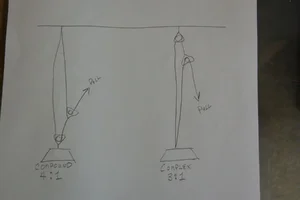
Pretty nice dude!
Some things i note slightly differently; in this ying/yang any measure of force can help or with 1 change hinder type of puzzle. Flip-Sides:
i think with the friction your effective MA is only reduced lifting, but at hold or lower the friction is a helper/load reducer on support and your pull. Thereby to your terminology effective MA is increased(?); but really we are speaking of friction increasing of decreasing efficiency of efforts. Hurting on lift/pull but helping on hold/lower/extend. So, a pulley gives more loading at hold and lower, but less on lift; opposite of non-pulley frictional redirect properties.
Elasticity too hinders on lift, but can help on lower/catching impacting forces and keeping them off support, load connection and you, by the line giving support and shock absorbing capabilities in one device. So, elasticity too is a tool/force that can help or hinder depending on setting/use. Then flipside is you fight less elasticity in MA lift than 1:1 lift.
The support loads of the rope MA systems decrease on lift and hold as you say. But, due to the fact that the lines are less loaded (as they divde load amongst them); the lines respond with less elasticity in multiple power/rope MA systems i think. So that, in catching impact forces in a rope leverage system, the support loads are higher than if all the load force was stretching a single line, rather than 3 (like it would in 3:1).
Ummmm i kinda think there should be arrows pointing up/ not all down to show equal /opposite and rope lift.
i really think MA & Leverage werks by taking a force out of it's singular inline position with it's Equal & Opposite force. If we take the E&O force out of 'inline status' with force we create, we lengthen the distance to E&O that force is carried over. Thereby maniputlating distance part of :
Total Power = Force X Distance, to give more distance, thereby more power in system. This power increases load on support leg(Leverage). Whereby if we furthermore bend the E&O all the way around 180 to pull on load again, we divide the load on the support leg(s)(MA).
But, whether we are increasing (leveraging) or decreasing (giving MA) load on a support leg device; in either case we are taking the E&O force that the initial force seeks and making the inital force travel longer as it seeks it's E&O; thereby manipulating things. Until the initiating force finds the point of it's E&O; the systems loads can't be calculated. A plum-bob works, for it can't resist, so thereby lines up at singular/minimal inline status. As all positions this is a unique event/ math loading in system. But this one just happens to be minimal forces!