Hitch hiker/2/x thread

Cool! Did you spend much time on it yet? Just wondering if the hitch tail works it’s way out at all like the taughline/ midshipman’s always did.
Blake’s always pretty much stayed put, but put a stopper on anyways. Taughtline the stopper was very necessary.
No, I haven't spent much time with it. But, I'm a die-hard SRT climber. I only use DdRT for a temporary second Tie-in. It's not likely to work it's way out with such brief use … I am and will be keeping an eye on creep, though.
 
Last edited:
With a carabiner on the Quicky, there is less clearance and the tail of the rope rubs more so on the carabiner spine. Really the Quicky isn't ideal for a few reasons, distance pin to the arch is too short. Causing a few annoying binding / slack tending issues in less than ideal orientations; the pin is very annoying to remove, not that comes up often the way I used the system. It stays on the rope for most days; the stack height is about the same as the original steel carabiner; Cost; I didn't notice any performance gain in the friction consistency. That is the primary reason I tried it, to see if the slic pin would behave differently then the original carabiner. I'll do some more testing, hope to buy a HHX soonish'

It did seem to tend slightly easier than just the original carabiner, but I run a Pinto with the original. Making disconnecting a PITA at height to ghost (ponytail redirect) then reconnect. Compared to the duo Quickies. Tends the nicest although

The tree I was working in was 4 feet from the swimming ladder...
 
With a carabiner on the Quicky, there is less clearance and the tail of the rope rubs more so on the carabiner spine. Really the Quicky isn't ideal for a few reasons, distance pin to the arch is too short. Causing a few annoying binding / slack tending issues in less than ideal orientations; the pin is very annoying to remove, not that comes up often the way I used the system. It stays on the rope for most days; the stack height is about the same as the original steel carabiner; Cost; I didn't notice any performance gain in the friction consistency. That is the primary reason I tried it, to see if the slic pin would behave differently then the original carabiner. I'll do some more testing, hope to buy a HHX soonish'

It did seem to tend slightly easier than just the original carabiner, but I run a Pinto with the original. Making disconnecting a PITA at height to ghost (ponytail redirect) then reconnect. Compared to the duo Quickies. Tends the nicest although

The tree I was working in was 4 feet from the swimming ladder...
That's a good assessment. I'm also not sure the difference between the slic pin's smooth surface, vs. the carabiner's rounded surface has that much of a favorable impact, despite a carabiner's propensity for side loading. With the steel carabiner in comparison to using a Quickie, at least on my HH2, it's hard to spoil this bulletproof combination, especially with the plastic tending holster. However, I can also connect the HH2 with the tending holster, right onto the Quickie and connect that straight onto my rope bridge. It is a tough call, trying to decide which method is better or worse, but it'll be a blast finding out.

Perhaps a properly sized swiveling-quickie, or swiveling shackle would be a nice way to trim and streamline the setup, if such a thing existed. There are a lot of ways to modernize and modify the tree quickie product into several new size designs that would fill a number of voids to improve both the Rope Runner and Hitch Hiker, but it just hasn't happened yet.
 
Last edited:
@John@TreeXP I was interested to see if the consistency of a cylinder, the slic pin. Would run any different than the original when the orientation shifts around slightly causing inconsistent friction. I never really noticed a big change due to this, it's just an idea in my head lol. I'm not worried about sideloading the steel 'biner.

If anything the slick pin seems to run a bit faster ( less friction on the pin, more on the hitch ), it doesn't spin while in descent but can while tending.

More climbing is needed to get a better feel.

A double slic pin with a swivel in between would be bomber!DoubleQuickySwivel.webp
 
The climbing innovations quickie that comes with the hhx is longer than the original so it should have less binding issues than the smaller one. I just ordered one to put in my hh2 to play with, although I was warned its a pain in the ass to get it back out. I'll probably have an hhx ordered sometime in october, I just ordered the quickie now because I really don't like when the biner turns in the hh2 and I have to take 1 or two seconds to fix it, and also don't like how hard it is to get it on and off with the pulley in the tree. I figure on a small oval biner between the quickie and my bridge ring or cali swivel for easy on and off in the tree, or setup as a long lanyard that can be run srt.
 
I'm gunna have to revisit that KnutH & get it working for me.. I'm pretty sure (as weird as it sounds), my issue was cordage related..


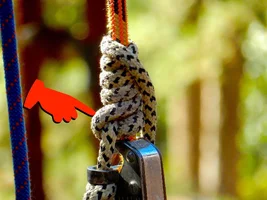
From climbing on the KnutH for quite sometime, I've found: it's that "knot-like" element under the wraps (pointed out in the photo, below) that makes the hitch succeed or fail. That lower portion of the KnutH has to be just right for the hitch to grab and release comfortably. I like it tight. ;)

HHx.jpg

FWIW, What follows is an over simplification - just some personal, general observations:
Wraps hold, 'tails' grab ("Tails"; that's all the stuff below the wraps). You only need enough wraps to hold your weight. At 200 pounds on the HH2 & HHx, I can make 4 wraps work. Too, many wraps makes releasing the hitch too hard. The "tails" of a hitch control the tending and grabbing. "Tails" too long; the hitch tends great but doesn't grab. "Tails" too short; the hitch doesn't tend well and grabs too well.
Side note: For a VT the braids act like a combination of wraps & "tails". So, finding the right combination takes a little more 'tweaking'. Other hitches (Distel, Michoacan, KnutH, etc.) have a kind of simplistic knot between the wraps & "tails" that acts like a more complex combination of wraps & "tails" allowing more complex 'tweaking'.
-- just my 2¢

 

The use of the omni on the bridge is interesting. Why not use a 1.1? Because its only 23 kn?

The Rock Exotica Omni-Block was originally designed and is often used for rescue. It shortened the total system length and is easy on/off while still requiring 3-actions (double-lock). The 'swivel-bale' on the 1.5 is larger than the 1.1 bale. This allows passage of a second 'biner-gate though the bale while still attached to the system. This is really great for attaching a second tie-in! And, the 1.5" pulley is much better for the life of the bridge.
 
The Rock Exotica Omni-Block was originally designed and is often used for rescue. It shortened the total system length and is easy on/off while still requiring 3-actions (double-lock). The 'swivel-bale' on the 1.5 is larger than the 1.1 bale. This allows passage of a second 'biner-gate though the bale while still attached to the system. This is really great for attaching a second tie-in! And, the 1.5" pulley is much better for the life of the bridge.
I didn't realize the ring was so small! I wish I had a good arborist store within easy driving distance so I could see things in person without buying them.
 
From climbing on the KnutH for quite sometime, I've found: it's that "knot-like" element under the wraps (pointed out in the photo, below) that makes the hitch succeed or fail. That lower portion of the KnutH has to be just right for the hitch to grab and release comfortably. I like it tight. ;)

View attachment 62510

FWIW, What follows is an over simplification - just some personal, general observations:
Wraps hold, 'tails' grab ("Tails"; that's all the stuff below the wraps). You only need enough wraps to hold your weight. At 200 pounds on the HH2 & HHx, I can make 4 wraps work. Too, many wraps makes releasing the hitch too hard. The "tails" of a hitch control the tending and grabbing. "Tails" too long; the hitch tends great but doesn't grab. "Tails" too short; the hitch doesn't tend well and grabs too well.
Side note: For a VT the braids act like a combination of wraps & "tails". So, finding the right combination takes a little more 'tweaking'. Other hitches (Distel, Michoacan, KnutH, etc.) have a kind of simplistic knot between the wraps & "tails" that acts like a more complex combination of wraps & "tails" allowing more complex 'tweaking'.
-- just my 2¢
Very good info there Singlejack .. I believe it shines a good amount of light on the topic of dialing this device in.. couldn't have been said any better.

Interesting use of the Omni to save head space + bridge wear.. Dmm's upcoming series of Director biners look like a good solution as well...(head space anyways)..

I didn't realize the ring was so small! I wish I had a good arborist store within easy driving distance so I could see things in person without buying them.
Hey RJB.. I completely agree. These types of stores are so scattered & hit or miss when it comes to gear from this century.. It's usually 50% Weaver 50% Buck with a pinch of Husky or Stihl.

You may already know this, but since you sounded suprised about the ring on the Omni.. Rock Exotica usually has pretty good specs available on their site.. i know at least the swivel section does, it shows all inner & outter specs, height, width, etc. I'd like to think they apply the same to the Omnis too, but haven't looked.
 
... Wraps hold, 'tails' grab ("Tails"; that's all the stuff below the wraps). You only need enough wraps to hold your weight...

Excellent post, SJ! The most common mistake I see climbers make is adding wraps because the hitch didn't grab. But as you stated, it is the tails that initiate the work and the release. Tails, in all their various forms, are what give a hitch a behavioral personality. It is an important distinction when you are trying to get the most out of your hitch.
 
Excellent post, SJ! The most common mistake I see climbers make is adding wraps because the hitch didn't grab. But as you stated, it is the tails that initiate the work and the release. Tails, in all their various forms, are what give a hitch a behavioral personality. It is an important distinction when you are trying to get the most out of your hitch.
BINGO!!
 
Good point about a extra wrap not always helping the other wraps to tighten quicker. I think there is another part between the wraps and tails, which I call the finish. The length of the tails and how the finish is configured determines how quickly and effectively the wraps will work.

The HH posses a unique challenge for hitches because the dogbone keeps the tails from touching the rope to start the squeezing, perhaps here the wraps do the grabbing also. The Michoacán’s tails don’t contact the rope when they exit the hitch, so this adds to the problem more when tried on the HH.
 
How does the following jibe with what y'all are saying?

I've had trouble with certain hitch configurations not engaging/grabbing once collapsed and advanced up the line, even though they have oodles of holding ability, due to what seems to be the top wrap not being 'permitted' to grab by how the 'finish' constricts the leg going back up to the top wrap of the coil stack.

Whereas I've had much more consistent success with hitches engaging reliably when the leg coming down from the top coil goes straight to the dog bone, as opposed to being encompassed by a turn/loop/etc. of the other leg. It seems like whatever the finish does to encumber the top coil, keeps that coil from constricting around the rope and initiating the remainder of the coil stack from stretching out and grabbing. It's actually scared the dookie out of me the first time or two it happened when I was learning to climb (still learning, and don't know crap compared to any of you guys, but you know what I'm getting at).

I think it's at least possible that's one reason the standard HH hitch does such a good job of engaging consistently. Now, perhaps the trade-off with ultra-reliable engagement is ease of tending, or any of the other numerous properties that make for an ideal hitch.

Whatchoo stank?

Edit: I love to hear you knot/hitch/rope gurus pontificate about the more obscure elements of hitch operation.
 
Last edited:
I generally "finish" a friction hitch so it ever so slightly favors loading the upper leg first. This may be done by moving the entire hitch by dressing the cordage; wrapping your hand around the hitch, rotating the hitch on the rope; or disconnecting the leg in question, twist then reconnecting. Or in the case of a HH, shift the stopper knot.

I found this video very informative Richard Mumford - Hitch Hiker X Hitches and Other Great Things
 
A few other things that effect how the hitch works is the braid of the cover, how tight it is, and the slickness of it’s surface. I’ve found that cords with mushy covers, like Beeline, and most single braids work best with the HH.
 

New threads New posts

Kask Stihl NORTHEASTERN Arborists Wesspur TreeStuff.com Teufelberger Westminster X-Rigging Teufelberger
Back
Top Bottom