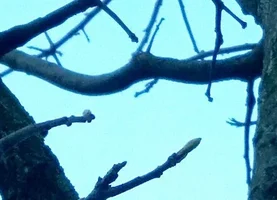
HELP! What is this growing on my Young Oak???

Get the grass away from it with a nice ring of shallow mulch. Definitely dig out the flair and look for girdling roots. Are the dead limbs on one side orall over the tree.

It looks too deep for sure. The grass is strong competition, get rid of it.
 
[ QUOTE ]

IGNORE the weeds!!! I'm in an epic battle with them right now!

[/ QUOTE ]Easier said than done.

Looks like they won about a month ago.

Find the flare!
peace.gif
 
Would you be excavating through a secondary adventitious root system that might have formed in this process? This kind of is a question to the other arbo's for my curiosity, would cutting through this to get to the primary root system harm the tree? Airspade? Or is it likely that it hasn't begun to grow?
 
I doubt that the tree has begun to grow since it's install. Having removed a few trees that looked similar in the past week, the burlap, rope and wire basket may all still all be on the tree. They say the burlap breaks down - it mostly doesn't. They say the wire rusts away - it doesn't. The stumps I yanked out had been installed for over 10 years - root mass still in the original area with very few roots out. Learn something on EVERY job. I don't usually jerk trees out, but it was more expedient than going to the yard to get the grinder for the 5" holly stumps.

If it didn't take off this year, I would dig it out, straighten the roots out, then re-install. If it has been in the ground for a couple of years and still looks like this, adapting to the new home with whatever conditions are going on is going to take longer than it would to take it out, correct the root/planting issues, re-install and re-establish. OR start over.

My apple tree was in this boat which I planted in my earlier "arborist" days that sat there and did nothing for 10 years. I investigated and the roots were a disaster. Fixed it last year and away it goes growing "normal" :).
 
I prune the small adventitous roots or leave them to dry out.

The main thing is keeping the stem tissue above ground so it's not always moist. If larger roots are girdling the STEM, the should be removed by an arborist.
 
[ QUOTE ]
I prune the small adventitous roots

[/ QUOTE ]Yes that's best--in the standard, it will say something like consider retaining them if they are large (>1/2"?) or many.

Best to save major surgery to late summer.
 
Okay. So I did the shake test on the tree and it is pretty sturdy. I did notice new bark missing towards the top so I am wondering if something isn't eating at the bark.

Looks like I should wait to dig down to look and fix(if necessary) the root system until late summer per guy's post above. I think I'll give it some fertilizer like last year as that seemed to help it.

Should I still clear the grass away around the top to reduce competition?

Thanks for all the suggestions and help!
 
As a tree grows and the stem expands, the older bark splits, cracks and peels. It's normal as long as green cambium isn't being exposed it's probably natural aging (it won't stay green long once it's exposed).
 
"Looks like I should wait to dig down to look and fix(if necessary) the root system until late summer per guy's post above.

O no ya don't! dig down and look NOW, just wait to prune the big sgr's (if any) until late summer.

"I think I'll give it some fertilizer like last year as that seemed to help it.

Please find the flare first!

"Should I still clear the grass away around the top to reduce competition?

Yes, as wide as the branches are long.
laugh.gif
 
I would avoid fertilizer. If you remove the grass and add a layer of compost and a good surface mulch, that will be far superior. For many reasons. Don't put on the compost and mulch much thick than the thickness of stripped sod though.

We use fertilizers incorrectly. They are NOT a general tree tonic. They can only adrress nutrient deficiencies in the soil, or in the trees ability to access them. They can be legit in some situations. They CAN help. Sometimes

After WW2, production of N, P and K for munitions was no longer needed. But there were factories under heavy production. What to do? What to do?
This stuff was just reformulated and marketed as 'fertilizer'. And half a century of advertizing has taught us that fertilizers are magic tonics. It's a real stretch, based on a few facts.
 
One other thing to consider about excess lichen growth on trees is that, yes, lichens don't pose a problem to the trees, but lichens do need light. So, maybe a better question is, "why is the canopy so thin that enough light is reaching the stem and branches to allow this many lichens to grow?"

When I see a lot of lichens, I look at the overall health of the tree and try to figure out why the canopy is so sparse.

Hope that helps.
 
[ QUOTE ]
[ QUOTE ]
Yea that one picture of the topped leaders made me cringe. Is the backyard have consistently moist soil. With the grass so vigorous a higher moist site doesn't favor a red oak. If that is what we determined it was. Oh and someone correct me if I am wrong.

Most likely a planting situation. Do the shake test like others mentioned.

[/ QUOTE ]

Unfortunately the "leaders" broke off, unless one was cut prior to our home purchase. When we bought the house the one on the right (look at the close up pic of top of tree)was already like that. The one on the left grew out of it and was doing pretty well last year. However, over this past winter/early spring, it broke too. I don't know where it went to as I didn't find it in my yard which is really strange, come to think of it. It's been quite windy this year, so I assume it blew away.

As far as the site moisture, in general it is not an overly moist site. The grass is "vigorous" because I haven't cut it in 2 weeks. I'm trying to get rid of the weeds and it's easier to see them when they are longer. I know, I know the weeds are getting stronger by leaving them grow too, but at this point it doesn't really matter cause they've pretty much taken over 1/2 my backyard.
crazy.gif
Trying to figure out how to deal with it.

So I will do the shake test tonight and post some results. I did look down at the base of the tree and don't see any root flare at all, so you all may be onto something about it being planted to deep.

In the meantime...I have a few questions for you all based on the guidance you've been providing:
confused.gif

<ul type="square">[*]#1 To fix the tree being planted too deep, would I have to dig it up and replant?
I really want to try to save the tree as it is beautiful in the fall when the leaves turn red. It also is going to make a great shade tree for my back porch.

YOU COULD START BY JUST SKIMMING SOIL OFF THE SURFACE TO SEE HOW DEEP THE TREE IS PLANTED. IF YOU CAN EXCAVATE THE ROOT FLARE AND HAVE IT EXPOSED TO THE SURFACE, YOU MAY NOT HAVE TO DIG IT OUT COMPLETELY. OF COURSE, IF IT'S SIGNIFICANTLY TOO DEEP (6" OR MORE) YOU MAY HAVE TO DO SOME GRADUAL GRADING OF THE SOIL DOWN TO THE TREE, WHICH MAY CAUSE A 'SOUP BOWL' EFFECT, PENDING ON YOUR SOIL.

[*]#2 Is there a definitive way to tell what type of tree it is as I think that it's an oak tree from when I looked up the leaf last year out of curiosity. When the leaves come out I'll take a pic and post it for confirmation. However, when looking at some pics on the internet I'm wondering if I have a Northern Red or a Pin Oak. I didn't go that in depth when I looked. Also it doesn't have acorns yet... I know someone asked if it was an Ash and I'm positive it's not as the leaves don't look like that.

THE BRANCHING COULD BE A RED OAK, DEFINITELY NOT A PIN OAK THOUGH. BUT LOOKING AT THE BUDS IN THE PHOTOS, I DON'T THINK IT'S AN OAK AT ALL. OAKS HAVE CLUSTERS OF BUDS AT THE BRANCH TIPS. THE BUDS ALMOST LOOK LIKE LIRIODENDRON (WHICH IS YELLOW IN THE FALL) OR AMELANCHIER (WHICH ARE RED AND PURPLE IN THE FALL). POST MORE PHOTOS AFTER IT HAS LEAFED OUT.

I ATTACHED ONE OF YOUR PHOTOS THAT I CROPPED TO FOCUS IN ON ONE OF THE BUDS. IT DOESN'T LOOK LIKE AN OAK.


[*]#3 Are there any recommendations for pruning or repairing the scars/breaks on branches?
I did trim off the dead branches and any new branches that started on the underside of the branch.

YOU CAN ALWAYS PRUNE OFF: DEAD, DISEASED, AND DYING BRANCHES. YOU DON'T WANT TO REMOVE MORE THAN 20% OF THE CANOPY IN ONE SEASON (I THINK 20% IS HIGH, AIM FOR 10-15%). PRUNE BACK TO LATERAL BRANCHES THAT ARE AT LEAST 1/3 THE DIAMETER OF THE BRANCH YOU'RE PRUNING. GO TO TREESAREGOOD.COM AND THEY HAVE GOOD PHOTOS OF HOW TO DO PRUNING.

[*]#4 Should I put some fertilizer down to give it a boost and if so what kind?
I don't want to traumatize it anymore by over fertilizing it since it's already stressed out.

I WOULDN'T USE ANY FERTILIZER THAT HAS A LOT OF NITROGEN (FERTILIZER IS N-P-K: NITROGEN-PHOSPHORUS-POTASSIUM). YOU WANT A LOW FIRST NUMBER AND MAYBE A SLIGHTLY HIGHER MIDDLE NUMBER (PHOSPHORUS ENCOURAGES ROOT GROWTH, WHICH IS NEEDED IN A STRESSED TREE MORE THAN CANOPY GROWTH). IF YOU WANT TO BUY SOMETHING AT A HARDWARE STORE, I LIKE OSMOCOTE, WHICH IS 10-10-10. IT'S A SLOW-RELEASE FERTILIZER THAT LOOKS LIKE LITTLE BALLS/PILLS. THEY'RE GOOD FOR ABOUT 3-4 MONTHS, SO ONE APPLICATION SHOULD GET YOU THROUGH A SEASON.

[*]#5 Should I do a soil pH test as I read that they can suffer from chlorosis in high pH soils?
[/list]

DOES IT LOOK CHLOROTIC (YELLOW) IN THE SUMMER? IF NOT, THAN IT'S PROBABLY NOT NECESSARY. DOING AN OVERALL SOIL TEST WOULDN'T HURT. CONTACT THE OSU PLANT CLINIC AND THEY'LL BE ABLE TO DIRECT YOU TO A GOOD SOIL TESTING FACILITY. MOST SOIL TESTS ARE ABOUT $20 FOR WHAT YOU WANT IN GARDEN/LANDSCAPES. I DON'T RECOMMEND GETTING THE PH KITS FROM A HARDWARE STORE, THEY'RE NOT VERY ACCURATE.

Okay that's all for now, sorry for such a long post and don't feel obligated to answer all the questions. If you just want to answer one or a few that would be great!
smile.gif


[/ QUOTE ]

I HOPE THAT HELPS. -STEPHANIE

 

Attachments

  • 321294-notanoakbud.webp
    321294-notanoakbud.webp
    24.6 KB · Views: 24
Stephanie, soup bowls can and should be drained if holes are punched in the bottom--see ANSI A300 16.4.1 and 16.4.3.

Phosphorus applications can kill mycorrhizal populations, so I would not be too promiscuous with P. Yes osmocote is a better recommendation than many, if they MUST apply something, but focusing on air and water and OM and for gosh sakes root structure First, and waiting on the chemicals, seems like better advice. Bryan S would probably agree. ;)
 
I wasn't familiar with the ANSI standards, thanks.

I don't know how the soil is in Ohio, but here in IL, especially in newly developed landscapes, the soup bowls aren't drain-able. Drilling just leads to more clay. I do like the idea of creating drainage by digging 'ditches' from the planting space, but it can be labor intensive. You could look into drainage tiles, too.

I agree with Guy that incorporating some manure and other organic matter would probably do the tree a lot of good, too. This is a better long-term solution than synthetic fertilizers. Especially since the fungus Trichoderma harzianum, which is antagonistic or parasitic of Phytophthora species, is often found in organic matter.
 
You'll love Part 2, and I hope that lanky boss of yours gets the whole set, and makes the whole staff aware of them. It would be good to hear BS's take on Part 2. Agree with all you posted, but...[ QUOTE ]
here in IL, especially in newly developed landscapes, the soup bowls aren't drain-able. Drilling just leads to more clay.

[/ QUOTE ]

That begs a more personal question; at least it would be if your gender was different: How deep do you drill?
grin.gif
That was the 16.4.3 reference. You should see the length of the dutch probe jim urban uses--~6'!

Seriously, subsoil can, and should, be fractured in a variety of ways.
And clay is just good soil in search of air and a little more.
santa.gif
 
[ QUOTE ]
And clay is just good soil in search of air and a little more.
santa.gif


[/ QUOTE ]

That' true. Clay soils are some of the richest soils on the planet. The breadbasket that was the interior plains of North America is testament to that. A bunch of compost and some aeration does wonders.

Any down and dirty subject whets my appetite, and soils is a favourite.

It's very likely different in the East where forest-grown trees are inconveniently in the way of housing development, but here on the high plains, in the last 30 years, the method of development has been to nominally scrape off the topsoil and regrade the entire surface of the development so that monster houses with walk-in basements can be built.

There is no remnant of soil remaining. 12000 years of post-glacial soil building wiped out. The thin layer that is spread back over is no longer soil. Soil is an ecosystem. What's spread on top like icing is just dirt.

The soils or dirts in older neighborhoods are likely in somewhat better condition, but decades of raking and removing organics, and possibly applying chemical fertilizers has taken its toll too.

The key is soil building, which comes down to supplying the ingredients of soil - mineral content, organics, soil critters and surface mulch and allowing these things to re-build their subterranean world.

I'm sorry, this is kind of a long-winded derail.
 

New threads New posts

Back
Top Bottom