Heading vs Reduction Cuts on Temporary Branches on Young Trees?

Yeah this is such an existential thing with many species, I see this a lot with sugar maples as well. Doesn’t the tree know how to achieve the best structure based on its location and growth habit? It always strikes me as trying to fit a square peg in a round hole. I think we often intervene unnecessarily.
I agree with this philosophy for the most part but some hybrids like autumn blaze maple definitely need intervention. They lost their knowing in the hybrid process.
 
I agree with the sentiment of not torturing trees or going against their nature. But I think we all also know that for most trees being grown in the open is not how they evolved.

Without the pressure of other trees, they grow too thick, too wide, and form too many codoninant stems. I think they can be beautiful. But most I see make me feel depressed about their future.
 
ithout the pressure of other trees, they grow too thick, too wide, and form too many codoninant stems. I think they can be beautiful. But most I see make me feel depressed about their future.
I would save your depression for something else. Open grown trees are simply growing to have the best structure for their conditions. Large, low, horizontal branches are what you’ll see on veteran / ancient trees that have decurrent form. Not more hazardous, not unhealthy.
 
I’d add: IF an arborist has helped them.
Whenever I see an oak in the middle of a pasture out in nowheresville, where zero attention has ever been paid to it, that’s about as close as I come to believing in intelligent design (not quite there tho sorry reach)…

I have less faith in interventions of humans and a lot more trust in a woody species ability to grow in the form that is best adapted to its location…

The problems come from site changes, poor pruning practices, introduction of foreign species, or hybrids like Autumn Blaze or Bradford…

Or it’s a weak wooded short lived species and it’s meant to come and go and create soil for the next succession.
 
I used to be a treevangelist of sorts once upon a time. Doing the full Gilman treatment on every urban shade tree. Then I started paying more attention to the trees themselves than the books and decided it was overkill. Now we just reduce if there are obvious major defects and/or there are targets below. 2" deadwood, clearance and that's it for the most part. Trying to work with nature and not against.

I remember a quote from Mick that stuck in my head, something about how the tree had not attended the seminar and therefore did not know it was in need of an arborist. Don't remember the context but still gives me a chuckle.
 
Where I agree with Stumpsprouts and L3VI is that some species do better in the open than others. Red maples generally develop terrible structure, whereas oaks are better. Two of five lawn red maples around my house have a circle of multiple codominant trunks, like open-center fruit trees, but better structure than the others that have a tight mess of trunks in the center as well as around the periphery. The open center ones do have massive trunks/limbs that could split, but so far the maple that got badly damaged by wind was one of the tight codominant ones—a trunk split off and ripped a huge wound in high wind. My arborist and I are trying to shape the rest so that doesn't happen again. But I've only been here 4 years and the trees have a 30 year head start, with no apparent pruning.

Trees don't know what their structure should be for each situation, in my view, but respond to light. Trees in the woods, where most evolved, grow upward as fast as possible. They don't waste energy on multiple leaders until they rise to or above canopy level. They and other trees shade their own lower branches.

Trees grown in the open often develop structure that is too wide, tight, and multi-leadered. Especially without other trees protecting them. Some do become magnificent. There's a wide white oak in my daughter's pasture like that. And for a red maple, the one in my front yard is trying hard to become so.

But their evolutionary environment didn't prepare most trees for that. I look at the winner trees in the woods, and they inspire awe. Massive trunks and huge, widely separated limbs. There's a white oak I look at almost daily like that. I bet no branch is closer than 6-8 feet. The trees still fighting it out all around such trees often look awful to me still, as my taste was formed on lawn trees, but some of them will prevail and become grand.
 
This thread reminded me of this great one with wonderful content and discussion from some smart dudes that don't seem to post here anymore.

 
Where I agree with Stumpsprouts and L3VI is that some species do better in the open than others. Red maples generally develop terrible structure, whereas oaks are better. Two of five lawn red maples around my house have a circle of multiple codominant trunks, like open-center fruit trees, but better structure than the others that have a tight mess of trunks in the center as well as around the periphery. The open center ones do have massive trunks/limbs that could split, but so far the maple that got badly damaged by wind was one of the tight codominant ones—a trunk split off and ripped a huge wound in high wind. My arborist and I are trying to shape the rest so that doesn't happen again. But I've only been here 4 years and the trees have a 30 year head start, with no apparent pruning.

Trees don't know what their structure should be for each situation, in my view, but respond to light. Trees in the woods, where most evolved, grow upward as fast as possible. They don't waste energy on multiple leaders until they rise to or above canopy level. They and other trees shade their own lower branches.

Trees grown in the open often develop structure that is too wide, tight, and multi-leadered. Especially without other trees protecting them. Some do become magnificent. There's a wide white oak in my daughter's pasture like that. And for a red maple, the one in my front yard is trying hard to become so.

But their evolutionary environment didn't prepare most trees for that. I look at the winner trees in the woods, and they inspire awe. Massive trunks and huge, widely separated limbs. There's a white oak I look at almost daily like that. I bet no branch is closer than 6-8 feet. The trees still fighting it out all around such trees often look awful to me still, as my taste was formed on lawn trees, but some of them will prevail and become grand.
I guess I’m a little confused. Are you trained in forestry and arboriculture? What experiences and training are informing your statements?
 
I introduced myself in my first post on the site and again, at less length, in my post that started this thread. Maybe I can put something in my signature? Am not sure what you appear to be/want to be taking issue with. My understanding is that anyone can raise questions and issues in General Discusison.

Anyway, I studied agriculture in college and grass farmed "part time" but seriously for decades. Am self taught in Gilman and other arboriculture experts' principals, aside from taking a few short courses over the years. Have planted thousands of trees at this point, including reforesting farm land and in agro-forestry systems, and have pruned a lot of trees. I have worked with several ISA arborists. Not a professional for sure but a serious amateur with a lifelong interest and practice.
 
This thread reminded me of this great one with wonderful content and discussion from some smart dudes that don't seem to post here anymore.

Very lively thread! Some discussion is over my head. I've made my way through most of it.
 
I introduced myself in my first post on the site and again, at less length, in my post that started this thread. Maybe I can put something in my signature? Am not sure what you appear to be/want to be taking issue with. My understanding is that anyone can raise questions and issues in General Discusison.

Anyway, I studied agriculture in college and grass farmed "part time" but seriously for decades. Am self taught in Gilman and other arboriculture experts' principals, aside from taking a few short courses over the years. Have planted thousands of trees at this point, including reforesting farm land and in agro-forestry systems, and have pruned a lot of trees. I have worked with several ISA arborists. Not a professional for sure but a serious amateur with a lifelong interest and practice.
That’s really cool. I think you have more experience than a lot of self described arborists. from the onset I thought you were just a guy with a few trees looking for some professional advice, but clearly you have had your hands in the dirt and know a lot about the subject.

What trees have you been planting?

If you haven’t read any of Shigos books, he has a really interesting perspective. I have Modern Arboriculture and it’s fantastic. I’ll skim through it again soon, and I feel like there’s a page or two on open growth habits.
 
Okay, thanks, have not read much Shigo. I inherited a lot of trees here, all those maples. I have never liked the species much but have grown fond of my front yard maple. Partly because I am trying to save it from itself/neglect. And have a brother who is nuts about Japanese maples who is determined to influence me. Plus going to the nearby VA Tech campus and studying their maple collection has made me less kneejerk.

Oaks and honeylocusts are my favorite species. Around the house and barn and in the front fields, I have planted pin oaks and many white oaks, most of which we raised from acorns from a great tree on the campus in Ohio where we worked, a few Japanese maples, three Asian persimmons, three mulberries of various types in the chicken range, several honeylocusts, and a couple Merlot redbuds.

This doesn't sound like a lot so far, but the previous owner had planted red maples and many white pines, giving lots of structure. He didn't like trees close to the house so tried to plant them, with few exceptions, 60 or more feet away. I know from past pictures that he grew two pin oaks close on the north side but cut them down when they were 30-40 feet and beautiful.

There was no shade on the west facade of the house and not enough on the east. After I planted the three pin oaks to the west, I took a soil test and learned how heavily he had limed. No wonder some of the pines and all his azaleas look sick. I am going to add sulfur to lower the PH.

But since he did create so much structure, I have spent most of my time planting shrubs. Furnishing the landscape, so to speak, as well as planting a vineyard. I want to grow blueberries but have been set back at least a year by that soil test.

Here is my wife and one of her sisters with the white oak in Ohio we raised 80+ seedlings from:
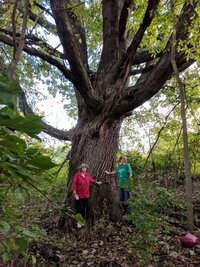
Otter Oak  Oct 2017.JPG

Here is my wife spraying BT, to fight a massive caterpillar outbreak, on one of the babies last summer; it was planted as a seedling of less than 24" in Fall 2017 in Virginia:
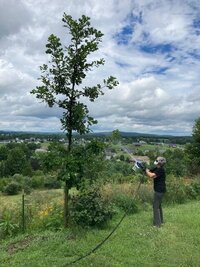
Kathy sprays oak 7-28-22.jpg

Some of the baby oaks on our sunroom in Ohio in October 2017:
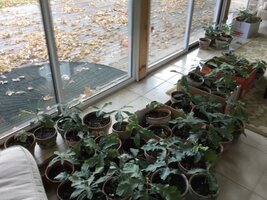
Sunroom Oaks Oct. 2017.jpg

An interesting thing is that the mother oak was near a burr oak and the offspring look like the pure burr oaks I've raised.

 
Last edited:
Merle, if you're up for it, ask Gilman if he's familiar with Progressive Liontailing, done in stages each time someone unknowledgably feels the urge to prune a tree and hires someone with a polesaw/ladder or a desire to cut where it's easiest to climb to, trunk outwards. ;) Feel free to report his reaction if you feel it would enlighten us ;) ;) Make sure he knows you're not being serious but ride the joke a little bit or else where's the fun? ;)
 
Regarding the thought of "trees don't need intervention".

Yes, that is true.

However, if trees could talk, I think they might say:
*I don't give a rip if you can't mow under me...in fact, I'd prefer it that way!
*It's fine with me if that big branch breaks off. Doesn't matter what it hits on the way down
*My fall colors are none of your concern.
*Seriously, you don't want me to produce ANY fruit? What's the point of life?!?

But we do need to provide clearance under and around trees - especially if the alternative is not having a tree there at all. It does matter if branches break and hit stuff. We do cultivate trees for certain properties that often sacrifice others (for example, the freemanii maples tend to have significant issues with multiple leaders that are poorly attached - in theory, that feature would cause them to slowly drop out of the natural selection war). Some of the Honeylocust that are so difficult to train a central leader were not selected for form, but rather their fruitlessness - again not a strong feature in the battle of the wild.

All that to say, when we expect trees to "behave" out of their natural environments and tendencies, we should expect to have some additional maintenance. That is not to say all trees should get heavy pruning dose every 3 years, but just to frame the "need" for maintenance in a different thought.
 
Would you bite on trying the classic line "Now the tree can breathe better and get more oxygen with the branches thinned out" I think I actually heard someone say it to their customer. I bit my tongue. I came in as damage removal when a previous customer saw their neighbour's tree butchered, liked the look of it and had their tree butchered by the same guy. Windy day comes, exposed lion tailed branches snap off, yay cut some more off the tree. Didn't bite my tongue, explained why the tree broke.

Maybe Ed appreciates humour. Sometimes it's in the delivery and not necessarily the joke. I'd figure you'd be on safe ground. Maybe he's already heard this stuff before.
 
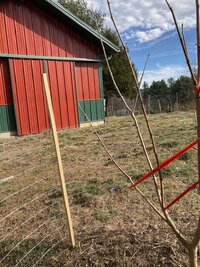
Here is an example of what perplexes me in pruning. Today I trimmed this little Saijo persimmon behind my barn. I am letting it develop some low scaffold branches and will select for some higher on the tree. See the branch on the left: I want to turn the low, lateral shoot into that branch's leader and ultimately remove the two upright leaders. Note this branch's base, showing it became codominant, almost the size of the tree's leader.

Barn persimmon 2-7-23.jpg

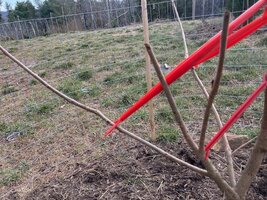
So far, my cuts have just been large heading cuts to the two upright branches, one the former leader and one fighting it for dominance:


Barn persimmon pruned 2.jpg

So you might wonder why I didn't just go ahead and take them off, and that is my question. Should I? I am trying to decide. Taking them off now would result in a large, awkward wound, I think. It would be like heading a sapling or majorly reducing it to the lateral, but I think orchardists do that all the time. I hedge on whether it's a "reduction" instead of a heading cut because the branch seems just under or maybe barely 3x smaller than the diameter of the stem.

By heading the branches but waiting on cutting the stem, I hope to slow their growth and thereby shrink the trunk-like branch section below them. But will that work is my second question? If the headed branches go wild, I can head them again this summer.
 
Last edited:
My $0.02 on this subject:

There is a ton of great info out there, and in this thread. Good on all for posting. However, something that is missing from so many discussions and publications about pruning (that I know of) is the factor of available light.

We all know that a species can alter form to a degree based on this major factor. Take an understory species that was field grown in a nursery…tougher to establish them back into their normal, shaded habitat.

Available light is such a major factor in what a plant will do following a pruning cycle that I think arborists could start implementing shade panels in some form or another into and/or around young trees. I wonder if in some cases that would be more effective than the “sword”?
 

New threads New posts

Back
Top Bottom