Has any one had a trusted worker, operate the lift from the base, inbetween the arborist making cuts?

I believe it will work.
No different than having a spotter for the unexpected. Crane operator and climber. See a situation make it safer
You got a brother and sister to trust. Go for it.
Key word trust.
 
So, I haven’t seen anyone mention the fact that a second guy is tied up using the lift when they could be doing other things on site, like cleaning up the material coming down. If you have, my apologies.

I don’t care how much snappier the controls are on the ground, how much time it takes to rack a saw, or any other small pause that comes from the cutter operating the controls- the other operator will not speed things up enough to justify the loss of a man working the ground. It is inefficient, cost-deficient, and adds needless complication/risks.
 
So, I haven’t seen anyone mention the fact that a second guy is tied up using the lift when they could be doing other things on site, like cleaning up the material coming down. If you have, my apologies.

I don’t care how much snappier the controls are on the ground, how much time it takes to rack a saw, or any other small pause that comes from the cutter operating the controls- the other operator will not speed things up enough to justify the loss of a man working the ground. It is inefficient, cost-deficient, and adds needless complication/risks.
I did mention that, but not as elaborately as you did. Thank you for the explanation, hopefully it will be heeded, though I have my doubts.
 
I once allowed a ground person to operate the lift when I was aloft and under normal working conditions…

I was new to lift use and we thought it might be helpful

It wasn’t helpful at all and was bad for all the reasons everyone has already elaborated on.


my proficiency in operating the lift was the real time saver as I made smoother plans and transitions from position to position

I would not let anyone operate a lift from the ground now unless it was an emergency lowering situation
 
Ah, I skimmed through too fast. For obvious reasons ;) My apologies, Reach.

I can’t believe I’m going to poke the bear, but here goes-

@RopeShield , lifts and cranes are completely different. A crane mostly handles material. When it is used to hoist a climber, the climber had to signal movements, which no matter how you slice it, adds inefficiency, even with comms. A climber has to read the operator’s movements, then communicate the next move, add corrections, etc. If the climber had the means to control his own movements, he’d be more efficient. Same with knuckle booms. The obvious reasons people don’t often control themselves when the crane offers remote operation-

• the climber is not proficient in the operation of the crane
• the remote is clunky and not effectively integrated with a climbing system.

A lift differs on the last point- aerial controls are integrated into the positioning device.

A lift also differs in that it does not transition to the movement of materials. Ground controls for landing material is usually better from the ground perspective, and is most efficient when a spotter is not necessary.

A better correlation would be having a remote Ronin or Wraptor operator. What’s the point?!


I’m curious, does Canada subsidize the employment of placeholder roles?

 
I once allowed a ground person to operate the lift when I was aloft and under normal working conditions…

I was new to lift use and we thought it might be helpful

It wasn’t helpful at all and was bad for all the reasons everyone has already elaborated on.


my proficiency in operating the lift was the real time saver as I made smoother plans and transitions from position to position

I would not let anyone operate a lift from the ground now unless it was an emergency lowering situation
Excellent point- proficiency is key, and possibly a contributing factor for the OP.
 
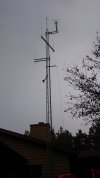
To bring in the perspective of the ground person. Last year I had a unique situation come up where a customer was looking to make repairs to his homemade radio tower. I was in no way familiar with the tower equipment or confident enough to make the repairs and he was not confident enough to operate the upper controls himself. The decision was made to have him up in the bucket making the repairs and I would position him with the ground controls through his guidance. (I know, potential liability issue, but he had his fall arrest and work at height tickets so I felt confident enough he would be ok up there)

It one was the most awkward, difficult, time consuming things I've done. Not only was I trying to position him correctly, I was also trying to not contact the tower, and not shake him too much, which is hard when you're not used to working the ground controls for positioning purposes. The boom was constantly in my line of sight, I was craning and kinking my neck more than if I were pole sawing, my depth perception was way off. I would think I'd have him in the right spot and he would come on saying he was still 2 or 3 feet away from being able to reach anything. What probably would have been a half hour job for someone with the right skills (positioning with upper controls+repair knowledge) turned in to 2 hours.

I can't see it what universe this would be the ideal setup.

(That's the customer up in the bucket)

20200911_083350.jpg
 
Something is wrong when 2 people are faster using a one-person machine.
Are they useless otherwise? They aren't working productively if they are doing your part of your job.


Something is also wrong if the ground operator can position the bucket better.

Something is wrong when ergonomics are second, or worse, to speed.
 
The first guy I ever worked for would make his groundies move the bucket for him I thought it was ridiculous not to mention no one wants to be responsible for causing injury to someone else especially when they could’ve easily repositioned the bucket themselves. Even though nothing ever went wrong there is definitely a chance, his old bucket moved a lot faster from the ground controls as his justification. The no one handing a chainsaw argument is in no way comparable though, that argument only holds weight with tree snobs who think to highly of themselves.
 
I did some work for a local guy with a very questionable old bucket truck. Halfway thru the removal I lost control of lower boom from basket so i had to rely on him to do 1/3 of my movements. It worked but in no way would I want to to always do things like that. Honestly should have called it quits but it was a simple small tree and having him run the lower boom from ground was easier than climbing. Still did not enjoy it. I will say that it is a good skill for someone to have to be able to operate a boom or lift from ground in case of emergency. And in case of boom truck near electricity the ability to run controls with an insulated pole from a distance could be a life saver. But all in all maneuvering a lift or bucket is quite simple and if you cant both cut and operate then you need to take a step back and figure out what you need to get better at. After one year of using a bucket im being the irresponsible asshole using one hand to control the bucket behind my back and one handing a saw cutting off sprouts and what not on the way up. I know for sure that is not in any way recommended but I know I have more control than having someone else guide the bucket up the tree while i use two hands on saw to take out sprouts. Horrible comparison but in no way can someone from the ground read your mind or listen through headset and get you where needed like you can yourself. At some point your going to find that no matter how big and bad your lift is your going to be in a bad position and you better be able to have full control of your machine to get out of harms way. That's when all the "fatigue" of running the machine pays off. You know how much time it takes to move out of danger zone takes and there's no lag once the hinge starts to break. Your the one making the cut and can see how its reacting so you know when its time to move and your "trusted worker" is oblivious. Your trusted worker should be mastering controlling lowering lines and not controlling you in the lift.
 
I did mention that, but not as elaborately as you did. Thank you for the explanation, hopefully it will be heeded, though I have my doubts.
An example of why all post on a thread should be readable on one page. To consolidate threads, by not having duplication of ideas, etc.
 
Last edited:
Also while in a lift moving faster is most definitely not always better. I understand the op is using a 50 foot lift but what happens if the trusted worker moves him along some sprouts that suddenly give way and he starts swinging around? Im sure he'll have something to say about that. The fact that ground controls are faster troubles me...They should be the same so some dummy on the ground cant hijack the machine and start sending some poor soul in the basket for a ride...
 
The specific situation, I had my worker operate the lift, was overlooked by commenters.
In that there was nothing the worker could do while I was throwing the branches, because there was only real estate for one small drop zone. So, he couldn't pick up any of the branches.
And, we were dismantling two, very close to each other, 40ft birch trees that, were leaning over a one story garage.
And, if someone is willing to be concerted, and "in tune" with one of their workers, it seems it would be faster and less fatiguing to working in unison, with a lift, to dismantle a small tree.
 
Last edited:

New threads New posts

Back
Top Bottom