Flint Knapping

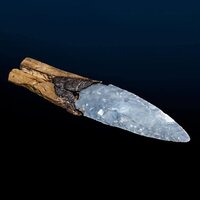
What amazing work. I keep returning to look at your knife. I saw this on facebook and thought of your work. here is the description: flint dagger.jpegA well-preserved late Neolithic flint dagger found in Allensbach at the Lake Constance, southwest Germany, dating 2900-2800 BCE. The blade was made of flint from Monte Baldo in northern Italy. It was fastened with birch tar in a handle made of elderwood
 
What amazing work. I keep returning to look at your knife. I saw this on facebook and thought of your work. here is the description: View attachment 92558A well-preserved late Neolithic flint dagger found in Allensbach at the Lake Constance, southwest Germany, dating 2900-2800 BCE. The blade was made of flint from Monte Baldo in northern Italy. It was fastened with birch tar in a handle made of elderwood

That’s really cool Gordon! Birch tar is stronger than pine pitch tar that I use.

I have a friend in Florida who found a dagger with an agatized coral blade and a human bone handle. There was evidence on the bone of cannibalism.
 
I haven't experimented with lashing yet, but I have read about it and seen it done on videos.
It is fascinating that you are learning the same exact ancient skill, via books and vids, that the ancients learned through one on one human interface. Same subject, radically different approaches.

The ancients would be dumb struck.
 
Can you explain a bit about birch tar? We are probably all quite familiar with pine pitch but birch trees aren't sappy afaik and I'm wondering about pine tar and birch tar. Thx. I could google but would like to hear about it from a hands on Treebuzz perspective
 
Can you explain a bit about birch tar? We are probably all quite familiar with pine pitch but birch trees aren't sappy afaik and I'm wondering about pine tar and birch tar. Thx. I could google but would like to hear about it from a hands on Treebuzz perspective
Birch Tar is extracted from the bark. I don’t think experts know exactly how ancient people created their tar, but I’ve read speculation that they would burn the birch bark in a fire. They would position the fire under a low rock overhang and the tar would build up on the rock. A modern version I’ve seen a video on was to put the birch bark in a metal cookie container, cut a hole in the bottom, position a smaller metal container under the hole, seal up all the cracks with clay putty, bury it in a shallow hole and light a fire on top. the tar drips down into the small container. I’ve tried this method without success because I did not seal up the container properly with putty.

Birch bark oil is used to tan high quality Italian leather.

I make my pine pitch hafting adhesive using white pine pitch, ground up wood charcoal, and pulverized deer sinew.
 
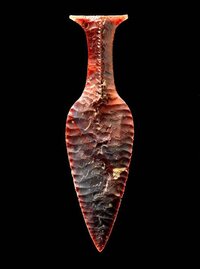
"The Hindsgavl Dagger (Late Neolithic Dagger Period, ca. 1900-1700 BC, Denmark). 29,5 cm. long and barely 2 cm. thick, it is widely recognized as the most beautiful example of Neolithic flint knapping from Denmark"View attachment 94604
Danish daggers are probably the most difficult weapon to Knapp. A cross section of the handle would show that it has four platforms for striking (or punching) off flakes. This is a very difficult thing to set up, so the knife was most likely a statuses symbol or for ritual purposes.
 

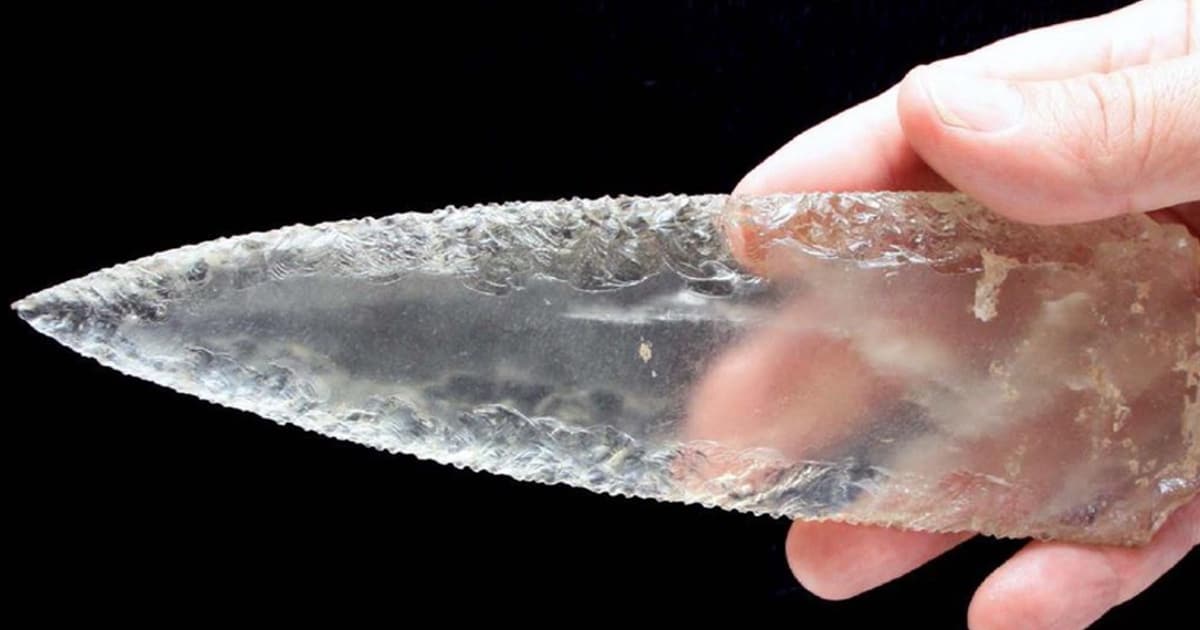
Here’s an interesting Crystal dagger that was found in a cave in Spain. I can tell by looking at it that they used a method called FOG (Flake Over Ground). They meticulously ground the blade into shape and then pressure flaked the knife edge. Typically, when using the FOG method, you would send flakes across the whole surface. In the case of this dagger, they did not.
 

New threads New posts

Back
Top Bottom