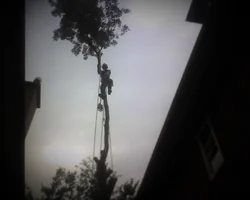
The longer they stand the worse they get.
A few years back, the wife and I were re-landscaping parts of a property we own about 7 miles from where we live. There's an old, dying ash tree I keep threatening to remove, but have left standing the last five years because it is habitat for so many critters. Anyway, while we were planting shrubs and bushes, I planted a Yew or an Arborvitae (don't remember which) fairly close to this ash tree... while digging the hole, I hit a nest of carpenter ants living in a large (8" diameter or so) root from the ash tree, but since the root was down about a foot or so, and the shrub was so small, I planted it, anyway. Needless to say, this invasion of their space didn't set well with the ants. A few days later, the shrub was laying on its side. The damn ants had chewed its entire root ball off.
That ash tree has creeped me out, ever since then. I can't help but think that the damage the carpenter ants are doing to the visible parts of the tree are probably nothing compared to what they're doing to the root system. The small part of that root I could see, was riddled with their galleries. It appeared that the nest ran up this root, to the tree about ten feet away. I had never seen them do this before.
I'll still remove the tree this spring, as a few cuts from a bucket truck or lift and then felling it is all that's needed... but I certainly won't climb it. I was over there yesterday and I can't believe how rapidly the tree is going downhill. I seriously doubt if there will be more than a smattering of budding, this spring. Less than a third of it leafed out last year. This is not an EAB tree, either... we haven't been hit with it, yet.
I can easily see, from this tree and the many others around here in equally bad condition, how a policy to just not climb them could be justified. There's a point where the risk might just be too great to bother trying to assess them. Every branch that falls off my tree explodes on impact, as described by others. I don't expect it to yield much, if any, usable firewood.
I hate to advocate blanket policies or regulations that don't allow room for individual assessment, but I must admit that sometimes it's the easiest way to prevent Suicide by Stupidity. I removed an ash last summer that was probably 20% dead, I just stayed off the dead parts. I wonder what criteria would be valid for deciding just how dead is a dead ash tree?