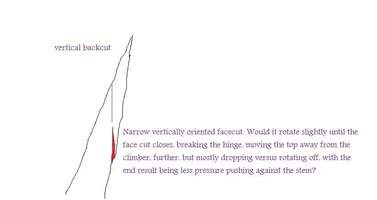
Facecut idea, Your thoughts?

southsoundtree

Been here much more than a while
Location
Olympia, WA
So there is a large, dead, leaning pine tree to be removed by another company discussed on another forum.


Since it is strongly headleaning, and dead, I was wondering if the following set-up would reduce the pushback force on the spar from the top rotating off. The hinge would not be oriented to the grain in the same way, but it maybe doesn't need to control the top against the natural lean much, or at all. My thought is that this will slightly rotate the top further forward before the face closes, and the top can slip downward, like an arrow, butt first.

What are your thoughts?
 

Attachments

  • 249845-DeadPineFacecut.webp
    249845-DeadPineFacecut.webp
    21.2 KB · Views: 275
I have done this with small stuff and has worked well. I would not try it with a top of any real size. On the small tops that I have done I noticed that they come out real quick. You need to be in just the right spot or branches and wood will hit you. Why not take a small top and not have to worry about push back. The other thing I like to do on tree's that worry me is cut a path up the tree on the side that you want the top to go. I'll leave all the other branches to soak up the energy from the top coming off. After that sometimes I'll remove the rest of the tree top down or go back down and work back up. Just my thoughts.

Mike
 
Thanks for the input Mike.

The tree that brought this up is a 160' dead pine of some sort in OR. It leans significantly. Compounding other factors. Taking a larger top means being able to be on a highline climbing system between two smaller trees. IF memories serves, these other trees are hovering around 100', and a bit of horizontal distance away.


I have some maples on an outstanding bid that are near-ish to primary electrical wires. I was thinking about this as an extra measure of safety with similarly leaning tops.

My thought is that if you are not vertically under the top to start, the little bit of rotation is going to take it further away from you, and it should drop right in front of you--Barring Wind or Brushing Other Branches.

If you are under the top somewhat, a climber had better estimate the correct degrees for the notch, otherwise they will get swatted.
 
[ QUOTE ]
Swatted...or speared!

Be careful of not getting any forward movement. In that case it will slide off the lower cut and drop straight down.

[/ QUOTE ]

That's kinda what I was thinking when I looked at it. It also could grab your lanyard.
 
I've speared 4"-6" top leaders out of decurrent trees like pecans and maples using a similar cut (no notch). It works two ways, you can make a deep undercut and match it on top or you can jumpcut in one swipe if your saw is sharp. You definitely want the ground guy watching and well away from the DZ. The pieces can deflect and shoot a long way from the intended path.

Sometimes when it's pretty much vertical I let the wood swat me as it passes, it's usually the small stuff and I just tuck in and let it rattle past on my helmet, scratches up my stickers though.

I haven't done it with anything the size of Willie's tree. I favor doing a standard top on that one, whatever will fit into his DZ, and burning the hinge once the top is committed to minimize push back.

It's worth noting that Willie's tree has a seriously compromised base. It would be a scary tree to climb.
 
Yes, SCARY. That's why I thought of minimizing the pushback.


TomD, the idea is that it will slide off, rather that rotate off. It is already leaning forward, so a little more rotation would help the clearance.

Thanks for thoughts.
 
He ought to put enough money on the job to buy himself some new shoes.. :) LOL

There's more rotten than just the base of that tree in the video...

PS..
my thoughts are that the real concern should be pull not push back, as the tree is a front leaner.. and there is no body around here that thinks about this sort of thing much... You've come to the wrong place to ask that kind of question..
 
[ QUOTE ]
and there is no body around here that thinks about this sort of thing much... You've come to the wrong place to ask that kind of question..

[/ QUOTE ]

Daniel,

have you ever condsidered switching to decaf?
 
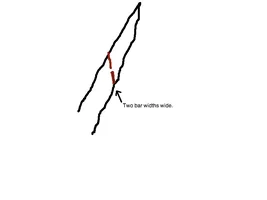
I've done that with straight tops but if its already leaning no need for a knotch in my opinion. As long as all the back branches can clear you I would use a jump cut, just use a deep undercut. Sometimes i'll use a wider undercut, basically make your undercut and then make a second cut right beside trying to make the undercut 2 bar widths wide. Thats probably confusing. Maybe the picture will clarify what i'm saying.
 

Attachments

  • 249929-DropCut.webp
    249929-DropCut.webp
    6.6 KB · Views: 120
not confusing... and a better term would be "two kerfs wide".. Use it all the time, when the cut is too big for a simple undercut, and not wanting to make a proper notch, for any number of reasons not the least of which is saving time.
 
In my second or third year of climbing I was taking down a basswood. The last leader had head lean and we put a pullover rope in to give it some initiative. I made a 'salami cut' as Jerry Beranek calls 'em, thinking that it would tip and the go off. What happened is that it didn't tip, just slid off the face cut. This would have been OK if I hadn't left a stub on the backside, right above me. Since the top didn't tip but came down mostly vertical the stub smacked my right shoulder into the trunk. I got winged. No surgery or anything...just hot/cold packs for a few days. What this taught me was to put a bigger face in and have a proper back cut. In time I learned where and when to make salami cuts and make them with care and caution.
 
[ QUOTE ]
not confusing... and a better term would be "two kerfs wide".. Use it all the time, when the cut is too big for a simple undercut, and not wanting to make a proper notch, for any number of reasons not the least of which is saving time.

[/ QUOTE ]

The cut is not confusing but i thought my explanation of it might have been. (maybe that was a little confusing for you?) Hope its helpful!
 
JT, the idea is to rock the stem as little as possible, either from the top pulling forward on the stem, or pushing back on the stem, and the resultant oscillation, until the energy is dissipated.

When mass of the large top starts rotating forward, its equal and opposite reaction pushes back on the stem. As it continues to rotate, it can pull on the stem (toward the landing zone of the top).

The goal would, in the case of the dead pine to minimize forces on a dead and compromised tree, and in the case of the maples near the powerlines, to have the top clear the climber, but not rotate over much, closer to the powerlines. The maples will have a building put below, and the gravel pad beneath will be regraded before construction, so the spearing effect won't matter.
 
I have done these cuts at times to side a tree top down a small incline or in a tight small space. I use a loggers notch more vertical to take the forward momentium out of the option it is a scary and not to ill advised method Tom D said it smacked, watch the branches you are sliding a tree down not away from you.Countryboy I have used your method too works . Just use your head or you will lose your head sliding tree parts down and not out.
 
[ QUOTE ]
The other thing I like to do on tree's that worry me is cut a path up the tree on the side that you want the top to go. I'll leave all the other branches to soak up the energy from the top coming off. After that sometimes I'll remove the rest of the tree top down or go back down and work back up.

[/ QUOTE ]

Hey Mike,

Thanks for sharing this.

Unlike most climbers down here, I almost never take big tops. I go clear to the top and push most stuff out by hand. For some reason it feels safer than hanging 200-300 pounds from the same tree I am locked to. (my big fear is tree failure).

Anyway, I was up a sweet gum today and at the top (approx 6 or 7 inches) feeling that "wiggle" after the top went. (They always wiggle so much when the top goes.)

Thanks for the idea. I will have to try that soon.
 
[ QUOTE ]
JT, the idea is to rock the stem as little as possible, either from the top pulling forward on the stem, or pushing back on the stem, and the resultant oscillation, until the energy is dissipated.

When mass of the large top starts rotating forward, its equal and opposite reaction pushes back on the stem. As it continues to rotate, it can pull on the stem (toward the landing zone of the top).


[/ QUOTE ]

Sean,

You also need to keep in mind that because the tree is already leaning forward, if you are going to cut a big top, allowing the tree to "hinge" just a little is a good thing.

you would not want to snap it off too quick (even though this may be impossible regardless because of the thickness)

But my point is--- as it rotates forward, it will push the trunk back just a little. Because of the lean, the trunk is going back anyway. If the rotation is slow, and the cut done right, it should just push back on the tree a little and slip off the front.

**** Did I read that he can install a highline? If so, what is the big deal? tie in the highline, climb up and test it's strength, set down on it and make your cut...
 
Danielson-

The idea that I was proposing was to let it rotate a little bit before breaking the hinge, maybe 15-20 degrees, then start to drop off, with what I thought would be less pushback. If the branches were plumb vertically above you with the top in place, then they would be 15-20 degrees forward by the time they drop passed you on the way down, IF the hinge holds until the face closes completely.
 
[ QUOTE ]
In my second or third year of climbing I was taking down a basswood. The last leader had head lean and we put a pullover rope in to give it some initiative. I made a 'salami cut' as Jerry Beranek calls 'em, thinking that it would tip and the go off. What happened is that it didn't tip, just slid off the face cut. This would have been OK if I hadn't left a stub on the backside, right above me. Since the top didn't tip but came down mostly vertical the stub smacked my right shoulder into the trunk. I got winged. No surgery or anything...just hot/cold packs for a few days. What this taught me was to put a bigger face in and have a proper back cut. In time I learned where and when to make salami cuts and make them with care and caution.

[/ QUOTE ]

Oh yeah, you got to make sure the overhead is clear before salaming off a vertical spar.
 

New threads New posts

Back
Top Bottom