Excellent Response

[ QUOTE ]
look at how many examples of wrong systems, materials and configurations we see..bad cabling systems will save more trees than none...I've seen that after MANY storms.

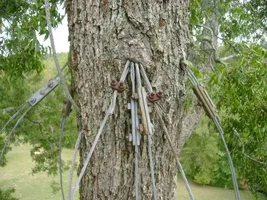
[/ QUOTE ]like this?
 

Attachments

  • 101345-DSC01304.webp
    101345-DSC01304.webp
    98.7 KB · Views: 71
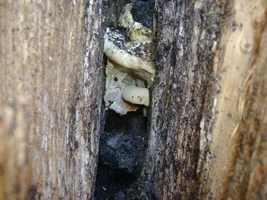
9 cables installed at the same height on the trunk, nd attached 5' from the origins of the branches. 6 failed, two leading to catastrophic injury and fungus in the heart of the tree--Inonotus dryadeus.

I think that no cable would have been better. Forks were wide-angled and strong.

But I have also seen a lot of bad cabling jobs intact after many years. Best to just put them in right the first time eh?
 

Attachments

  • 101346-DSC01256.webp
    101346-DSC01256.webp
    79.2 KB · Views: 59
[ QUOTE ]
[ QUOTE ]
look at how many examples of wrong systems, materials and configurations we see..bad cabling systems will save more trees than none...I've seen that after MANY storms.

[/ QUOTE ]like this?

[/ QUOTE ]
I beleive this could be a candidate for Dr. Octopussy
smirk.gif
So when should we use a Cobra system?
 
[ QUOTE ]
[ QUOTE ]

The foolishness being, doing a lot of something that is not "decades-proven". I'd say 15 to 20 years is a minimum for understanding.

[/ QUOTE ]O yes, it would be great if we could all be protected from change.
crazy.gif


Mario I hope you agree that doing something new is the only way to know if it works.

[/ QUOTE ]

I only agree that "testing" something new is the best way, not "implementing" as the only path.

It's not too prudent to "implement" something un-proven by time for contracting in residential situations.

I was almost going to say unless it's something as irrelevent as flowers like annuals and perennials. But then I realized such a comment would also be fruitless.

That's how many small plants have become noxious weeds in areas.

So very little about horticulture should escape being substantially tested before its implemented.

There is a chasm between "doing something" and "implementing". So I'm all-for testing and research centers, and I almost don't care what they test, as long as they give it better than 15 years.

Except the genetically altered grass seed, etc.. Did you hear about that genetically altered bentgrass seed? Apparently, somehow, some of it spread beyond it's research boundaries. And it was not supposed to happen, or be allowed.
 
That's the paradox of technology. If we waited and tested everything to the Nth degree and Nth permutation nothing would ever move ahead. There are plenty of examples of the Oops Factor in technology too.
 
[ QUOTE ]
That's the paradox of technology. If we waited and tested everything to the Nth degree and Nth permutation nothing would ever move ahead. There are plenty of examples of the Oops Factor in technology too.

[/ QUOTE ]

So we need to be patient enough to reach the Mth degree, but not go past the Nth degree.
grin.gif


Delays for research merely may slow down or postpone some things for a while, but not neccesarily stop them. There is a phrase "better the steady slow advance of veterans than the reckless rush of raw recruits"

Actually, temporary delays may mean more progress. Sometimes when things are not tested to the "Nth" degree, the problems, can send things backward as the mess is unraveled and rebuilt or restored.

A classic example, is how wound dressing was used by so many tree care professionals for so long on so many trees. It was not tested to the "Nth" degree. As a result, tree care professionals in their "reckless rush" like "raw recruits" were providing a bad practice - regardless of their motives or intentions.

I wouldn't even be surprised if there were a few researchers against promoting it's use back then, and then some sidelines folks started saying stuff like "you know nothing will move ahead".
 

New threads New posts

Back
Top Bottom