Employing lanyard SRT-style: descending?

I don't get the cano-base reference. Please inform.

It's setting a basal style anchor in the crown of the tree, gives the climber advantages of a basal anchor: strong redirect opportunities when there aren't great high canopy anchor options, efficiencies for pruning jobs working the entire crown (resetting/reversing the canobase to work another section of the crown without changin gthe rope path through the upper crown), etc. without the danger of ground crews hitting your anchor. You can work taller trees with less line in play but still always get to the ground as needed. Can be smoother for getting out of the tree when you're done. Another tool in the kit, not for every situation.

And... back to the original subject of this thread ;-)
-AJ
 
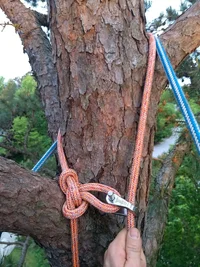
Gentlemen, while everyone is here, could y'all take another look at the cinched part of my basal anchor? Do I have the loop and the link reversed from what they should be?

ijLUTX6.png
 
Set it up this way this morning. Hand is on working end. Pulled slack, threw bight with HH2 in it 6' up, and foot ascended on up. Worked like a boss.

Here's the 'gotcha' tho: the way I think had the cinch drawn accomplishes the purpose I included it for, which was to keep basal leg from slacking much. The 'right' way I tied it this morning still allows it to slack.

On the upside, now I know how to set up a proper 'canobase', I guess.

IMG_20190510_063035172.webp
 
Last edited:
Will try tonight or this weekend!

It's the little tips like that. Stupidly obvious once someone says it.

Still, it was good practice converting a basal to a canopy/canobase anchor - I've never done either one of those before! Also, that was the first time using the Quickie! I luhhhhh that thing!
 
Last edited:
Set it up this way this morning. Hand is on working end. Pulled slack, threw bight with HH2 in it 6' up, and foot ascended on up. Worked like a boss.

Here's the 'gotcha' tho: the way I think had the cinch drawn accomplishes the purpose I included it for, which was to keep basal leg from slacking much. The 'right' way I tied it this morning still allows it to slack.

On the upside, now I know how to set up a proper 'canobase', I guess.

View attachment 59565
Flip that quickie around so the slic pin can reduce friction on retrieval
 
Thanks for the tip! I actually removed that and converted back to a normal basal before coming down so I can run the paracord back up in the tree. Majorly majorly helps me being able to climb more often! (my free time is in spurts, so I'd spend 45min trying to set a line, and 15min climbing before it'd be time to wrap it up).
 
. . . so I can run the paracord back up in the tree. Majorly majorly helps me being able to climb more often! (my free time is in spurts, so I'd spend 45min trying to set a line, and 15min climbing before it'd be time to wrap it up).
I bought one of those 1200 foot rolls of paracord on eBay and now have bookmarked all my own trees I like to practice in, as well as some good ones scattered around on Federal land here where I poach a climb when I get a chance. Like you said, sure saves time messing about with throw line and bag.
 
Keep on keeping on with your throwing, the Big Shot will get you into trouble almost as many times as it will help you, the dreaded over throw through two other trees ;-)
-AJ

Okay - I've not gotten enough experience with the Bigshot for this to have happened yet. I'm mostly throwing at pines in the yard, which are the in-the-woods kind with no limbs below 50'. At this point in time, that's a tough throw with the ball, but a sure thing with the BS. However, since I live in a pretty small and crowded stand of trees, I only fire from about 20' from the base of the trees, but am aiming for limbs in the 70' range; it's a pretty vertical proposition, which keeps me more-or-less safe from going through other trees.
 
Keep on keeping on with your throwing, the Big Shot will get you into trouble almost as many times as it will help you, the dreaded over throw through two other trees ;-)
-AJ
A second throw line avoids that problem. Over shoot, as second line to the tail, pull up and manipulate to where you'd like it, lower to ground, pull climb line in place, remove throw bag from the first line and pull clear
 
Last edited:
Maybe, maybe not, if your base tie was still connected, you'd be loading into that, you wouldn't necessarily notice the error until the

A second throw line avoids that problem. Over shoot, as second line to the tail, pull up and manipulate to where you'd like it, lower to ground, pull climb line in place, remove throw bag from the first line and pull clear

Until the...? What negative effect would happen if I was to set up the anchor this way?
 

New threads New posts

Kask Stihl NORTHEASTERN Arborists Wesspur TreeStuff.com Teufelberger Westminster X-Rigging Teufelberger
Back
Top Bottom