Employing lanyard SRT-style: descending?

Yesterday, I set a line in a new pine, about 20' below where I thought I would end up advancing the basal anchor to, and once I reached the initial PSP, I pulled slack through my HH, pulled a bight into the basal side and tied it in an overhand to my harness. I then threw the HH over a higher support point, untied the overhand that was keeping the basal from slacking, and climbed on up. Worked like a boss.

Thanks for the recommendations and advice, guys.

Took forever to do all this - climb 60' or so, advance PSP, come down, about 50min in all - but hopefully it'll get smoother with practice. I had to do a fair but of pausing to think about what to do, and then sometimes undoing and redoing.
 
Last edited:
At my age, that applies to more or less everything, even getting out of bed in the morning.
I don't mind thinking about it, per se - I WANT to be thinking about it for safety - but I had to take allot of time to figure out what I was doing exactly. Forgoing that would help things along considerably. I just don't have the procedure down pat.
 
Last edited:
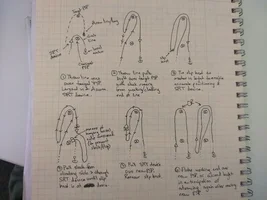
Gentlemen, I worked on a little diagram to try and help my mind absorb some of these concepts about advancing a basal anchor, and wanted to share this here for critique and, possibly, the benefit of others. Please feel free to let me know if there are any inconsistencies, incoherence, mistakes, inefficiencies, etc., etc.

I was watching the Schultz Effect closely and trying to adapt what he's talking about in the advancing basal anchors video to advancing a basal on a bight, without having to yard over 130' of climbing line, knowing I'd only end up doing it again further up the tree.

IMG_20190529_161043784.webp
 
I'm working on one for advancing a basal PSP and converting it to a canopy anchor at the same time, while leaving the basal anchor in place (built-in retrieval line, plus doesn't require someone on the ground to untie and send the end up to you).

I'll share that if it actually works out after I've tried it a few times successfully.
 
Last edited:
I'm working on one for advancing a basal PSP and covering it to a canopy anchor at the same time, while leaving the basal anchor in place (built-in retrieval line, plus doesn't require someone on the ground to untie and send the end up to you).

That can be accomplished using an MRS friction saver set using the same method as from the ground. Then tie a stopper knot at a point that removes the tension going to the basal tie.
 
These are all great ideas. My game for advancing a TIP usually involves doing a throw line retrievable SRS tie in, or a MRS tie in with a long lanyard which I send up to my TIP before I start my ascent. Advancing a basal anchored TIP is a whole other concept and I like those illustrations. LordFarkwad really solidified the concept. Isolating a climbing line in many of my neighborhood's dense conifers is pretty challenging, so I use a basal anchor a lot.
 
Last edited:
If you're pulling up huge amounts of rope, you're probably not leaving enough at the base-tie.

Base-tie does Not mean end-of-rope termination/ no lowering system or full-blown lowering system.

If you're tree's highpoint for climbing is 60', and you have a 200' rope, mid-tie at the base, using a PSP at say 45' for an arbitrary example, you can base-tie at 80' from the end of the rope, and still reach the ground after advancing from 45' to 60'. When you're at 45', you only have 75' of rope-tail/ standing end.

I like having everything tidy. It's easy to bag 75' of rope and carry. Especially if you sit down as much as possible, effectively putting most of the rope-weight on the rope, through your saddle/SRT-SRS device. Dropping limbs and tangling them in my rope is not as easy of a day as it could be. Another rope on the ground to add to groundworker work, not as easy as me carrying it. Won't go in chipper!!!!!


...and, oh yeah, you have 80' of lowering capacity in that hypothetical 60' PSP tree.

IF its a taller tree, you many have a lowering system that won't reach the ground, from the PSP. Its still a help, and can clearly be added onto, in order that the system can be lowered to the ground.

I've seen and heard of a successful base-tie lowering rescue Zero times. IF I really think I'm going to need to be rescued, I better stop climbing and figure out a functional, reasonable way.


I look at a mid-line base-tie as rope-management first and foremost, rescue-potential a secondary plan. Nice. Secondary. I expect I'm in it alone.
 
If you're pulling up huge amounts of rope, you're probably not leaving enough at the base-tie.

Base-tie does Not mean end-of-rope termination/ no lowering system or full-blown lowering system.

If you're tree's highpoint for climbing is 60', and you have a 200' rope, mid-tie at the base, using a PSP at say 45' for an arbitrary example, you can base-tie at 80' from the end of the rope, and still reach the ground after advancing from 45' to 60'. When you're at 45', you only have 75' of rope-tail/ standing end.

I like having everything tidy. It's easy to bag 75' of rope and carry. Especially if you sit down as much as possible, effectively putting most of the rope-weight on the rope, through your saddle/SRT-SRS device. Dropping limbs and tangling them in my rope is not as easy of a day as it could be. Another rope on the ground to add to groundworker work, not as easy as me carrying it. Won't go in chipper!!!!!


...and, oh yeah, you have 80' of lowering capacity in that hypothetical 60' PSP tree.

IF its a taller tree, you many have a lowering system that won't reach the ground, from the PSP. Its still a help, and can clearly be added onto, in order that the system can be lowered to the ground.

I've seen and heard of a successful base-tie lowering rescue Zero times. IF I really think I'm going to need to be rescued, I better stop climbing and figure out a functional, reasonable way.


I look at a mid-line base-tie as rope-management first and foremost, rescue-potential a secondary plan. Nice. Secondary. I expect I'm in it alone.
I agree and the only rescue ive heard of from a base anchor was done by mark chisholm
 
Thanks, @southsoundtree. You nailed it - I base tie right at the end of the line. On my tallest tree, once all the knots and height is factored in, I only have about 20' of line left over anyway. But on the others, I could definitely stand to take up some slack on the base side and get a shorter working end. Thanks!
 
Why all the hate/non-love for the double ended lanyard? Too much hardware?

Also, thought this in my sleep: what about a 3:1? As in, throw lanyard up, cinch, set an ascender or prusik with pulley, run tail of lanyard through, and climb on up. Gets rid of friction, but without a friction saver, as such.
Do you not find hauling, tailing and working 3x the length of rope a bit of a nuisance does it make the extra work worth the ease of friction
 
Do you not find hauling, tailing and working 3x the length of rope a bit of a nuisance does it make the extra work worth the ease of friction

Naw, naw. It's a real pain, any of this. I just got a rope runner, and also practiced advancing my basal tie so that it doesn't seem like as much of a chore now, nor require as much thought to redirect with the hitch hiker.
 

New threads New posts

Kask Stihl NORTHEASTERN Arborists Wesspur TreeStuff.com Teufelberger Westminster X-Rigging Teufelberger
Back
Top Bottom
