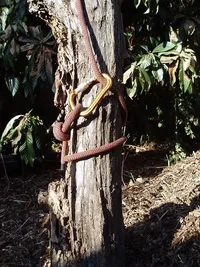
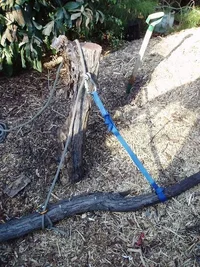
> I'm appreciating the ease of using this knot to pull over trees.
And where do you use this knot--i.e., around what does the
knot's eye go?
I'd be concerned that it would collapse, and otherwise be
less strong/kind-to-the-rope than one might get by at least
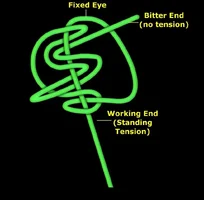
making a slight modification to it--to wit: make a loop
in the mainline vice the, um, up-down arc. And, as the knot's
oriented in the cited site, simply put a counter-clockwise twist
(one half turn) in that part after pulling it up through the
end's loop laid over it. This way, the tucked end-bight will
best resist the force to un-twist the mainline's loop.
A slipped Bowline, which has struck me as gratuitous easing of
untying (for what is a usually easily untied knot), should work
well, the finishing with a slip-bight providing one extra diameter
of rope for the mainline to crunch around, and a ready handle
(the end) to tug it apart.
There are various, myriad ways to "slip" a knot so that it's
easily untied (and yet simply finishing with a slip-bight is
no real assurance of untying ease: the knot can bind too tightly
around it to enable release), and another one pretty well known
is the treacherous "Highwayman's Hitch" (aka "Draw Hitch")
--which is not all so stable in some materials, and might capsize.
There's a simple revision of this, shown in Clyde Soles's knots
book <u>Outdoor Knots</u> (Mountaineers pub., 2004);
it's a spar or ring hitch--i.e., for relatively small dia. objects.
*kN*