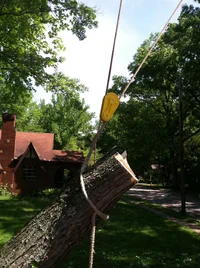
Double Block Rigging

Recently I worked with Tony on a project to figure out where the forces on the DBR system go and what concideration for the climber. He will be sharing our finding with Gareth (wrote the article for TCI) at the Expo this fall.
From what we did I felt it definately has its applications, especially on weakened stems. It was slightly cumbersome to set up but I think with a little practice, as with anything we do, the set up could be made easier. I got to try both the work aloft and on the ground and found it very interesting. To be honest I was sceptical going into it, but coming out it is something I will definatly pull out of my tool box if it fits a situation I face.
 
After using a DWT for a while my crew and I realized the benefit of running a 2:1 system is that we could lift many tip tied limbs easily. Then, when it comes time to let it run there is half the load on the down rope. Many times we didn't even use a lowering device or a half trunk wrap. This sped things up a LOT!
 
After using a DWT for a while my crew and I realized the benefit of running a 2:1 system is that we could lift many tip tied limbs easily. Then, when it comes time to let it run there is half the load on the down rope. Many times we didn't even use a lowering device or a half trunk wrap. This sped things up a LOT!
Just as a reminder--and correct me if I'm wrong, Tom--that puts 3x the weight of the piece into a single rigging point (if a single rigging point is used). Something not to be overlooked.
 
I briefly read the article. I should not comment on it till I read it word for word, but instead, I asked my friend that read it. I asked, "did it say anything about the dangers of how slow it is for a piece to run?" he said no, what do you mean?

I've done this several times in the past. When I have done it, it took the groundperson and I for surprise with how slow the log or limb moved or "ran" away. It almost seems like the groundperson needs to run the rope 3 times as fast in order to get the material away from the climber as usual.

it seems like 3 times......., maybe it's two times, but the material seems to move away dangerously slow and it's a major danger, so I feel the need to say it here, even though I don't have all the answers and math to it.

You guys can figure it out. I'm just talking from experience. Proceed with caution, that's all I say.

I only did it a handful of times, usually to remove a redirect and use what was already in place.

I don't like it. But..... maybe with more experience, it would be okay.

I'm just saying............ treat it different and climbers beware of a struck by...... as it seems there are no warnings with this article.

I wondered if any of my ancient videos showed any of it.

This one video posted in 2012 showing videos of previous years shows it at 1:53. The final tie point is a little low, which should speed things up, but it was still slow. Also the flipping force of the log should have sped things up dramatically, but it didn't. Like I said, I haven't done it much, but when I did, I didn't like it. With only doing it a few times, I could very well be completely wrong.


Just use caution and start small and get out of the way guys.

 
Tried it out today. Used a different limb to tie it off as a redirect because my original rigging point would've brought it back towards the bucket.
X is right on starting smallish. It takes half the wraps to control and is slow to run. image.webp
 
The speed of compressing or expanding mechanical advantage is directly rated to the MA ratio as you've found out. If you use a GRCS you know this for turning the winch handle one way or the other

There is lots of good info on. MA on the sailing smacks webpage that I linked. Take the time to read it. It gave me a much better understanding of he variableS
 
Excuse my lack of understanding but... what is the advantage in using this technique???
I think it's when you only have one REALLY LONG rope and two blocks and a LOT of weight. It allows a single rope to be able to take the big weight by dividing the load into the multiple legs of the rope.

I don't like the drastic switch up of the handling for the groundperson to deal with though. It makes them feel like they can't do a good job if they are use to regular systems. Maybe if they did it every day, it could be perfected. Instead of double block rigging with one line, using double line systems gives a groundperson the normal feeling when it comes to running the loads. I personally would just use two ropes with two "traditional" systems when it comes to huge weight. After the two lowering devices, the two rigging lines can be joined together with a small line (after enough length to reach the ground) and run by one man simultaneously, as if he was only dealing with a single rope.
 
This is how I did tree rigging in the early days when I was working for a landscaper/tree surgeon (it was back in the day). I was in my early teens and worked for him in the summer. It has some neat things you can do with it... we would tie the working end of the rope near the main block anchor for straight vertical lifting/lowering, but would tie it off (on the same limb) closer to the trunk if we wanted the load to move toward the trunk of the tree as we lowered it. We would tie it off to a point about the same height as the TIP on a different stem if we wanted the load to move in that direction as we lowered it. This came in real handy when we were removing limbs that extended over the house, etc. and with a tag line, as well, we could move the load in very predictable (albeit unusual) ways. You had to really think things through, and we'd even model our rigging plan with small branches and string and a fishing weight. It helped us to see how the load was likely to move, and whether the redirected line's TIP needed to be higher than or lower than the main block, and such. You can also run the working end through a third block and use two ground persons to control the load. The old boy I worked for was an ex-Navy man, knew his knots and his rigging. I learned some neat stuff, but I'd forgotten about this trick until you guys brought it up. Might have to give it a go, again!
 
Last edited:
I think it's when you only have one REALLY LONG rope and two blocks and a LOT of weight. It allows a single rope to be able to take the big weight by dividing the load into the multiple legs of the rope.

I don't like the drastic switch up of the handling for the groundperson to deal with though. It makes them feel like they can't do a good job if they are use to regular systems. Maybe if they did it every day, it could be perfected. Instead of double block rigging with one line, using double line systems gives a groundperson the normal feeling when it comes to running the loads. I personally would just use two ropes with two "traditional" systems when it comes to huge weight. After the two lowering devices, the two rigging lines can be joined together with a small line (after enough length to reach the ground) and run by one man simultaneously, as if he was only dealing with a single rope.
I would think that there is more force on the rope?
 
Its like a "basket" lift versus a "vertical" lift with a round sling, sorta. More 'legs of rope'.


Often taking things to extremes help to clarify what is happening. If, rather than two legs, there were twenty legs supporting a load, you would see that it divides up to 1/20 the load/ rope.
 
X has it right it allows you to remove a larger piece then normal rigging, but it allows you to spread those forces out over the stem of the tree. When set up correctly it spreads the weight of the piece between the termination, the primary block and the rigging device. The change in friction needed at the ground IS drastic but as with anything we do you must know going into the situation.

I would think that there is more force on the rope?

As for increasing the force on the rope, it actually is the exact opposite, the rope, primary block and rigging device see less force. But in theory the secondary block (on the falling piece) should see double. (We did not test this with a load cell due to their expense and our uncertainty of it getting smashed). But when thinking about it as long as you have heavy enough equipment on the piece who cares. It's the best place to to have increased loads... It don't matter.
Again I'm not advocating this technique, I'm just saying what we found. have a great day.
 
"but it allows you to spread those forces out over the stem of the tree. When set up correctly"

flyingquirrel, thanks for this. Good point.

Great to have you in this thread.

What about rope speed though? The speed of the rope through the groundperson's hands seemed to need to be about 3 times faster than normal to get the material the same normal distance away from the climber so that there was not a struck by.

this has been odd for the groundperson the handful of times that we did it over the years.
 

New threads New posts

Back
Top Bottom