












treebilly
Branched out member
- Location
- N. Lawrence
Thanks for linking Reg’s video. I read what was posted but “silly cunt” sounds so much better when he says it. Did he give you a mention @rico? Thought I heard it when he mentioned Martin
Follow along with the video below to see how to install our site as a web app on your home screen.
Note: This feature may not be available in some browsers.
He truly mentioned Rico....rightfully so. That vid was so spot on. Like you I enjoy the use of silly cunt. My fav word.....Thanks for linking Reg’s video. I read what was posted but “silly cunt” sounds so much better when he says it. Did he give you a mention @rico? Thought I heard it when he mentioned Martin

Oh crap here we go! I remember this shit. Circles...I've done my share of big nasty trees and posted video starting in 2009, well before most:
This was 2010. If you can find a video of someone taking out these kinds of tops before 2010 post it. Even to this day, you will not find anyone that has shown a large top getting taken out with a push of the hands as shown at 5:39
Thanks for the kind words Swing.He truly mentioned Rico....rightfully so. That vid was so spot on. Like you I enjoy the use of silly cunt. My fav word.....

At this time Your Honor, the prosecution would like to add narcissistic tendencies to the charges against the defendant.Reg said:
"they've said to me oh that's not safe
and well he just watched
me do it perfectly
but they seem to have lost the
ability to think for themselves this
little living in fear that rule books
it's a terrible shame and unfortunately there
seems to be more of them than there is
of us the way it's going at the moment
In the OP video the pine top made the hole perfectly. you saw it.
There is a reason Scott Parry has 3 Youtube subscribers, van brunt has 73, and I have nearly 10,000.
No disrespect meant, those are all fine videos of good tree work, but how many crane videos do we have to watch?
I've been showing cutting edge techniques and extraordinary videos for over a decade:
this was 2010... nothing like this had been shown at the time
ps.. what you can never get from video is that it was 102 degrees in the afternoon sun on that second tree (the beech)
I've done my share of big nasty trees and posted video starting in 2009, well before most:
This was 2010. If you can find a video of someone taking out these kinds of tops before 2010 post it. Even to this day, you will not find anyone that has shown a large top getting taken out with a push of the hands as shown at 5:39
Pictures dont lie. Legit. Reg seems to say there are too many videos being posted of mundane standard affair everyday tree work. Reg and Daniel are saying danger is relative. What may be dangerous to you may be ok for me, fine. Here is the difference i believe, there are times when you can reduce or eliminate danger/risk by doing it differently. There are times you cannot, example climbing a dead tree with no other tree for a TIP, no bucket or crane access. I speculate that Reg doesnt take unnecessary chances. I am sure the response will be " I am not taking a chance because i am so confident and skilled i trust my life to this cut" Makes my point, why trust your life to anything if there is another way. This stangle thingy is unnecessary because there is other straight forward ways to do it. Risk and chance, they are different. I dont take chances, i assume calculated risk when necessary. Why didnt the bowline on a bight get named the shoopty woop if it was so different, why because it describes the knot and are closely related. Same with the stangle, why not call it a slice cut with a notch which describes it better. Finally when clearing a big snag from the ground why not cut a notch in the top compression so the log doesnt pop so hard, instead of all that hacking at the cut and jumping around.Thanks for the kind words Swing.
Yesterday I pulled up some of those amazing pictures of that big old Mahogany crane job you did last year.
Epic shit bruv!e
View attachment 65570
I've tried it both ways and prefer my way. Have you tried them both? The pop rather than fold may scare some, but as long as the piece is but heavy (which they almost always are) the but is going to drop straight down, fast or slow doesn't matter. One advantage that the pop and drop offers is that the tree will tend to get straighter faster with the holding or hanging onto hinge fibers, whihc properls the but more forward than a quick straight dropdown. Once those pieces get straight they can become very dangerous and uncontrolled. Another advantage is that cutting the top-notch is more difficult than the snap cut, especially on bigger stems. And agin in an effort to keep the piece from getting straight, I try to cut as high as possible to get more drop from each bit of forward movement. I can reach up and cut those snap cuts as high as 7'. Cutting a notch from the ground at that height is impossible. In the case of this tree, I needed to get the tree to drop about 15' before the 75-foot elevator would be able to piece the rest out. In order to keep the job as safe as possible for the bucket operator, it was important to still have a good bit of lean to the tree. We didn't want the tree to get too straight!Finally when clearing a big snag from the ground why not cut a notch in the top compression so the log doesnt pop so hard, instead of all that hacking at the cut and jumping around.

Fair enough, i prefer the notch because it feels more controlled and and removes pressure from the cut. I prefer slow.True the piece becomes vertical quicker which usually causes the snag to flip out sooner which usually doesnt matter. If that is a concern i will take other measures as you stated you didnt want the tree vertical. I am talking in general, i acknowledge everything situation can be different. Yes i have done both. The body language and saw handling in the videos indicate some discomfort with the release of pressure, just my take.I've tried it both ways and prefer my way. Have you tried them both? The pop rather than fold may scare some, but as long as the piece is but heavy (which they almost always are) the but is going to drop straight down, fast or slow doesn't matter. One advantage that the pop and drop offers is that the tree will tend to get straighter faster with the holding or hanging onto hinge fibers, whihc properls the but more forward than a quick straight dropdown. Once those pieces get straight they can become very dangerous and uncontrolled. Another advantage is that cutting the top-notch is more difficult than the snap cut, especially on bigger stems. And agin in an effort to keep the piece from getting straight, I try to cut as high as possible to get more drop from each bit of forward movement. I can reach up and cut those snap cuts as high as 7'. Cutting a notch from the ground at that height is impossible. In the case of this tree, I needed to get the tree to drop about 15' before the 75-foot elevator would be able to piece the rest out. In order to keep the job as safe as possible for the bucket operator, it was important to still have a good bit of lean to the tree. We didn't want the tree to get too straight!
Well there ya' go folks...A real live story from a man who attemped a slice/salami cut while aloft, and got his bell rung. Wouldn't you know it he agrees that the risk just aint worth the reward, and there are much safer ways to accomplish the same goal.Wow!
I’m on a road trip and internet access is intermittent
I just read the first and eighth page of this thread because I took the title at face value.
Lots of comments to agree with many fir disagreement
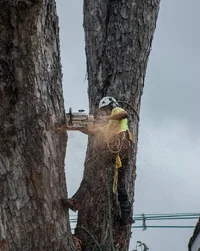
In the first few years of full time climbing I made a salami cut of a top. It slid off...no tip...and clocked me. Trip to ER. Bruises only. X-rays and discharged. After thinking about what happened I never made a salami cut in a tree in any material larger than four inch diameter. And even that was rare. There were always safer solutions that had comfortable margins of error. Using this technique is dangerous, in my way of thinking, because the margin of error is non existent. Skilled or not.
I wish I could watch the vid. Was it removed?

"It coming right at me so I'm gonna have to boogie when it comes over"made the lay, cleared the shrub. you saw it... so what's the complaint....
it's a common misconception that the pull line is in the direction of the lay. planned hinge failure is not uncommon tool in my box.... wonder if @Tony ever tried it or teaches it























