Stephen Moore
Branched out member
- Location
- Anglemont
seems like a great winter pastime though? Thanks for the thread Moss and gang.
Follow along with the video below to see how to install our site as a web app on your home screen.
Note: This feature may not be available in some browsers.

seems like a great winter pastime though? Thanks for the thread Moss and gang.

But you're not done perfecting the process. Off to a great START though.The main problem with it is how much work it is ;-) which is why it hasn’t become a widespread DIY activity.
-AJ


@moss inspired me to go get a Speedy Stitcher. Running the 45lb thread that came with it. Both ropes are KMIII 3/8, which BTW is already hard and a royal PITA to stitch.
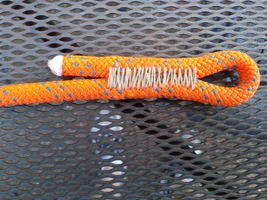
The orange was my first project with the Speedy. I have done some very low altitude hanging on the orange and it didn't budge. Just the top row alone has ~64 lock stitches (loops). The basting row probably has the same. So for top row, you have 45lbx2 per lock stitch loop then x.70 efficiency for the lock stitch, then x64 loops should theoretically yield 4,032lb. BUT, notice that I didn't completely capture 1/2 of the internal parallel cords so it could be slightly less.
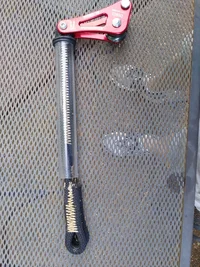
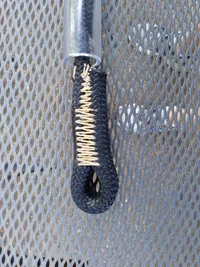
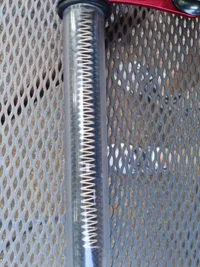
The black is my 3Gen stiff tether that is in use on my SRT setup. I still have to finish that bottom part where the legs meet the poly tube, but it's still pretty darn stiff. FYI for any SRT newbies or concerned equipment suppliers - the wrench and tether are not considered life support. I know, it says it right there on the wrench.
Hello Moss and others... This is a great thread of ideas and experiences!! Thank's for the info and opinions. I too have enjoyed making my own gear, but the sewn tight eye has been one I've resisted trying.....it just makes me a little too anxious for my comfort.
Best wishes,
Bob F.
Syracuse, NY
Yeah, that orange will probably never see the light of day other than some utility use. But, I think I may finish the other side and have it break tested just out of curiosity. As far as the SS needles, I ground them round and polished before using them. I believe you had a post where you mentioned doing that. As far as stitch density on the orange, that's about as tight as I'm going [can go] on something like KMIII. But stitch density that can vary a little as long as you have the correct total stitches. Man I love the the speedy. I have used that thing a bunch of times on other stuff around here and it's great.Only way to know actual strength is to have it pull tested. You’re good to go with the tether but the stitch density doesn’t look good on the KM III.
The biggest problem right now is that if you’re using the needles that came with the speedy stitcher, they are cutting needles, they will rip cordage fiber every time you push the needle in, you can hear the sound. I posted a spec for ball-tipped industrial needles earlier in this thread. You should use those for life support sewing in cordage.
-AJ
It's not just because it's forced through the rope harder but just because it can. You just can't do that by hand. so here I think we're trying to find a way around that and get the maximum strength from every thread you do get through the rope. Yes somewhere in the middle is good even if it's not in the middle you'll get some amazing strength as long as you capture some of the core, I know that doesn't sound right but it's true. Some cores are slipperyer than others so that is a consideration.Hey Richard, I'm not understanding how the machine sewn stitch would be stronger than the hand sewn just because it is forced through the rope harder. Once the rope is bent or stretch, it would seem both would just be the same stitch under the same conditions.
Also, are you suggesting that the circular running stitching should be in the middle of the two sections of rope, or around the outside ,like the Round Peremeter stitching.
Best thing for cutting rope, any kind is a ceramic knife.Dyneema can be cut. X-acto knife w/ brand new blade. Pair of genuine Wiss big size canvassmaker's scissors. Or burn using a Weller gun with a flat blade end. (A person probably should have a flat blade hot tool to do this kind of work anyway -- usually cheap ($6-8) at your local 2d hand tool store...)