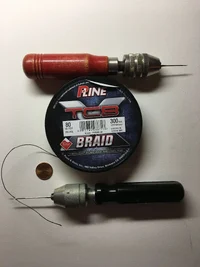
Documenting my hand-sewn eye process

Okay, Petzl wants me to send in the bridge for warranty evaluation. They won't say one way or another whether this is normal or not even after I told them the rope legs were moving within the stitching. They better do me right on this.
Sorry for the derail, but you will likely buy a new one (so you can use your harness while they inspect). The results will be that it’s fine, but they will send you a new one because they will say “it’s a customer service issue”. You will be out shipping which will cost more than a replacement.
Their rope bridges are bogus. Uncovered loose sloppy pieces of crap made in SE Asia. This bridge issue, and the alevo helmet (ear nuff slot cracked) turned me off petzl gear long before the zigzag came out.
 
Needle
7x3 (ball tip) 180 industrial machine needle (ground down the needle shaft to fit the sewing awl chuck)

Moss, can you or anyone else help me find this needle? A link or a site would be great. I've searched heavily on Google and my local Jo-Ann fabrics and am coming up empty handed.

Thanks much, I appreciate any help.
 
Tippmann Industrial, from page 2, post 21. I think that they don't sell that exact needle. Last time, I just bought the smallest of that type, I think it is the 7x3x120.
 
Last edited:
Even though the eye on the 180 is big it's still difficult to thread the heavy thread I use through the needle, I made a "threader" with a guitar string, needs to be a thinner string, the high E is good. Bend an open loop into the string, put the loop through the needle eye, put the thread through the loop and pull it back through, quick and easy.

31197948627_f030c24c4b_c.jpg

-AJ
 
I've been experimenting with not pre-clamping the two sides of the join with C clamps. Using narrow electric tape wraps to hold things in position as I have in the past. Not having any problem with too little compression, I'm wearing grippy gloves with the finger tips cut off so I can tighten each stitch extremely hard. Problem is it's possible to overtighten so that cordage becomes like a rock too soon in the process. I bent two needles beacause of overtightening the stitches and broke the thread halfway though the final pass. Conclusion is the C clamps are a good technique, not for the compression but because you can align the "grain" or I guess weave of the cordage perfectly, then tape, the tape holds that alignment. It's the hand tensioning per stitch that creates the most compression. In the eye that I did without using C clamps, there was some very slight twist and the needle didn't want to go straight through in the direction I wanted. I tried again was able to get the cordage lined up properly with just the tape but it's easier to accomplish the alignment with the C clamps.
-AJ
 
I use dyneema thread and only need a smaller needle. Hope I didn't lead you to getting the wrong size needles if you are going to be using a polyester thread.
 
Even though the eye on the 180 is big it's still difficult to thread the heavy thread I use through the needle, I made a "threader" with a guitar string, needs to be a thinner string, the high E is good. Bend an open loop into the string, put the loop through the needle eye, put the thread through the loop and pull it back through, quick and easy.

31197948627_f030c24c4b_c.jpg

-AJ

In this photo the string and the needle look absolutely huge. The string looks like it's 1/8 inch diameter, or something. Is this just a magnified shot for clarity? Putting a copper penny into the photo would give a size reference. Great photo of your tools and technique, thanks for posting it, moss.

Tim
 
In this photo the string and the needle look absolutely huge. The string looks like it's 1/8 inch diameter, or something. Is this just a magnified shot for clarity? Putting a copper penny into the photo would give a size reference. Great photo of your tools and technique, thanks for posting it, moss.

Tim

Magnified photo, here's one for scale:

46096061792_c2ac324880_c.jpg
 
This is what I use. The teflon coating is similar to wax, very little tangling and very easy to thread the needle.
View attachment 55643
And I've included the requisite penny for size comparison!

I have no idea what my stitching strategy would be using that thread, with thicker threads less stitches required to achieve a life support join, each stitch takes a fixed amount of time no matter the thread thickness. However when sewing say 8-10mm cordage this would be great. Also would be excellent for sewing webbing and general harness repair etc.
-AJ
 
I’d guess that with dyneema you’d need quite a few stitches, not for strength but to spread the load over a greater surface area to prevent host failure
 
I’d guess that with dyneema you’d need quite a few stitches, not for strength but to spread the load over a greater surface area to prevent host failure

Yeah so maybe not great for the 11-11.5 or greater lines. I can imagine a more open stitch pattern to cover the length you'd want, would be interesting to break test something like that.
-AJ
 
Hey Moss..
Can i be lazy & ask if there is some point or page within this thread that pretty much sums the basics up? You know, Preferred patterns for Cordage/Core type, Preferred all round Thread, Preferred Needels, Tools, Common Misconceptions/Errors to look out for.

I'm looking at 480 pages on my app here & I've got the urge to experiment with it this week. Is it ok to be lazy & ask as long as I own up to it? Haha..

-Side note
I was blown away at how high that RIT Cordage broke on Richards machine with what looked like minimal stitching. Iirc, it looked like a fatter thread was used.
 
Hey Moss..
Can i be lazy & ask if there is some point or page within this thread that pretty much sums the basics up? You know, Preferred patterns for Cordage/Core type, Preferred all round Thread, Preferred Needels, Tools, Common Misconceptions/Errors to look out for.

I'm looking at 480 pages on my app here & I've got the urge to experiment with it this week. Is it ok to be lazy & ask as long as I own up to it? Haha..

-Side note
I was blown away at how high that RIT Cordage broke on Richards machine with what looked like minimal stitching. Iirc, it looked like a fatter thread was used.

The first page of this thread has the essentials for the way I do it. A bunch of other people make great contributions when you have the time to look around.
-AJ
 
The first page of this thread has the essentials for the way I do it. A bunch of other people make great contributions when you have the time to look around.
-AJ
I gotchya.. I've read through the first couple.. just realized that I'm already around page 100 in the app.. so i don't think it's actually that long. I wasn't sure if you had changed your technique at all or came to a point somewhere in the middle of the thread where you decided that "xyz" are the best practices.. so on & so on..

I've seen some interesting stuff so far though, for sure.. like that foot locking device Hitman made up.

Anyone here been brave enough to sew Icetail? You know the ice tail with the skinny mini core? What about rigging tools.. are those a no-go zone for sewing? Or.. maybe a small xring Prusik?
 

New threads New posts

Kask Stihl NORTHEASTERN Arborists Wesspur TreeStuff.com Teufelberger Westminster X-Rigging Teufelberger
Back
Top Bottom