Documenting my hand-sewn eye process

seems like a great winter pastime though? Thanks for the thread Moss and gang.

It would be except weather is decent enough in eastern Mass. to climb all winter. Actually a great time to climb, a little slower but you rarely overheat ;-) I think for the people that do it, it just grabs them and like me they probably ignore the fact that if time equals money just buy a machine sewn eye. Then there's growing your own vegetables, building your own house and on and on. There's something special about growing your own, changes your relationship with your gear. Once you prove that what you've made is safe (break tests, experience etc.) It feels safer then anything you can buy from a manufacturer, you know exactly what went into it.
-AJ
 
Just thinking to myself here after reading some arguments about the safety factory of "hand" sewing these.. but i wonder if some sort of needle jig could be made up to increase precision & quality control of doing these by hand.

In other words to create the same exact acceptable/ repeatable pattern every time..

I don't have a clear idea what it the jig would look like, but I'm sure some of you have a better imagination than i. This is a wildly different example but, i know when I've studded snomobile tracks I've used a jig/template out of metal to mark the suggested drilling pattern.. if the holes in the template were big enough to pass the cutter/punch i was using, I could have just layed it over track & gone to town instead of just marking the holes & drilling after... Maybe this could be done on a needle/awl size with one jig under & one jig over & you match the holes while the rope is compressed by whatever means..

Maybe these things have all been discussed already..idk..

Cool thread for sure though...

Sent from my Pixel 2 XL using Tapatalk
 
Last edited:
In my opinion, if you wanted to standardize any of this, learn what it feels like to pull about 20 lb on the thread, make that consistent and do a circular running stitch to a tested length and repeats.
 
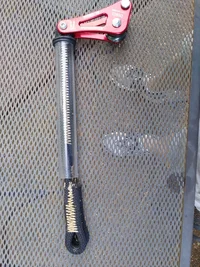
@moss inspired me to go get a Speedy Stitcher. Running the 45lb thread that came with it. Both ropes are KMIII 3/8, which BTW is already hard and a royal PITA to stitch.

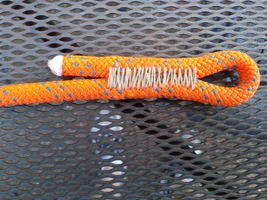
The orange was my first project with the Speedy. I have done some very low altitude hanging on the orange and it didn't budge. Just the top row alone has ~64 lock stitches (loops). The basting row probably has the same. So for top row, you have 45lbx2 per lock stitch loop then x.70 efficiency for the lock stitch, then x64 loops should theoretically yield 4,032lb. BUT, notice that I didn't completely capture 1/2 of the internal parallel cords so it could be slightly less.

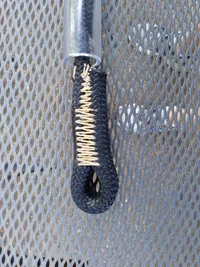
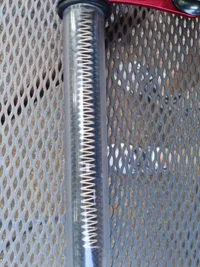
The black is my 3Gen stiff tether that is in use on my SRT setup. I still have to finish that bottom part where the legs meet the poly tube, but it's still pretty darn stiff. FYI for any SRT newbies or concerned equipment suppliers - the wrench and tether are not considered life support. I know, it says it right there on the wrench.
 

Attachments

  • 0827181846.webp
    0827181846.webp
    663.8 KB · Views: 59
  • 0827181846a.webp
    0827181846a.webp
    434 KB · Views: 58
  • 0827181846b.webp
    0827181846b.webp
    343.2 KB · Views: 53
  • 0827181846c.webp
    0827181846c.webp
    380.1 KB · Views: 55
My observations. Using the Speedy Stitcher pushes 2 threads into the same hole and with the bend in the loop much strength is lost when the challenge is to push thread into the sewn eye. Machines have an advantage and can hammer that thread into the rope and make up for the strength loss by filling and pressurizing the core in the cover. Hand sewing seems to give better results if more effective strength can be achieved from each stitch. Use stronger thread but no lock stitch, a circular running stitch. Think about Kevlar thread that yields twice the strength. Just a few thoughts for those with needles.
But for me, I'll stick to my sewn CI stitch pattern.
 
@moss inspired me to go get a Speedy Stitcher. Running the 45lb thread that came with it. Both ropes are KMIII 3/8, which BTW is already hard and a royal PITA to stitch.

The orange was my first project with the Speedy. I have done some very low altitude hanging on the orange and it didn't budge. Just the top row alone has ~64 lock stitches (loops). The basting row probably has the same. So for top row, you have 45lbx2 per lock stitch loop then x.70 efficiency for the lock stitch, then x64 loops should theoretically yield 4,032lb. BUT, notice that I didn't completely capture 1/2 of the internal parallel cords so it could be slightly less.

The black is my 3Gen stiff tether that is in use on my SRT setup. I still have to finish that bottom part where the legs meet the poly tube, but it's still pretty darn stiff. FYI for any SRT newbies or concerned equipment suppliers - the wrench and tether are not considered life support. I know, it says it right there on the wrench.

Only way to know actual strength is to have it pull tested. You’re good to go with the tether but the stitch density doesn’t look good on the KM III.

The biggest problem right now is that if you’re using the needles that came with the speedy stitcher, they are cutting needles, they will rip cordage fiber every time you push the needle in, you can hear the sound. I posted a spec for ball-tipped industrial needles earlier in this thread. You should use those for life support sewing in cordage.
-AJ
 
Hey Richard, I'm not understanding how the machine sewn stitch would be stronger than the hand sewn just because it is forced through the rope harder. Once the rope is bent or stretch, it would seem both would just be the same stitch under the same conditions.

Also, are you suggesting that the circular running stitching should be in the middle of the two sections of rope, or around the outside ,like the Round Peremeter stitching.
 
Hello Moss and others... This is a great thread of ideas and experiences!! Thank's for the info and opinions. I too have enjoyed making my own gear, but the sewn tight eye has been one I've resisted trying.....it just makes me a little too anxious for my comfort.
Best wishes,
Bob F.
Syracuse, NY

It's probably way too much work, but I would bet that if you had a significant number of samples break tested, and they all came out well above the required minimum numbers you were looking for, you might be able to trust your work and feel less anxious. It is tough to think about destroying so much hard work, though.

Tim
 
A jig probably would just make it more difficult. If the two sections of rope are properly set up, the individual braids of each section when lined up, can be used as indicators to sew uniformly.
 
Only way to know actual strength is to have it pull tested. You’re good to go with the tether but the stitch density doesn’t look good on the KM III.

The biggest problem right now is that if you’re using the needles that came with the speedy stitcher, they are cutting needles, they will rip cordage fiber every time you push the needle in, you can hear the sound. I posted a spec for ball-tipped industrial needles earlier in this thread. You should use those for life support sewing in cordage.
-AJ
Yeah, that orange will probably never see the light of day other than some utility use. But, I think I may finish the other side and have it break tested just out of curiosity. As far as the SS needles, I ground them round and polished before using them. I believe you had a post where you mentioned doing that. As far as stitch density on the orange, that's about as tight as I'm going [can go] on something like KMIII. But stitch density that can vary a little as long as you have the correct total stitches. Man I love the the speedy. I have used that thing a bunch of times on other stuff around here and it's great.
 
Semi-random notes from a chance to do a little reading of posts....
- The move to make hand work be entirely like machine work is not in all cases necessarily a good one in this context. That is to say that there are conditions in which a certain irregularity is a benefit. It is my view, for just one small example, that having the insertion point in the rope for the thread not be exactly in a line with all the other insertion points-- whihc are also lined up along the rope fiber axis -- means that a) the connecting load is a little bit better distributed, and b) that the fiber is "held" better by in effect being squeezed around the difference.
- There are people using lighter hread than I would be fully comfortable with. What is the difference between a lot of sewing with a lighter thread, and less sewing with a stronger thread? (I seem to be on one end of the spectrum using 300 lb test dyneema (from which a weight of even a little more can be hung.) Most of the answer for me has to do with time and various kinds of deterioration (or injury). If UV, or ozone, or solvents, or scorching, or random cuts is going to get to the "thread bundle", the bigger/stronger sewing material is going to fare better.
 
- Then there is the idea of several different kinds of "headroom."
-- break test "headroom" ... If a smaple of the rope breaks when pulled on at 6,000 lbs, assuming the rope I'm using isn't damaged compared to the sample, I can put 2,000 on it without going crazy with fear.
-- calculated "headroom" ... if I'm hanging on a bolt half a square inch in cross section of 35,000 psi steel, I probably can put a couple thousand ponds on that if it isn't rusted, or cracked, etc.
-- experience "headroom" .... no friction knot weakens a rope strand more than about 50 % of the former breaking strength. So, if i've got a knot in 8,000 lb rope, I can still put a few pounds on it
-- distributive "headroom" ... two-part falls usually work out having each rope part carrying about fifty percent of the total load....
Etc.
In sum, there are a lot of very basic engineering notions one can use while rigging and which, if coupled with lots of respect and distance from the limits, can keep a person out of trouble in most of what we do. Hand sewn tight eyes, among other things, follow these principles if made properly, and used intelligently and with respect. (Maybe worry more about cutting your arm or your rope with your saw.....
 
Plus the dyneema is harder to cut then polyester, or nylon.

Perhaps hand sewing is evolving into two distinct methods of accomplishing the same thing.
Multiply, tight, lock stitches on the interior of the two rope sections, like the machine produced ones, and the other with fewer stitches, that spiral, are spaced further apart, and using stronger thread.
 
Dyneema can be cut. X-acto knife w/ brand new blade. Pair of genuine Wiss big size canvassmaker's scissors. Or burn using a Weller gun with a flat blade end. (A person probably should have a flat blade hot tool to do this kind of work anyway -- usually cheap ($6-8) at your local 2d hand tool store...)

 
Hey Richard, I'm not understanding how the machine sewn stitch would be stronger than the hand sewn just because it is forced through the rope harder. Once the rope is bent or stretch, it would seem both would just be the same stitch under the same conditions.

Also, are you suggesting that the circular running stitching should be in the middle of the two sections of rope, or around the outside ,like the Round Peremeter stitching.
It's not just because it's forced through the rope harder but just because it can. You just can't do that by hand. so here I think we're trying to find a way around that and get the maximum strength from every thread you do get through the rope. Yes somewhere in the middle is good even if it's not in the middle you'll get some amazing strength as long as you capture some of the core, I know that doesn't sound right but it's true. Some cores are slipperyer than others so that is a consideration.
 
Dyneema can be cut. X-acto knife w/ brand new blade. Pair of genuine Wiss big size canvassmaker's scissors. Or burn using a Weller gun with a flat blade end. (A person probably should have a flat blade hot tool to do this kind of work anyway -- usually cheap ($6-8) at your local 2d hand tool store...)

Best thing for cutting rope, any kind is a ceramic knife.
 

New threads New posts

Kask Stihl NORTHEASTERN Arborists Wesspur TreeStuff.com Teufelberger Westminster X-Rigging Teufelberger
Back
Top Bottom