
Go disinfect your tool.I tend to BOOF my WD-40....

Navigation
Install the app
How to install the app on iOS
Follow along with the video below to see how to install our site as a web app on your home screen.
Note: This feature may not be available in some browsers.
More options
You are using an out of date browser. It may not display this or other websites correctly.
You should upgrade or use an alternative browser.
You should upgrade or use an alternative browser.
Disinfecting Tools
- Thread starter rico
- Start date

Evo
Been here much more than a while
- Location
- My Island, WA
Tempering is a three stage process.I also use denatured alcohol. That's the only thing I've read on the subject so that's what I've always gone with. @Jemco - that's an awesome idea but you'd need to research the specific steel to figure out what temps it can take without changing the blade temper. Some steels will start to harden or soften at much lower temperatures than others, possibly making your blade brittle. I believe the term is called normalizing when it's just enough, but without changing properties too much... maybe there's an amateur knife maker around here somewhere who can elaborate!
1 normalize the steel by heating it up and cooling it slowly to release any internal stresses (forging)
2 heat the steel to the desired temperature to quench (cool rapidly) in oil, brine, or water depending on the type of steel or metal.
3 temper the steel by either holding back a section out of the quench to re warm the working edge, or heat the entire thing in a oven 300-800 depending on hardness or temper color desired. (Ever see the rainbows on heated metal before it starts glowing? Those are specific temperature ranges per metal type). Then if done in oven simply let cool, or re quench to not allow the edge to over heat (making the metal soft)
The act of rapidly cooling the metal hardens it. The act of tempering is softening the metal to the desired hardness. Some metals also air harden, without the quenching process (good for working hot steels).
Heat, pressure, and time is what it takes to sterilize. Like most things it’s a balance between all three. Sure red hot steel will kill anything, but also ruin the temper. Autoclaves can be acquired cheaply, but often limited in size. Always best to do a ultrasonic soak to get into all the nooks and crannies first.
The question is how sterile is acceptable? Or warranted?
Evo
Been here much more than a while
- Location
- My Island, WA
Normalizing = Annealing = Bringing the steel up to critical (non-magnetic) temperature (generally around 1200*F) and then letting it cool verrrrrrrry slowly. It softens the steel and removes any hardening, leaving it dead-soft.
Typically steel is hardened by heating to critical temperature, then quenching in water or oil or just air. After you quench the steel, it is usually TOO hard and therefore brittle (sometimes it's so brittle and filled with stresses that it can explode like popcorn all by itself) so you need to "soften" it some, which also toughens it. This is done by bringing it up to some temperature below critical and then letting it cool.
If you heat a tempered steel edge too hot by grinding it or whatever, you can "take the temper out" -- i.e. raise it to a temperature higher than the temperature at which it was tempered...which will soften it.
Much of this is done by watching the colors the steel turns. Google "steel tempering colors" and "steel temperature and color" for more....(these are two different things)...
Beat me too it!
Yes you can fuck up a temper at 450.I sorta doubt heating blades to 450F in an oven'd mess up the steels temper.
Jemco

Matthew Stone
New member
- Location
- Scranton
So, with these great replies on metallurgy... What's a good temp to sterilize at without destroying the blade? 300- 325? This is purely hypothetical, I have plenty of half made knives that never went anywhere and I'm not about to start explaining to the boss why the whole house smells like a welding factory... Again. Also, would anyone think a good blast to the blade's teeth with a propane torch could do much? I like the ultrasonic parts cleaner idea a lot.

160 F or if you absolutely must, 212 F with boiling water. I would not go hotter than that.
I suspect either one is going to kill darn near 100% of pathogens.
This ain't a surgical suite, and there's lots of stuff that blows in the wind and rain. I think "ruining tools to get them 100% sterile for cutting off tree branches" would qualify as "overkill."
How 'bout "spray everything down with 50-50 bleach/alcohol and then rinse it off with boiling water" for a 99.999999999999999999999999999999999999999999999999999999% cure?
I think it could end up ruining the teeth. Remember, the actual cutting edge on the tooth of a saw -- where the hardness of the steel matters most -- is very, very thin, which means that it takes very little heat to raise its temperature A LOT. With a propane torch, there's no way to really KNOW how high you're raising the temperature. With boiling water, you know the absolute hottest you could possibly make the tooth would be 212*F, which should be safe for any steel that I've ever heard of...
I suspect either one is going to kill darn near 100% of pathogens.
This ain't a surgical suite, and there's lots of stuff that blows in the wind and rain. I think "ruining tools to get them 100% sterile for cutting off tree branches" would qualify as "overkill."
How 'bout "spray everything down with 50-50 bleach/alcohol and then rinse it off with boiling water" for a 99.999999999999999999999999999999999999999999999999999999% cure?
Also, would anyone think a good blast to the blade's teeth with a propane torch could do much?
I think it could end up ruining the teeth. Remember, the actual cutting edge on the tooth of a saw -- where the hardness of the steel matters most -- is very, very thin, which means that it takes very little heat to raise its temperature A LOT. With a propane torch, there's no way to really KNOW how high you're raising the temperature. With boiling water, you know the absolute hottest you could possibly make the tooth would be 212*F, which should be safe for any steel that I've ever heard of...
Last edited:
So I blew all the saw dust off the old silky, sprayed down with a 50/50 blend of bleach/alcohol, then popped it in the oven along with a batch of chocolate chip cookies. Then when I was headed to bed I threw it in the wood stove while dropping in an allnight party log.. I woke up this morning to the smell of burnt plastic and a super cool looking chunk of highly sterilized molten metaI. I hated that fucking thing anyhow.....
Last edited:
Matthew Stone
New member
- Location
- Scranton
That's a badass batch of cookies.. cookies with teeth! It must have worked if you're still evading the corona!

cerviarborist
Very stable member
- Location
- Florida, USA
Pests of Landscape Trees and Shrubs, Third Edition
Completely revised and expanded, Pests of Landscape Trees and Shrubs, 3rd Edition, is a comprehensive, how-to integrated pest management (IPM) resource for landscapers, arborists, home gardeners, retailers, and parks and grounds managers. This easy-to-use guide covers hundreds of insects...
books.google.com
Note that their heat sterilization method only requires ten seconds with a torch. I would think that keeping the torch moving the length of the saw blade on both sides and edges for a total of ten seconds wouldn't heat it sufficiently to draw temper.

Basswood
Carpal tunnel level member
- Location
- Long island
My job actually wants us wearing tyvek suits and clean/disinfect the hose and tools on all PHC visits where Boxwood blight is confirmed.
Otherwise on PHC visits if I take samples of suspect plants, those pruners are not used until they are cleaned (I have a few secateurs in my bag). I will clean them or my saw if out pruning anything I know has health issues. I’ll do a very through clean of tools a few times a year.
Otherwise on PHC visits if I take samples of suspect plants, those pruners are not used until they are cleaned (I have a few secateurs in my bag). I will clean them or my saw if out pruning anything I know has health issues. I’ll do a very through clean of tools a few times a year.
ghostice
Been here a while
- Location
- Way west of Lake ONTARIO
This thread was kicked around some years ago now if it helps . . .
Sanitizing Pruning Tools
What is the best way to disinfect pruning tools between trees? We have always used bleach water when a situation called for it. I have heard that bleach is phytotoxic. Is there a better way?
www.treebuzz.com

cerviarborist
Very stable member
- Location
- Florida, USA
Soap and water will destroy COVID19 on a rope as will laundry detergent. Surfactants are the bane of corona viruses. They dissolve the outer cover of the virus and all the innards dissolve into harmless components which go down the drain. Soap and Water. Soap and Water. Say it with me.

JeffGu
Been here much more than a while
- Location
- Osceola, Nebraska
THIS PAPER shows that in all strains of coronavirus, the capsid is destroyed by copper ions when it is on many copper and copper alloy surfaces, resulting in destruction and fragmentation of the virus's RNA and thus destroying its ability to replicate.
Very interesting stuff. Copper, of course, isn't cheap... but, the authors felt that in a hospital situation, the initial costs of plating surfaces could be recovered in a few months. Hospital workers are constantly touching surfaces, then touching their faces at a rate of about 15 times per hour... even though they're trained to know better.
Also of interest, common ammunition brass has a high enough copper content that it was very effective, as well! You guys building bunkers in your backyard might want to melt down your used brass and roll it into sheets to plate the walls, ceilings, and benchwork in your underground bunker.
I know, you're going to want to reload all that used brass for your firefights with gubbermint death squads, but... really... we all know how that's going to turn out, anyway. Better melt it down and work on your copper fortress.
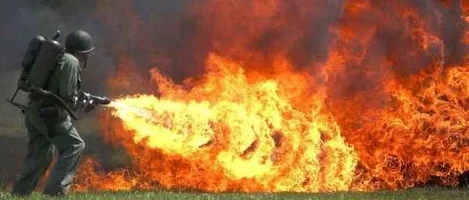
Your average conflict with gubbermint death squads ends like this...
Very interesting stuff. Copper, of course, isn't cheap... but, the authors felt that in a hospital situation, the initial costs of plating surfaces could be recovered in a few months. Hospital workers are constantly touching surfaces, then touching their faces at a rate of about 15 times per hour... even though they're trained to know better.
Also of interest, common ammunition brass has a high enough copper content that it was very effective, as well! You guys building bunkers in your backyard might want to melt down your used brass and roll it into sheets to plate the walls, ceilings, and benchwork in your underground bunker.
I know, you're going to want to reload all that used brass for your firefights with gubbermint death squads, but... really... we all know how that's going to turn out, anyway. Better melt it down and work on your copper fortress.
Your average conflict with gubbermint death squads ends like this...

Tree-Taylor
Branched out member
- Location
- Canada
With all the historic changes that Mother Earth is experiencing my local ecosystem has become very stressed and we are seeing all sorts of diseases/bugs that are reeking havoc on our trees and forests. I have been doing my best to try and clean my tools (handsaws, chainsaws, gaffs, ect) between trees/jobs in the hopes of Not spreading anything into unaffected trees and areas... Looking for recommendations as to what would be most effective for my stated purpose.....
I had good luck in my 20s with doxycycline.
Not many living things like copper much, including sperm. For one thing, it's very noble on the galvanic series. In an electrolyte like rainwater, almost every metal on earth will be sacrificed to copper in a galvanic cell. It's also the 3rd-most conductive metal on earth, after silver (#1) and gold (#2), which tends to take the starch out of things that depend on a particular temperature or voltage/electrical potential in their environment...it's like a big grounding strap or Faraday cage around static electricity...and many critters just kind of wilt when they encounter it...which gives brass door knobs and silver flatware some disinfecting properties..they also use some compound of silver in textiles (underwear, socks) and plastics (dog bowls, fast food trays) for its antimicrobial properties...and then there's copper anti-fouling paint on boat hulls...
Last edited:
I use barbicide , but the guys above have excellent solutions to this problem , I'll take some note
For example, I did not know about Lysol , but now I read information about it on the Internet and found out that it also copes with this task perfectly.
There is also an option that my father told me , he saw on https://housebouse.com/tools/hand-tools/ a certain type of wd-40 but which works much better in this case than a regular wd-40 and I also want to order it one of these days and try if this is really the case , I just have some tools that I urgently need to clean, since they are already quite bad
For example, I did not know about Lysol , but now I read information about it on the Internet and found out that it also copes with this task perfectly.
There is also an option that my father told me , he saw on https://housebouse.com/tools/hand-tools/ a certain type of wd-40 but which works much better in this case than a regular wd-40 and I also want to order it one of these days and try if this is really the case , I just have some tools that I urgently need to clean, since they are already quite bad
Last edited:
New threads New posts
-
test
-

-
 Alternatives to standard asphalt around roots
- Started by southsoundtree
- Replies: 12
-
-

-

-
