Sad to say about two years ago we cut down a 2'DBH Paulownia tree in a wooded area about 75ft' tall and straight trunk. Winded up cutting, halfing then chipping the entire tree. Didn't find out until recently of the theives cutting, stealing, selling, and exporting this wood overseas. Would have made an effort to do something with it had I known. P.S. Isn't the Empress tree the common name not Princess tree? Latin name is Paulownia Tomentosa

Navigation
Install the app
How to install the app on iOS
Follow along with the video below to see how to install our site as a web app on your home screen.
Note: This feature may not be available in some browsers.
More options
You are using an out of date browser. It may not display this or other websites correctly.
You should upgrade or use an alternative browser.
You should upgrade or use an alternative browser.
Disappointed with logs to lumber service
- Thread starter Cameron
- Start date

Funny you couldn't get someone to take the cherry off your hands. Last I knew, it's the hot-ticket item.
Cherry's perfect firewood for this time of year. It ought to be ready next fall.
I love how it smells like cough drops
Cherry's perfect firewood for this time of year. It ought to be ready next fall.
I love how it smells like cough drops

- Location
- Home of the New Jersey Devils
I cut down four Empress trees a few years ago that were all over 36" dbh. I couldn't get anyone to take the wood. I tried all over the internet. It got recycled two years after.

- Location
- Lansing, NY
Just a thought, after I just read over some of what was being said. How about posting in the tree bay section of the buzz. I do not know some other buzzers probablly would like the logs.

Riggs
Participating member
- Location
- Bryn Mawr , Pa.
I just gave a beautiful , 16 . 6 Cherry log to an amish mill last month . I got 38 dollars . How do you flatten a buggy wheel ? I gave the same mill a Walnut log , sweet , fifty dollars . I could've made more money if I sold it for firewood. I can't figure them mills out.
- Location
- Lansing, NY
I had the same deal with the amish doing a lot clearing job in Ohio for a friend of mine. His land was near the border of a field that they had tier farm on. Upon felling some good size logs I asked where to put them. My bud did not put into this part of the job(logs utohwhat to with them). I walked over to the farmer and asked him where the local mill was. After listening to him in broken german&english we figured it out. To make this short the mill payed out $100 for for 20 logs. In the long run I figures that they can do more with the logs seing how they are great woodworkers, so to the loss of money we did not care. He still lives there and has a great relationship with the amish and that mill.
Somethings seriously wrong here! Like I said, I got about 19 cents per board foot. Go to Home Depot and for red oak it is about $6 a BF jointed and planed. Whose the one making all the money, the retailer? I wonder how the actual loggers are making out? Even loggers have expensive equipment and high overhead costs. They are the ones only getting paid from the mill and no one else. We on the other hand do get paid from the clients removing the tree and selling the wood is extra. I would think the pay would be higher for the wood. We have done the hardest part, getting the tree down and ready for shipment. There can't be an excess of lumber around-Look at what it's cost to buy.
I get a kick out of folks thinking that walnut tree in their yard is worth $6,000. Well, it might be; but that's only after it's been harvested, transported to the mill, sawed, dried, and then worked into finish product. Who along the line is supposed to work for no wages or no return on investment of equipment or storage location?
Is a guy who was at one time married to my brother's wife's sister any relation to me? Whatever that may be, he pretty much runs a hardwood mill about an hour and a half away. They mainly do oak. They don't want to see a tree that didn't come out of the middle of at least 50 acres. They utilize every part of what comes through the gate. They don't touch walnut because it has to be steamed and they can't use any of the refuse, some of which would normally go for animal bedding. It's just not worth the trouble to them.
Then there's the competition from the Chinese et. al. who take timber, load it on a ship, take it out to sea, process it, then bring it back to shore as finished product. No real enforceable regulations to contend with, etc.
Their field crews have to contend with all sorts of EPA stuff. He mentioned a while ago about these things that are somewhat like baby-changing tables which they have to use when filling/servicing the saws in the woods. They are supposed to capture any spilled oil/gas. Not saying that being responsible with the environment isn't a good thing, but all of this stuff really eats into the profit margin. Granted, that doesn't have anything to do with tree-services wanting to market material, but it all factors into the cost of the (at least that) mill doing business.
Then there's the guys like a friend of mine who owns a portable bandsaw mill. He uses an outdoor boiler for several things around the property so he's always in the market for stuff he can either saw or burn. Quite regularly, folks give him trees just for taking them down and out. I keep telling him he has to quit doing that; it makes it difficult for those of us who would like to actually earn our living doing that work. He doesn't understand, I guess, because the whole wood thing is a side-business for him.
Is a guy who was at one time married to my brother's wife's sister any relation to me? Whatever that may be, he pretty much runs a hardwood mill about an hour and a half away. They mainly do oak. They don't want to see a tree that didn't come out of the middle of at least 50 acres. They utilize every part of what comes through the gate. They don't touch walnut because it has to be steamed and they can't use any of the refuse, some of which would normally go for animal bedding. It's just not worth the trouble to them.
Then there's the competition from the Chinese et. al. who take timber, load it on a ship, take it out to sea, process it, then bring it back to shore as finished product. No real enforceable regulations to contend with, etc.
Their field crews have to contend with all sorts of EPA stuff. He mentioned a while ago about these things that are somewhat like baby-changing tables which they have to use when filling/servicing the saws in the woods. They are supposed to capture any spilled oil/gas. Not saying that being responsible with the environment isn't a good thing, but all of this stuff really eats into the profit margin. Granted, that doesn't have anything to do with tree-services wanting to market material, but it all factors into the cost of the (at least that) mill doing business.
Then there's the guys like a friend of mine who owns a portable bandsaw mill. He uses an outdoor boiler for several things around the property so he's always in the market for stuff he can either saw or burn. Quite regularly, folks give him trees just for taking them down and out. I keep telling him he has to quit doing that; it makes it difficult for those of us who would like to actually earn our living doing that work. He doesn't understand, I guess, because the whole wood thing is a side-business for him.
- Location
- Home of the New Jersey Devils
You did not do as well as hauling them yourself for sure. Prices will fluctuate during the year. That's why it's nice to use two or three mills and see what's on their "hot list". One time a mill was paying $2000/1000 on cherry and a different mill was paying $1000. But, the second mill was paying $1200/1000 on Tulip at the time. So, bring chery to "A" and Tulip to "B". I hauled a load of 20 footers of straight oak (red,black,chestnut) and had a check for $580.00 sent to me the next week.

- Location
- Retired in Minneapolis
How much of the cost of a loaf of bread or the steak go to the farmer who raised the wheat or cattle? This has been a part of the supply chain ever since people started producing goods. Having a discussion like this should help people mazimize their return.
There should be a law to eliminate the export of our timber resources in raw log form. That is Third World economics. Doing some of the processing here keeps a bit of the money here. That's idealistic I know, too bad...
There should be a law to eliminate the export of our timber resources in raw log form. That is Third World economics. Doing some of the processing here keeps a bit of the money here. That's idealistic I know, too bad...
Here is how log salvaging works now in St. Louis: my partner Joe and I bought a log truck and exclusively salvage urban logs here. We do not cut down trees, only haul logs. Joe is a (very) full time driver and wielder of the chainsaw while I kept my day job and take care of all back office work and assist in anything lumber related (as opposed to log related). We pick up for free any and all lumber worthy logs from tree care, municipalities, gold courses, cemeteries, developers, etc. and see that they get to the correct sawmill given their species, grade and so on. I give you all this detail to so that you might believe me when I say that after over two years of perfecting the process, and with all the right equipment, I can honestly assure you that there is very little money in the whole process after time and expenses.
Over 85% of our volume is low grade destined for pallet or RR ties or blocking. Our main mill pays $220/mbf for this stuff but scales aggressively (against our yield). We spend considerable time trimming logs and scanning each for metal and considerable money getting them to the mill. Higher grade logs and more valuable species go to another mill or we have sawn for our lumber business. This end of the business calls for its own equipment: kiln, forklift, and saw (with sawyer) plus considerable labor in getting the wood into salable condition and then sold. I am hoping this will boost our bottom line somewhat, but frankly I doubt I will ever get value for my time.
My primary point is this: we do this all the time and have the knowledge and equipment and experience to do it right and will probably pay off the 5 year truck loan in 4 years. So are you sure that this is a good use of your time trying to replicate this process? For the grade logs maybe it pays, but nobody here has shown a calculation of the cost side to offset the extra revenues. Maybe you already trim logs like mills want to see them. But if you are not scanning for metal, your mill relationship will quickly run into trouble. And there is the truck and driver to deliver. If you convert anything or take back lumber in anything more than personal hobby use volume, you will need a large shed and equipment and labor.
I would love to see way more urban logs salvaged, but my view is that the single best way to accomplish this is not by having arborists trying to do this themselves "on the side". Find a local portable bandmill guy and encourage him to scale up his log hauling (get a good truck!). Or get someone with a passion for wood (not necessarily trees), like me, and salvage 90%+ of you log waste stream. You will save much more money and time and effort.
Over 85% of our volume is low grade destined for pallet or RR ties or blocking. Our main mill pays $220/mbf for this stuff but scales aggressively (against our yield). We spend considerable time trimming logs and scanning each for metal and considerable money getting them to the mill. Higher grade logs and more valuable species go to another mill or we have sawn for our lumber business. This end of the business calls for its own equipment: kiln, forklift, and saw (with sawyer) plus considerable labor in getting the wood into salable condition and then sold. I am hoping this will boost our bottom line somewhat, but frankly I doubt I will ever get value for my time.
My primary point is this: we do this all the time and have the knowledge and equipment and experience to do it right and will probably pay off the 5 year truck loan in 4 years. So are you sure that this is a good use of your time trying to replicate this process? For the grade logs maybe it pays, but nobody here has shown a calculation of the cost side to offset the extra revenues. Maybe you already trim logs like mills want to see them. But if you are not scanning for metal, your mill relationship will quickly run into trouble. And there is the truck and driver to deliver. If you convert anything or take back lumber in anything more than personal hobby use volume, you will need a large shed and equipment and labor.
I would love to see way more urban logs salvaged, but my view is that the single best way to accomplish this is not by having arborists trying to do this themselves "on the side". Find a local portable bandmill guy and encourage him to scale up his log hauling (get a good truck!). Or get someone with a passion for wood (not necessarily trees), like me, and salvage 90%+ of you log waste stream. You will save much more money and time and effort.

alot of our companies logs got to the mills here in ohio, don't get rich but helps pay for the rising costs of fuel. we average about 600 bucks a load for good looking pin oak and other bs wood. red oak is great, about 2500 a full load, but that doesn't happen too much. these prices include what our driver/friend charges us to make the run. seems lie sometimes though the mills screw you though, they love the word "hardware". we just lost big on some red oak logs that supposedly were full of crap, i know one was, but all of them? how does a homeowner hang a bird feeder or hook 40 feet up? oh well, every trip to the mill does one thing, the wood is gone.
- Location
- Netherlands
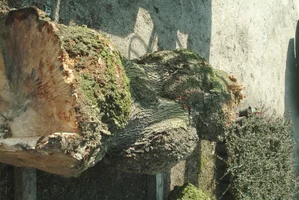
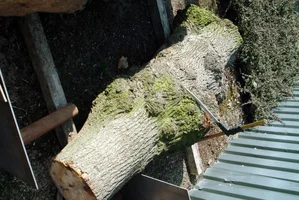
These are the two maple logs with 'burls' is saved from firewood. I wanted them to mill and sell wood to a guitarmaker but he was afraid of the risk of getting good/bad quality wood. 
I sold one (and maybe the two) log this morning to an artist that does woodcarving. 150€ for a log, thats good enough for me.
I sold one (and maybe the two) log this morning to an artist that does woodcarving. 150€ for a log, thats good enough for me.
Attachments
- Location
- Netherlands

- Location
- Dallas, Texas
This has been an interesting thread so far. Anyone wish to comment on how to go about finding a mill? They seem to be in short supply around here in North Texas. Maybe because we only have the 'little' trees that make good firewood.
I work on 164 acres of campus, which amounts to a little over 2000 trees. For each removal I take the opportunity to cut aside at least one log or limb and not its location. Several of the guys at the shop have them drying and will make commemorative pens that we may use for commemorations, gifts, or fund raisers. To salvage a greater percentage of the wood requires a mill.
I work on 164 acres of campus, which amounts to a little over 2000 trees. For each removal I take the opportunity to cut aside at least one log or limb and not its location. Several of the guys at the shop have them drying and will make commemorative pens that we may use for commemorations, gifts, or fund raisers. To salvage a greater percentage of the wood requires a mill.

tomfromstlouis,
If you had tried harder to stear these guys away from selling their own logs to the mills, then you should have lied and said you tried this as a business but went out of business doing this.
You and your partner still in business says something right there, depite you stating that it isn't profitable.
These tree companies can make some decent money if they care a little and do things right. Which this discussion is probably going to help some people. The attitude that all logs are not worth anything needs to stop (well, for us tree service guys).
I understand you would like the tree services not to haul or sell their own logs. Us selling our own logs to the mills does not help your business and I'm sorry about that, but this is a tree service related forum and we help each other out.
If you had tried harder to stear these guys away from selling their own logs to the mills, then you should have lied and said you tried this as a business but went out of business doing this.
You and your partner still in business says something right there, depite you stating that it isn't profitable.
These tree companies can make some decent money if they care a little and do things right. Which this discussion is probably going to help some people. The attitude that all logs are not worth anything needs to stop (well, for us tree service guys).
I understand you would like the tree services not to haul or sell their own logs. Us selling our own logs to the mills does not help your business and I'm sorry about that, but this is a tree service related forum and we help each other out.

Roger_Barnett
Participating member
- Location
- Seattle, in the PNWet
While I've never sold a figured bigleaf maple log, it is some of the most valuable wood in the world, if it is the highest grade. The most preferred figure is "quilted" Electric guitar makers will pay up to $100 for a 2.5 bosrd foot piece. Anyhow, I heard of a log truck load that sold for $18,000, and one log that fetched $10k!!! Out here, there are maple thieves, who will hook up a flexible pipe to their chain saw mufflers and route it into a bucket of water, to mask the noise.
I just bid ~$4000 on 5 large fir and 2 hemlock. Probably 6000 board feet, worth $4000. I may need a 110 ton crane to get them out, but should still net about $6000 for the job, which should take 3 days. If we had to make firewood out of the trees, the bill would probably be $10,000.
Tom, for me it is not "on the side" Any marketable log is money for us. I'd guess I've sold a quarter million board feet over the years, just a pittance compared to a logging outfit...but more than most certified arborists, I'm sure. I've only had a problem with metal a couple times. Once, when I complained and asked the sort yard to cut the metal section off, the buyer simply gave me the full value, which was ~$1000 as it was a big fir log, and that was when export fir was bringing up to $1260 mbf.
I just bid ~$4000 on 5 large fir and 2 hemlock. Probably 6000 board feet, worth $4000. I may need a 110 ton crane to get them out, but should still net about $6000 for the job, which should take 3 days. If we had to make firewood out of the trees, the bill would probably be $10,000.
Tom, for me it is not "on the side" Any marketable log is money for us. I'd guess I've sold a quarter million board feet over the years, just a pittance compared to a logging outfit...but more than most certified arborists, I'm sure. I've only had a problem with metal a couple times. Once, when I complained and asked the sort yard to cut the metal section off, the buyer simply gave me the full value, which was ~$1000 as it was a big fir log, and that was when export fir was bringing up to $1260 mbf.
New threads New posts
-
test
-

-
 Alternatives to standard asphalt around roots
- Started by southsoundtree
- Replies: 9
-
-

-

-
