designated anchor point

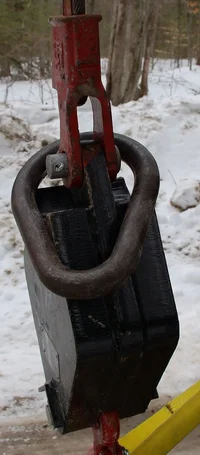
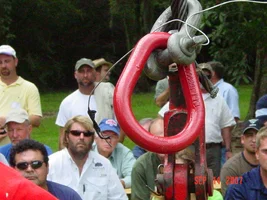
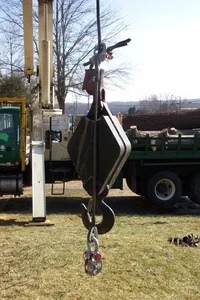
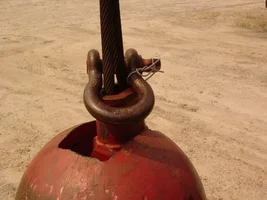
Hey guys, Can you tell me what the preferred method of attatching a "designated anchor point"(ansi z133.1, 5.7.9) to the load line would be. I'd like to get my crane co. to allow me to do this. Heres a pic I took off here a while back, but would like some input. Also seems a bit ambigious, if they don't mean to include the ball, they really should be more specific.
 

Attachments

That looks like a variation on a setup that I've seen from Norm Hall.

I'd like to see two small changes though.

Have the strap just a little longer so that the rings hang down below the equator of the ball to keep them from rubbing.

Use something like chain or cable with swaged eyes instead of a webbing FC to make the FC. Most of the crane balls that I've seen are pretty greasy and not all of them are smooth enough to eliminate a rope snag.
 
[ QUOTE ]
Hey guys, Can you tell me what the preferred method of attatching a "designated anchor point"(ansi z133.1, 5.7.9) to the load line would be.

[/ QUOTE ]


Read this:


http://www.treebuzz.com/pdf/mar07-cb.pdf


for some suggestions. The link is from the Articles section here on TBzz.

I can't tell from your photo, but the pin of the shackle <u>must</u> have some type of wire to keep it from unscrewing.

I agree with Tom that the straps on the false crotch in your photo should be longer.

But, I disagree about using a chain or cable. The rings of a FC are machined to have a rope run through them, while swaged eyes are not. The webbing of the FC can stand up to the abrasion of rubbing against the ball.

The flat, nylon, eye-and-eye slings such as the ones in your photo don't cinch down as securely as other types of slings. Have you tried steel, Tuflex (or similar), or Tenex (or similar) slings?
 
Thanks for that Mark. Exactly what I was looking for. Very informative article. Funny thing is I read that when it came out! Some memory I got. I like Norms idea of clipping a biner through the pin hole (if its big enough?) and around the webbing of the false crotch. Seems like there is a possibility of it moving when retrieving your line otherwise. Is there any other way to prevent this? Also, would it be okay to girth hitch the false crotch around the shackle and just tie into one ring?
 
A question came up at work today about using a pulley attached to the carabiner/ring(s) in Figure H page 46 of the linked article.

The idea was to climb off the pulley instead of the two rings in the friction saver. I personaly don't kow why a person wouldn't just climb of the rings or rings-biner combo, but the question was, could you if you had a pulley rated for life support...

Any thoughts would be appreciated


thanks,

mk
 
The crane FC that I was thinking of would incorporate terminations similar to a spelter. An open for the cable end and closed for the rope to run through. As long as the fitting is smooth and has a reasonable radius it should be fine. The exact length could be spec'd. and swaged.

It would seem to me that if arbos are trying to fit into the crane world we should look as much like them as possible.

Does anyone have any feedback on this setup?

http://www.gatorsupply.com/spelter.htm
 
I dont see how that would work with the downhaul weight and hook. If there was something similar that had an eye at a 45* angle that could be used above the becket I think it would work.
 
Rocks_and_Trees:


Sorry for the late reply.


[ QUOTE ]
I like Norms idea of clipping a biner through the pin hole (if its big enough?) and around the webbing of the false crotch. Seems like there is a possibility of it moving when retrieving your line otherwise. Is there any other way to prevent this?

[/ QUOTE ]

There are two other ways to prevent the FC from moving when it is retrieved. One is described on pp. 44 and 46 (p. 45 was a full page add isn't in the PDF) and Figs. D, E, and F of the article in the link. Another way to prevent the FC from moving when retrieved is described on pp. 46 and 50, and Figs. G and H.

Norm's method is probably the most secure because it holds the FC even after the line is retrieved. But, it requires a shackle that is large enough that the hole in the pin will accept a carabiner.

The second method (mine) will keep the FC in place while the rope is pulled through, but after the rope is pulled out the FC simply hangs on the shackle. If the FC is set on the shackle as in Fig. I (Norm's methed) then the FC is secure. If the FC is simply draped over the shackle (Fig. C, my method) then the FC could be pulled out of the shackle when the ball is manuevred through a thick canopy. This has happened once in five years. This setup requires no extra gear.

The third method (from Tod Kramer) requires an extra double auto-locking carabiner. If it is steel it should not have been used for rigging. A large splice (The Fly) or an eye that is folded over could go through one side of the FC and snag on the other (and thus move the FC or even pull it out of the shackle), but this is unlikely. How secure the FC will be once the rope is pulled out depends upon how it is set up on the shackle. See the preceeding paragraph.


[ QUOTE ]
Also, would it be okay to girth hitch the false crotch around the shackle and just tie into one ring?

[/ QUOTE ]


NO NO NO!!!

Definitely DO NOT do this. What you have described is basically a cow hitch without the half hitch to keep it in place. You could girth hitch the FC and go through BOTH rings, but do not go through just one ring.

 
[ QUOTE ]
A question came up at work today about using a pulley attached to the carabiner/ring(s) in Figure H page 46 of the linked article.

The idea was to climb off the pulley instead of the two rings in the friction saver.

[/ QUOTE ]

I'm not sure how you intend to attach the pulley. There are ways to do this, but I think some ways are better than others.

See the attachment in my reply to allmark and Tom below for one method.
 
BostonBull wrote:


[ QUOTE ]
We use a 30 ton steel oval ring attached directly to the hook, and then run our life line through that. The hook is sealed with a pin.

[/ QUOTE ]


Strictly speaking that is contrary to ANSI:


[ QUOTE ]


5.7.9 A qualified arborist may be hoisted into position utilizing a crane if the arborist is ...secured to a designated anchor point on the boom line or crane.

[/ QUOTE ]


I also think it is less fluid in certain situations. There are times when the the climber attaches the rigging sling to the ball while the climber is still attached to the crane (see Figs. K, L, N1, N2, M, and P in the link). If the system is set up as you described then the pin has to be removed from the hook while the climber is still attached. Or the climber has to tie-in in some other way while attaching the sling.

If you guys really like the idea of a master link then you could attach it on the cable as in the attachment....
 

Attachments

  • 101895-DSC_0312_email_from_Tim_Walsh.webp
    101895-DSC_0312_email_from_Tim_Walsh.webp
    144.7 KB · Views: 100
allmark and Tom;


I don't understand allmarks objection.

I think Tom means something like the attachment, but with an open Spelter socket attached directly to the cable and a closed Spelter socket for the climbing line.

Again, I don't know if these are smooth enough for a climbing line. Looking at the chart in Tom's attachment they definitely have a big radius.
 

Attachments

  • 101898-copyofdaveycraneattach1_rotated_resized_39%.webp
    101898-copyofdaveycraneattach1_rotated_resized_39%.webp
    122.1 KB · Views: 95
None of the suggested methods actually attach to the cable.

It is a given that the ball is 100% bomb proof and never comes off?

Of course an attachment above the ball would be in peril if the cable were fully retracted and pulled into the crane pulley.
 
[ QUOTE ]
None of the suggested methods actually attach to the cable.


[/ QUOTE ]

???????


The FC is put through the shackle in the attachment. Why would that not be attached to the cable?
 

Attachments

  • 101981-DSC01460_resized_25%.webp
    101981-DSC01460_resized_25%.webp
    36.5 KB · Views: 81
[ QUOTE ]
[ QUOTE ]
None of the suggested methods actually attach to the cable.


[/ QUOTE ]

???????


The FC through is put through the shackle in the attachment. Why would that not be attached to the cable?

[/ QUOTE ]

It is attached to the cable in the sense that it is around the cable. It would not be attached to the cable if the ball were to fall off. Like Norm, I've never heard of a crane line losing a ball either.
 
I think, emphasis on think, it happened at a company I once worked for. It happened while unloading. To the best of my knowledge, a novice operator was unloading in the yard and "double blocked" (sucked the ball all the way up). The angle was fairly steep, greater than 45degrees, then he boomed down and lost the whole load, ball and all. Its a possibility the line severed.
There was some giggling and taunting the next morning in the "fish story" circle before the crews deployed. I did my best to stay out of that circle...Also, fortunately, I never worked with that crew.
 
I once use a FC with a large carbiner on one side and a carabiner with a micro pully on the other. If I remember right I clipped both ends together and climbed only off the pulley. After I pulled my line through, re-tied and made my cut, the pulley hooked a stub and would not let the operator move the piece. The load would not spin and could not be lowered. Simultaneously the lead snagged the computer line. This was extremely ugly. Foolishly a collegue climbed back up and unsnagged the pulley. He got lucky, the load did not shock but the computer line still snapped. This is what can happen after to many days and hours of intensive tree removal. Be safe out there.
 

New threads New posts

Back
Top Bottom