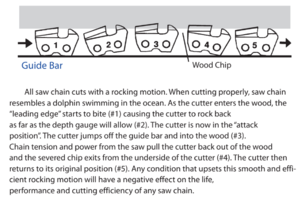
Depth gauge setting (can of worms)

Fascinating.

I had the reason wrong for using a progressive raker offset, or at least partially wrong.

Does the narrower kerf that is being cut at the back of the of the tooth allow a thicker chip with the same power without bogging down, as well? Does the chip thickness change through the life of the cutter?
 
Does the chip thickness change through the life of the cutter?
I think the chip thickness stays the same as the cutter tilts back farther and farther.
Does the narrower kerf that is being cut at the back of the of the tooth allow a thicker chip with the same power without bogging down, as well?
Something is defiantly going on at the back of the cutter since race chain has its cutters filed back to the minimum mark and old chains cut faster.
 
I think the chip thickness stays the same as the cutter tilts back farther and farther.

Something is defiantly going on at the back of the cutter since race chain has its cutters filed back to the minimum mark and old chains cut faster.

I've seen photos of race chains that had the back of the tooth ground away leaving the front standing.

I'm pretty sure I have.

And chains taken apart and 'thinned'. Also after assembled some taken off of the rivet tips.

Also the side of the depth gauge controls that the side plate of the tooth gets in the wood appropriately which can sometimes mean a little off the side of the depth gauge might be in order.

Or so I've read or have had explained to me.
 
In no way scientific, but I have a 550 with a near the end chain, I was going to replace but I tickled it up, checked the rakers, which were low enough according to the gauge, but I gave the rakers a good turn with the flat file and tested it, cuts like a demon, not grabby at all.

Good tip and thread.
 
This is another reason chain tension (and not to over tighten the chain) is so important. A little slack is a good thing, too much is just as bad as too tight.
 
I've pondered this for quite a while and chased the mythical porpoise with no success. The simplest layman terms I come up with, based partly on the Carlton textual description, is that the cutter link pivots into "attack" position from the drag load at the cutting tip and this position has an optimal angle. Standard raker height combined with worn short tooth equals wrong attack angle, shortening the raker results in the optimal attack angle. And based on "exits the wood" I think there's no porpoise, just a constant attack tilt as long as the tooth cutting tip is dragging in the wood cut. Further to that, from my own noggin, I think the more relatively taller the tooth tip is than the raker, the more it biases the splitting of the contact force to the cutter tip and off the raker = better (more aggressive) cutting.

I like the vintage adjustable raker tool. Anyone still make one like that?

autocorrect changed layman to batman!!!!
 
  • Like
Reactions: evo
I'm not convinced on the porpoise theory either.

"" splitting of the contact force to the cutter tip and off the raker""
As for the progressive raker method it looks like they are trying to achieve that balance of forces. Lets say a new chain is in balance and the cutters forward rivet has enough force to fight tilt back. But, as the cutter gets shorter and closer to the rear rivet the balance is lost and the (leverage) forces on the rear rivet exceed (tension) forces on the forward rivet causing tilt back(lose of balance).

"" I like the vintage adjustable raker tool ""
That would be pretty sweet, never seen one of those. Would be handy for various woods. I've resorted to just using different feeler gauges. I then go by how hungry the chain feels and try to remember that feeling but I'm in mixed wood so I'm kind of all over the place and just try to shoot for a happy medium.
 
Last edited:
I think a large factor in chip size is getting pounded scuffed and buffeted through the cut in a confined pocket between chain teeth for perhaps a foot or so after leaving the cutting edge of the tooth. Hard to stay intact. Especially with the weak orientation of the grain. And I've never seen the rippled cut surface that would result from all those independently porpoising little teeth. Further - wouldn't all the chainsaw carvers complain about the porpoise ripples in the carving surface?

Wouldn't the chips themselves throw some light on this? But I still can't get past the porpoise ripples (lack of).
 

New threads New posts

Back
Top Bottom